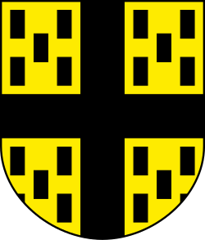
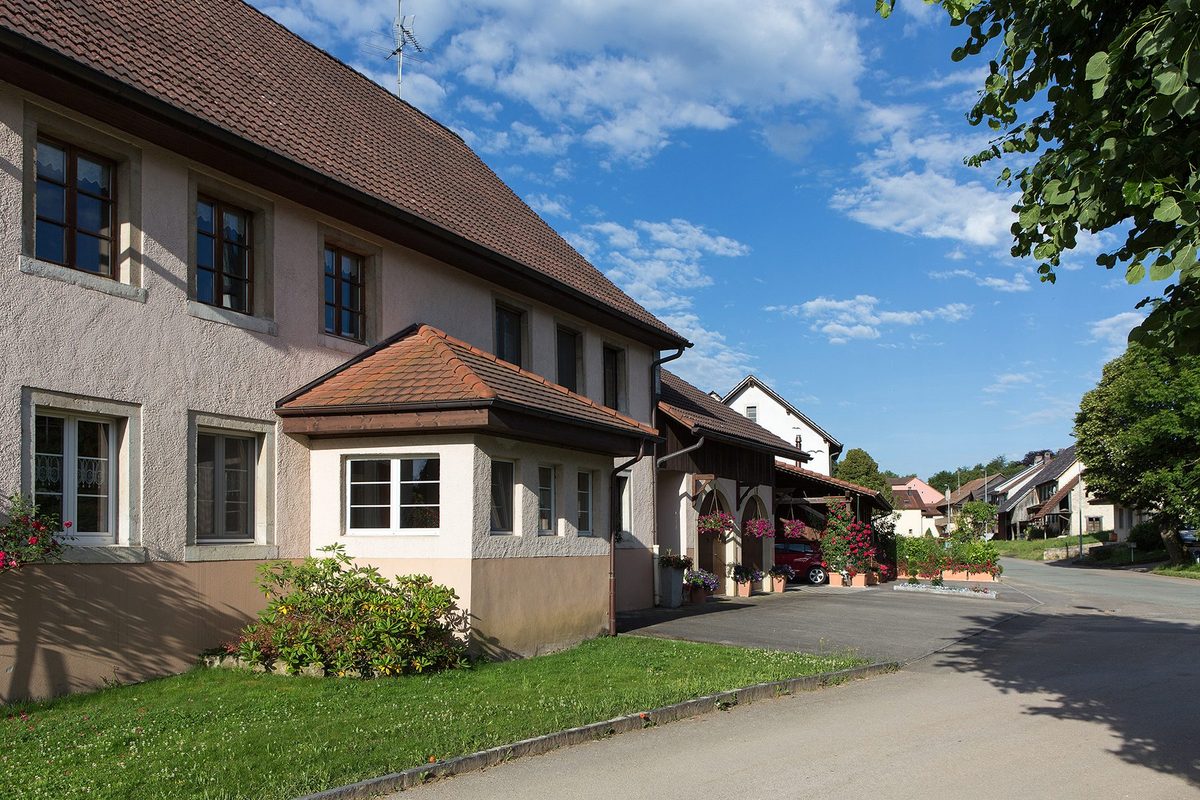
Grandfontaine
Origin of the name Grandfontaine
The village is first recorded in 1136 as « Granfontana ». The name, « great fountain », comes from the karst spring beside which the village stands, now laid out as a large basin with a wash house.[1]
Founding of Grandfontaine
Neither the founder nor the date of Grandfontaine's creation is known. The village grew up beside a karst spring in a narrow Ajoie valley and is recorded from 1136. Its church of Saint-Étienne is mentioned in the 12th century among the possessions of the priory of Lanthenans, in Franche-Comté. Grandfontaine belonged to the Prince-Bishopric of Basel, which extended its rights there after the Burgundian Wars. Under the Ancien Régime it came under the mairie of Chevenez.[1]
History of Grandfontaine
1136. First mention: « Granfontana ».[1]
12th century. The church of Saint-Étienne is mentioned in the confirmation of the possessions of the priory of Lanthenans (Franche-Comté).[1]
Late 15th century. After the Burgundian Wars, the Prince-Bishopric of Basel extends its rights over the village.
Ancien Régime. Grandfontaine comes under the mairie of Chevenez.[1]
1756. Great fire in the village.[1]
1765. Another major fire.[1]
1779. The parish, which also includes Roche-d'Or, passes from the diocese of Besançon to that of Basel.[1]
1785. Third great fire of the 18th century.[1]
1836. Grandfontaine becomes a mixed municipality.[1]
19th century. The large basin and wash house are built at the karst spring.[1]
1876. Rocourt, until then part of the parish of Grandfontaine, breaks away from it.[1]
Early 20th century. The farming village sees the beginnings of industry with the production of semi-precious stones. A few watch-case workshops, a sawmill and a joinery remain later on.[1]
Population of Grandfontaine
Sources and references: [1]
| 1818 | 395 |
| 1850 | 471 |
| 1900 | 424 |
| 1950 | 396 |
| 2000 | 330 |
| 2010 | 362 |
| 2025 | 362 |
Historic sites in Grandfontaine
Church of Saint-Étienne. Parish church mentioned from the 12th century among the possessions of the priory of Lanthenans. The parish belonged to the diocese of Besançon until 1779.[1]
Large basin and wash house. Large fountain and 19th-century wash house built at the karst spring that gave the village its name.[1]
Sources
- Dictionnaire historique de la Suisse, « Grandfontaine » (Dominique Prongué), version allemande
- Statistique Jura, tableau JU-T.01.01.03, population résidante permanente au 31 décembre 2025
- geo.admin.ch (swisstopo), recherche de lieux « Grandfontaine »
Other villages near Grandfontaine
Missing information, or do you have a source? Suggest a correction or addition. Every submission is checked before it's published.
Suggest a change