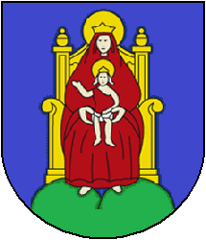
Damvant
Origin of the name Damvant
Old form « Dampvant » in 1283. The first certain mention may instead be « Danval » or « Dampna Walle » in 1346, then « Dampvant » around 1360. The name is thought to come from the Latin « dominus » (lord, saint) followed by the name of a saint, perhaps Wala.[1]
Founding of Damvant
Neither the founder nor the date of the village's creation is known, but a Gallo-Roman villa, partly excavated in 1842, shows occupation since Antiquity. Recorded in 1283, Damvant belonged to the Bishop of Basel, whose rights were strengthened after the Burgundian Wars (1474-1477). From the 16th century the municipality was part of the great mairie of Chevenez. The parish, which also included Réclère and Villars-lès-Blamont, came under the diocese of Besançon until 1779, and the priest was appointed by the prior of Lanthenans (Doubs). A mixed municipality from 1836, Damvant is now part of the municipality of Haute-Ajoie (merger of 1 January 2009).[1]
History of Damvant
Gallo-Roman period. A Gallo-Roman villa stands on the village's territory.[1]
1283. Damvant is recorded as « Dampvant ».[1]
13th-14th centuries. Damvant reportedly belongs to the lordship of Roche-d'Or.
1474-1477. After the Burgundian Wars the Bishop of Basel's rights over the village are strengthened.[1]
16th century. Damvant is part of the great mairie of Chevenez.[1]
1725. A boundary treaty adjusts the border between France and the Prince-Bishopric of Basel.[1]
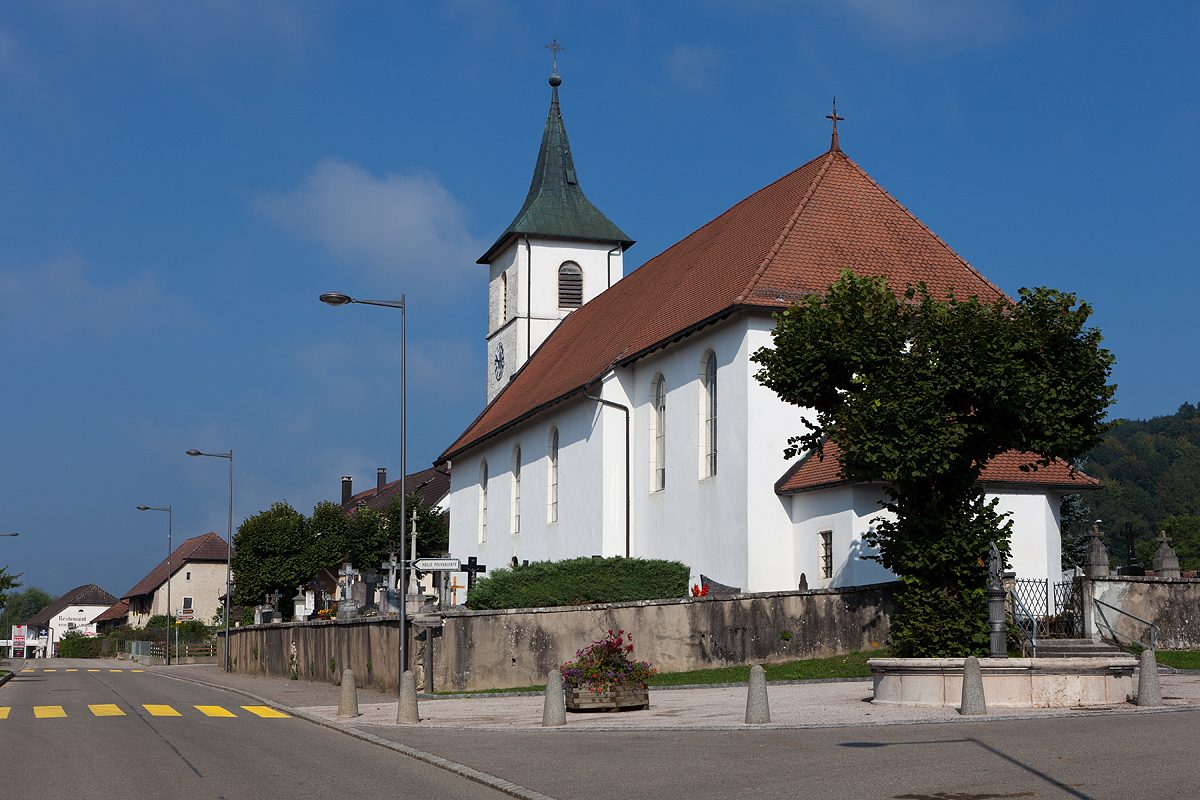
1745-1747. Construction of the church of Saint-Germain, reportedly on the foundations of a medieval church.
18th century. Villars-lès-Blamont separates from the parish of Damvant.[1]
1779. The parish passes from the diocese of Besançon to that of Basel.[1]
1793-1813. Damvant is attached to the French departments of Mont-Terrible, then Haut-Rhin.[1]
1815-1978. The village belongs to the canton of Bern.[1]
1836. Damvant becomes a mixed municipality.[1]
1842. Partial excavation of the Gallo-Roman villa.[1]
1979. Damvant joins the new canton of Jura.
2009. On 1 January Damvant merges with Chevenez, Réclère and Roche-d'Or into the municipality of Haute-Ajoie.[1]
Population of Damvant
Sources and references: [1]
| 1818 | 275 |
| 1850 | 357 |
| 1870 | 288 |
| 1900 | 352 |
| 1950 | 214 |
| 2000 | 136 |
| 2008 | 120 |
Historic sites in Damvant
Church of Saint-Germain. Parish church whose priest was appointed by the prior of Lanthenans (Doubs). The present building, from 1745-1747, is said to have been built on the foundations of a medieval church and to have a classical high altar.[1]
Border village. Damvant is a farming village known for horse breeding, on the road from Porrentruy to Besançon. Its border with France was adjusted by the boundary treaty of 1725.[1]
Farms and fountains. The village reportedly has many 19th-century farms with large barn doors and three old fountains with circular basins.
Remains in Damvant
Gallo-Roman villa. The remains of a Gallo-Roman villa, partly excavated in 1842, show the early occupation of the site. Cultural property of regional significance (federal PCP inventory).[1][3]
Sources
- Dictionnaire historique de la Suisse, « Damvant » (Dominique Prongué), version du 04.06.2020
- République et Canton du Jura, Gouvernement, message au Parlement relatif à la révision de la législation en matière de fusion de communes (30 mars 2011)
- Office fédéral de la protection de la population (OFPP), Inventaire PBC, liste cantonale du canton du Jura (état au 1.1.2026)
- geo.admin.ch (swisstopo), recherche de lieux « Damvant »
Other villages near Damvant
Missing information, or do you have a source? Suggest a correction or addition. Every submission is checked before it's published.
Suggest a change