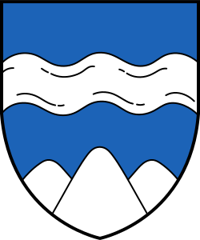
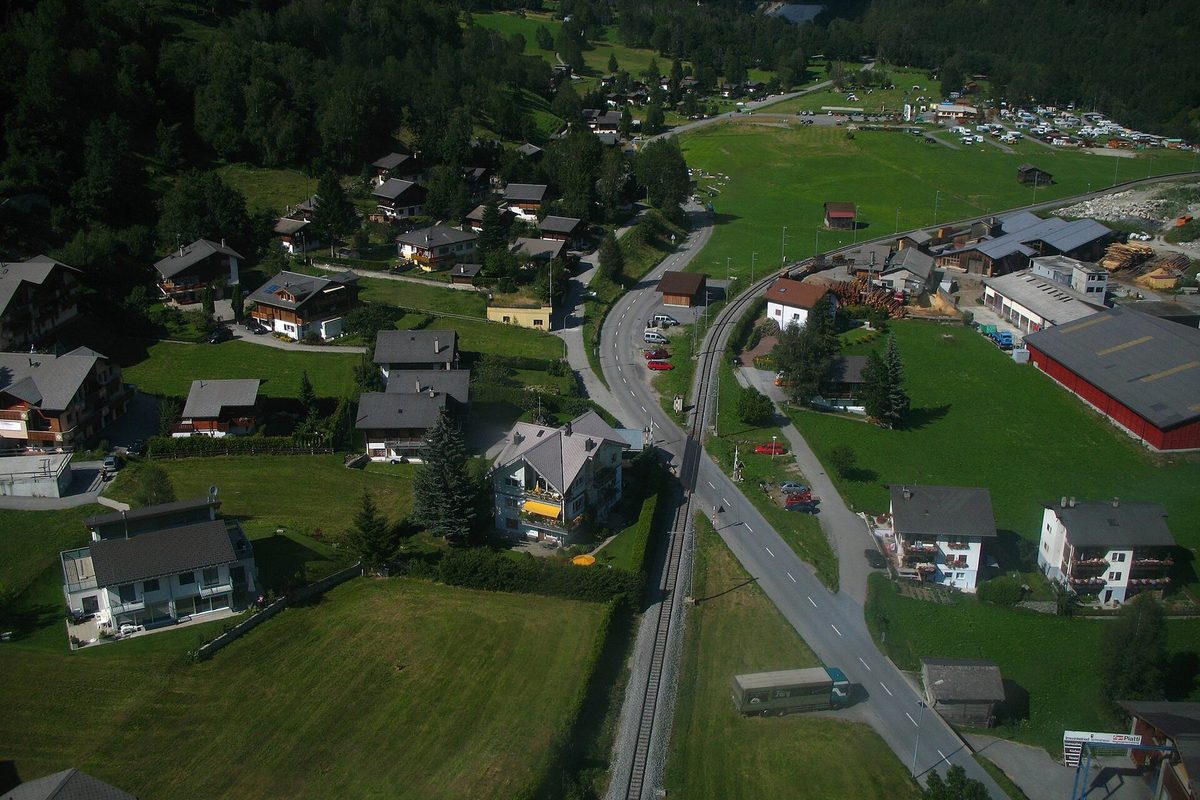
Fiesch
Origin of the name Fiesch
The village is recorded as « Vios » in 1203 and « Viesch » in 1438. The spelling Fiesch has been used since 1905. The name is said to come from Latin vicus, « village », but this is uncertain.[1]
Founding of Fiesch
Fiesch arose in the late Middle Ages from the union of six formerly independent quarters (Quartarien), scattered in a hollow and on the slopes of both banks of the Weisswasser: Fiesch, Uberegga, Spembule (now in the municipality of Goms), Fuxwiler, Birchwiler and Moos. The municipality of Wiler was added around 1835. In the 13th and 14th centuries jurisdiction belonged mainly to the Blandrate family. Until 1798 Fiesch formed one of the nine quarters of the Goms dizain together with Lax. Irrigation was regulated from the 14th century, the farmers' guild (Bauernzunft) of the Fiesch quarter dates from 1470, and the municipality bought back from private owners the tithe, originally episcopal. Part of the parish of Ernen in the Middle Ages, Fiesch became a rectorate in 1540. In the 17th and 18th centuries the village was a centre of painting in the lower Goms. A starting point for the Jungfrau region, it became a tourist centre in the Belle Époque thanks to the roads, the post station of 1865 and its hotels. At the start of the 21st century it is a year-round resort, mainly for winter sports. Approved by popular vote on 15 June 2025 and ratified by the Grand Council, the merger of Bellwald, Fiesch and Lax into the municipality of Unnergoms takes effect on 1 January 2027.[1][2]
History of Fiesch
Bronze Age. A weapon of this period, found in 1862, attests that the site was frequented.[1]
1203. Recorded as « Vios ».[1]
1339-1343. The Augustinian convent of Gnadenberg (Montis Gratiae), founded at Ernen in 1339, moves to Fiesch in 1343.[1]
1342. A church dedicated to Saint John the Baptist is mentioned.[1]
1438. Recorded as « Viesch ».[1]
1470. Founding of the farmers' guild (Bauernzunft) of the Fiesch quarter.[1]
1489. Dissolution of the Gnadenberg convent.[1]
1540. Fiesch becomes a rectorate, with burial and baptism rights.[1]
1572-1573. Construction of the tithe barn (Zehntenstadel).[1]
1590. Boundary agreement with Fieschertal.[1]
1592. First alp regulation, followed by a second in 1594.[1]
1667. Construction of the presbytery.[1]
1771-1772. The chapel of Saint Augustine takes its present form.[1]
1840. First ascent of the Eggishorn.[1]
1856. Founding of the Jungfrau mountain hotel at the foot of the Eggishorn.[1]
1865. Opening of a post station with a change of horses.[1]
1883-1884. Construction of the present church, whose tower partly dates from the 14th century.[1]
1915. Fiesch becomes a station of the Furka-Oberalp railway.[1]
1966-1971. Cable cars to Kühboden (1966) and the Eggishorn (1968). The « Feriendorf » (holiday village) is built in 1967-1971.[1]
2025. On 15 June the voters of Fiesch approve the merger with Bellwald and Lax by 81.4 %, effective 1 January 2027.[2]
Population of Fiesch
Sources and references: [1][5]
| 1809 | 415 inhabitants |
| 1850 | 245 inhabitants |
| 1900 | 467 inhabitants |
| 1950 | 517 inhabitants |
| 2000 | 996 inhabitants |
| 2025 | 894 inhabitants |
Historic sites in Fiesch
Church of Saint John the Baptist. A church dedicated to Saint John the Baptist is mentioned in 1342. The present building dates from 1883-1884, but its tower is partly 14th century. The neighbouring presbytery dates from 1667.[1]
Chapel of Saint Augustine. A reminder of the Augustinian convent of Gnadenberg, at Fiesch from 1343 to 1489. The chapel has had its present form since 1771-1772.[1][4]
Tithe barn. Barn (Zehntenstadel) built in 1572-1573, when the municipality was buying back the tithe from private owners.[1]
Eggishorn and Fiescheralp. First climbed in 1840, the Eggishorn made Fiesch a starting point for the Jungfrau region. The Jungfrau hotel was founded there in 1856. Cable cars link the village with Kühboden on the Fiescheralp (1966) and the Eggishorn (1968).[1]
Feriendorf. Holiday village built in 1967-1971, a symbol of the tourist boom in Fiesch, which at the start of the 21st century had about 4'000 guest beds and around a dozen hotels.[1][4]
Legends of Fiesch
The vow against the glacier. Since 1678 the people of Fiesch and Fieschertal have walked in procession every 31 July to pray against the advance of the Aletsch glacier, which threatened people, pastures and houses. In 2009 Pope Benedict XVI approved changing this vow, and they now pray for the glacier to be preserved.[3]
Sources
- Historisches Lexikon der Schweiz, « Fiesch » (Philipp Kalbermatter, version du 04.05.2017)
- Radio Lac / ATS, « Le parlement entérine une fusion à trois dans le Haut-Valais » (4.5.2026)
- Marija Jannuzzi (d'après RSI), « Hier beteten die Walliser einst gegen das Gletscherwachstum », swissinfo.ch, 21.7.2025
- Office fédéral de la protection de la population (PBC), « Révision Inventaire PBC 2021 : liste cantonale du canton du Valais » (état au 1.1.2026)
- Office fédéral de la statistique (OFS), STATPOP, chiffres provisoires au 31.12.2025, via citypopulation.de
- geo.admin.ch, recherche de lieux (coordonnées)
Localities of the municipality with a page
Other villages near Fiesch
Missing information, or do you have a source? Suggest a correction or addition. Every submission is checked before it's published.
Suggest a change