Fieschertal
Origin of the name Fieschertal
The valley is recorded in 1351 in the Latin form « vallis de Vies », the valley of Fiesch, whose name the municipality bears. The origin of the name is not explained.[1]
Founding of Fieschertal
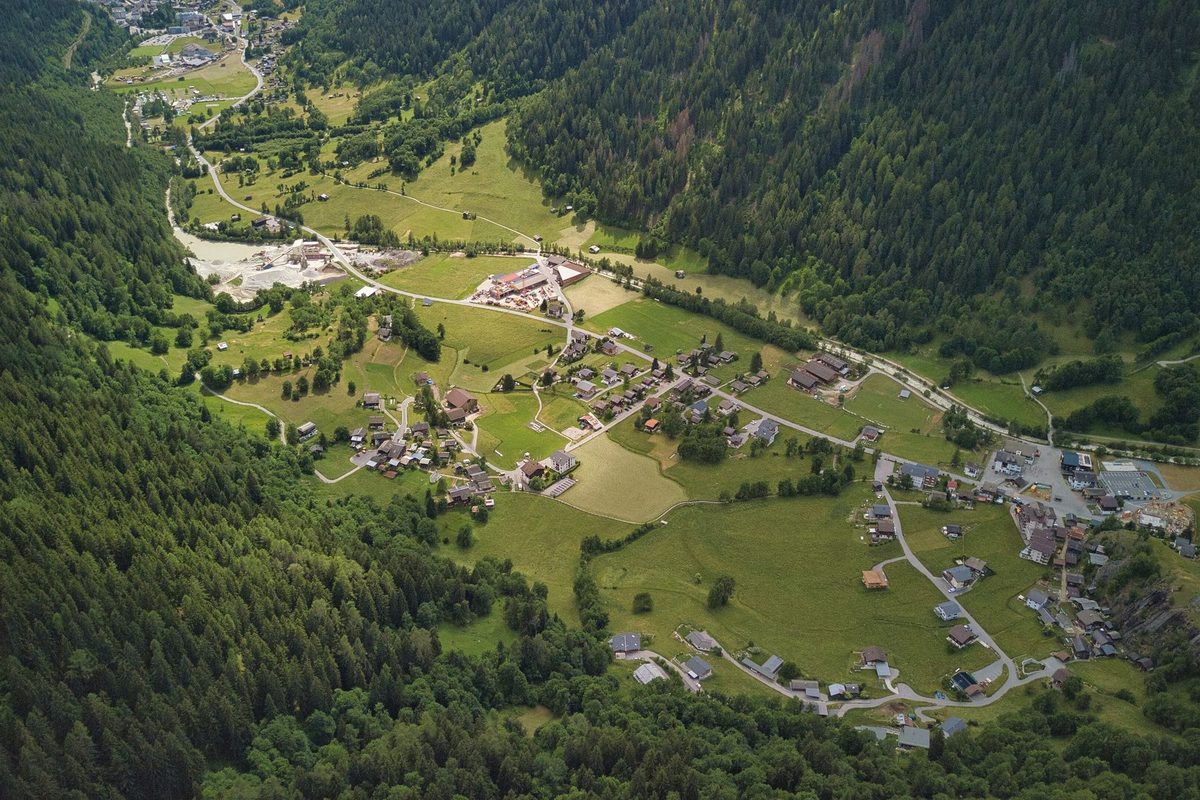
Fieschertal, in the Weisswasser valley, consists of several hamlets, including Wichul, Zer Flie and Wirbul. The highest were abandoned from the 17th century onwards. Its territory includes the Fiesch glacier, the Märjelensee and the Jungfraujoch. In the 13th and 14th centuries the lordship rights belonged to the Blandrate family, then passed to the knight Johann Thomas de Platea. The community (« communitas ») is first mentioned at the same time as the valley. From the 15th century the valley formed an episcopal ammanship with lower jurisdiction, and the ammann, who also led the community, came to be elected by the inhabitants. Until the end of the Ancien Régime Fieschertal and Bellwald formed one of the nine quarters of the Goms dizain. Part of the parish of Ernen in the Middle Ages, the valley has belonged to the parish of Fiesch since the 16th century.[1]
History of Fieschertal
13th-14th centuries. The lordship rights over the valley belong to the Blandrate family.[1]
1351. The valley is recorded as « vallis de Vies » and the community (« communitas ») is first mentioned.[1]
around 1404. The lordship rights pass to the knight Johann Thomas de Platea.[1]
15th century. Start of the episcopal ammanship with lower jurisdiction, which lasts until 1802.[1]
16th century. The valley, until then in the parish of Ernen, passes to the parish of Fiesch.[1]
1590. Boundary agreement with Fiesch.[1]
1646. The ammann, who also leads the community, is henceforth elected by the inhabitants of the valley.[1]
1662. Citizenship rights are regulated.[1]
1688. Construction of the chapel of Our Lady at Wichul.[1]
17th-18th centuries. Crystal trade; the highest hamlets are gradually abandoned.[1]
1798. End of the quarter formed with Bellwald in the Goms dizain.[1]
1802. End of the episcopal ammanship.[1]
1965. Opening of the road for vehicles.[1]
1970. Start of steady tourist growth, following Fiesch.[1]
1975. Commissioning of the power plant at Flie.[1]
2016. Opening of the Aspi-Titter suspension bridge to Bellwald.[2]
Population of Fieschertal
Sources and references: [1][3]
| 1850 | 138 inhabitants |
| 1900 | 181 inhabitants |
| 1950 | 254 inhabitants |
| 2000 | 255 inhabitants |
| 2025 | 359 inhabitants |
Historic sites in Fieschertal
Chapel of Our Lady at Wichul. Marian chapel built in 1688 in the hamlet of Wichul.[1]
Fiesch glacier and Märjelensee. The Fiesch glacier, at the head of the valley, and the Märjelen lake are part of the municipal territory.[1]
Jungfraujoch. The municipal territory extends to the Jungfraujoch, where the terminus of the Jungfrau railway is reportedly located.[1]
Aspi-Titter suspension bridge. 160 metre footbridge opened in 2016, crossing the Weisswasser gorge 120 metres up and linking Fieschertal with Bellwald.[2]
Sources
- Historisches Lexikon der Schweiz, « Fieschertal » (Philipp Kalbermatter, version du 29.11.2005)
- Hängebrücke Aspi-Titter, site officiel (Bellwald et Fieschertal)
- Office fédéral de la statistique (OFS), STATPOP, chiffres provisoires au 31.12.2025, via citypopulation.de
- geo.admin.ch, recherche de lieux (coordonnées)
Localities of the municipality with a page
Other villages near Fieschertal
Missing information, or do you have a source? Suggest a correction or addition. Every submission is checked before it's published.
Suggest a change