Genolier
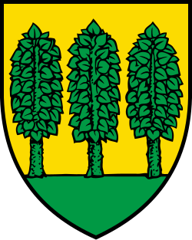
According to tradition, Genolier dispensed justice under three lime trees planted in the middle of the village. The three trees now appear on the municipal flag.
Entry based on 8 sources · Our method · Reusable text (CC BY-SA)
Origin of the name Genolier
The name appears in 1110 (« Genolliaci », that is « Genolliacum »), then in the forms « Genollei » in 1162 and « Genolie » in 1221. It may derive from a Roman family name. The inhabitants are reportedly nicknamed the Pesants, a nickname not yet confirmed.[1][2]
Coat of arms of Genolier
Or, three lime trees vert issuant from a terrace of the same. On a yellow field, three green lime trees grow from green ground. They recall the three lime trees planted in the village centre, under which the lordship's court sat. The arms first appear in 1775, on the municipal flag.[5][6]
Founding of Genolier
Nobody knows who founded Genolier. The site was occupied in Roman times, as a foundry and glass slag show, then in the early Middle Ages, with Burgundian graves from the 5th and 6th centuries. In 1110 the church of Notre-Dame belonged to the abbey of Saint-Claude, in the French Jura, which set up a small priory there. The village was then shared between the Prangins family and the lords of Mont. The latter took the title of lords of Genolier, built a castle and freed their subjects.[1][2]
History of Genolier
Roman period. A foundry is in operation. Glass slag has been found.[1]
5th-6th centuries. Burgundian graves show the occupation of the site.[2]
1110. First mention (« Genolliaci »): Bishop Guy of Geneva confirms the abbey of Saint-Oyend (Saint-Claude) in possession of the church of Notre-Dame.[1][2]
1184. The priory of Genolier is mentioned.[1]
late 12th century. The revenues of Genolier are assigned to the sacristy of Saint-Claude.[1]
1210. The lords of Mont, joint lords with the Prangins family, build a castle.[1]
1214. The tithe is ceded to the neighbouring monastery of Oujon.[2]
1221. The lords free their subjects.[1]
around 1243. The monks of Oujon set up a mill, a threshing mill and a fulling mill at Montant.[2]
1384. The revenues of Genolier pass to the abbatial and capitular mensa of Saint-Claude.[1]
1528. Genolier belongs exclusively to the lords of Prangins.[1]
1536. Start of Bernese rule: the village is part of the bailiwick of Nyon until 1798. With the Reformation the church becomes a chapel of ease of Vich.[1]
17th century. An arms factory operates in the village.[1]
1725. After various owners, the lordship passes to the lord of Coinsins.[1]
1764. The village has 247 inhabitants.[1]
1798. Genolier is attached to the district of Nyon.[1]
1840. Genolier again becomes the centre of a parish, which also includes Givrins.[1]
1898. Discovery of Burgundian graves, followed by another in 1962.[2]
1916. Opening of a station on the Nyon-Saint-Cergue line.[1]
1970. The construction of many villas turns Genolier into a suburban municipality.[1]
1974. A private clinic devoted to cardiovascular diseases opens.[1]
2000. The municipality has 1'494 inhabitants. Three quarters of the working population are commuters.[1]
2025. The municipality has 2'071 inhabitants on 31 December.[3]
Population of Genolier
Sources and references: [1][3]
| 1764 | 247 |
| 1850 | 315 |
| 1900 | 366 |
| 1950 | 275 |
| 2000 | 1'494 |
| 2025 | 2'071 |
Families of Genolier
Citizen families before 1800. Boveyron, Desvignes, Guillermin and Vallon, with no precise date.[7]
In the 19th century. Bolay, Francelet and Tecon, with no precise date. The Tecon family comes from Bassins VD.[7]
From 1901 to 1962. Seven entries, all between 1956 and 1960. The Leuenberger of Lauperswil BE open the series in 1956. They are followed in 1957 by the Neuffer of Montherod VD and the Zehnder of Willisau Land LU, in 1958 by the Barbezat of Les Bayards NE and the Herren of Mühleberg BE, then in 1960 by the Giordanengo, from France, and the Peter of Radelfingen BE.[7]
Notable people of Genolier
Frédéric-Théodore Dubois (1876-1945). Born in Genolier, this deputy archaeologist of the canton of Vaud became chief librarian of the Vaud Cantonal Library in 1921. A genealogist and heraldist, he launched the Calendrier héraldique vaudois and designed many coats of arms as a member of the Vaud commission on municipal arms. In 1922 he co-authored the Armorial des communes vaudoises.[8]
Economy of Genolier, past and present
Fields, pigs and vines. Until the 19th century the farmers of Genolier mainly grew potatoes, maize and some fruit. Dues were paid in wheat, barley, oats and rye, and hemp and flax were also grown. Acorns from the Bois de Chênes fed the pigs, and bacon appears in the accounts of dues. On the shore of Lake Geneva, the vines of Barin produce the local wine.[2][6]
Mills and workshops. Several mills were set up in the Middle Ages. One is recorded at La Raisse in 1615. After the arms factory of the 17th century, an oil mill and a crate factory operated in the 19th century. Le Martinet had an oil mill and a forge.[1][2]
The clinic. Founded by the Duchess Elena di Cassano, the Genolier clinic began as a heart surgery centre.[6]
The village today. Genolier has about thirty businesses, two restaurants, a grocery, a pharmacy and a butcher's shop. The municipality owns 380 hectares of forest and leases four mountain pastures to farmers.[6]
Historic sites in Genolier
Church of Notre-Dame. Owned by the abbey of Saint-Claude from 1110, it houses a small priory mentioned from 1184, whose growth is held back by the distance from the mother abbey and the nearness of Bonmont and the charterhouse of Oujon. A chapel of ease of Vich after the Reformation, it becomes a parish church again in 1840.[1]
Le Martinet. A site of craft activity known for its oil mill and forge, heir to the mills established in Genolier since the Middle Ages.[2]
Genolier clinic. Private clinic opened in 1974, devoted to the treatment of cardiovascular diseases.[1]
Remains in Genolier
Roman remains. Remains of a foundry and glass slag show activity in Roman times.[1]
Burgundian graves. Early medieval cemeteries have been uncovered. Burgundian graves from the 5th and 6th centuries were discovered in 1898 and 1962.[2]
Protected heritage in Genolier
Cultural property of regional significance (B objects)[4]
- Cure
- Eglise réformée Notre-Dame
Legends of Genolier
Justice under the three lime trees. According to tradition, justice in Genolier was dispensed under three lime trees planted in the middle of the village, though this is not certain. The three lime trees appear on the municipal flag.
Traditions and festivals in Genolier
Carnival, flea market and fir tree festival. Genolier holds its carnival in March. A large flea market fills the village on the first Sunday of October, and the fir tree festival (fête du sapin) takes place on the first Sunday of December. Every two years, the local theatre group Le TRAC stages a show.[6]
Sources
- Dictionnaire historique de la Suisse, « Genolier »
- Commune de Genolier, « Histoire »
- Statistique Vaud, « Population résidante permanente au 31 décembre 2025 »
- Federal Office for Civil Protection (FOCP), Swiss Inventory of Cultural Property (PCP), list for the canton of Vaud (as of 1.1.2026)
- IPI, Swissreg, emblems database: coat of arms of Genolier (no. 101977)
- Feuille des avis officiels du canton de Vaud, "Alphabet des communes vaudoises: Genolier"
- Register of Swiss Surnames, 3rd edition (1989), search Commune "Genolier", Canton VD
- Dictionnaire historique de la Suisse, « Dubois, Frédéric-Théodore », version du 06.12.2000
Published by Sébastien Jörg ·
Other villages near Genolier
Missing information, or do you have a source? Suggest a correction or addition. Every submission is checked before it's published.
Suggest a change