Grandcour
Founded in 1381, Grandcour's «Milice bourgeoise» is the oldest shooting society still in existence in the canton of Vaud.
Entry based on 9 sources · Our method · Reusable text (CC BY-SA)
Origin of the name Grandcour
Grandcour is attested in 1212 as «apud grancort». The name is said to come from the Latin «cortis», a rural estate: «Grandcort» would thus mean «large estate».[1]
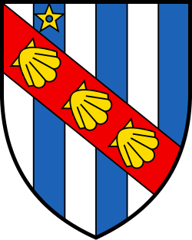
Coat of arms of Grandcour
Paly argent and azure, a bend gules charged with three escallops Or, the first pale azure charged in chief with a mullet of five points Or. The shield is striped with white and blue vertical bands. A red diagonal band with three yellow scallop shells runs from top left to bottom right. At the top of the first blue stripe shines a yellow five-pointed star. These are the arms of William of Grandson, who gave his banner to his burghers in 1381 to thank them for their support against the lord of Champvent. Similar arms already appear in the church of Ressudens in 1375. Grandcour also adopted William of Grandson's motto, "ie le weil" (I will it).[7][8]
Founding of Grandcour
It all began with a villa about 1 km south of the present village, which in the early Middle Ages became «Grandcour-la-Ville», with its church. In the 10th century the settlement moved and a new fortified town was built, with castle and church. Its foundation is attributed to the lords of Cossonay. The first known lords are the Prangins, around 1200.[1][4]
History of Grandcour
early Middle Ages. A villa 1 km south of the present village becomes «Grandcour-la-Ville», with its church.[1][4]
10th century. The settlement is moved and a new fortified town with castle and church is built.[1]
around 1200. The Prangins, first known lords.[1]
1212. First mention: «apud grancort».[1]
1293. Grandcour passes to Louis I of Savoy. The town henceforth enjoys the customs of Moudon.[1][4]
1311-1397. The lordship is in the hands of the Grandson family.[1][4]
1381. Founding of the «Milice bourgeoise», the oldest shooting society in the canton of Vaud still in existence.[1]
1403-1440. Humbert of Savoy is lord of Grandcour.[1]
1532-1736. The lordship belongs to the Diesbach family of Fribourg.[1]
1536. Bernese conquest; the lordship, limited to the present municipality and Chevroux, falls under the bailiwick of Avenches. It is raised to a barony in the mid-16th century.[1][4]
1563. The town hall is built.[1][4]
1738. Abram Sinner has the classical castle built.[1]
1756-1798. The lordship belongs to the Labat family of Geneva.[1]
1803. Grandcour becomes the seat of a circle, in the district of Payerne.[1][4]
1817. The castle is bought by the Oulevey family.[1]
1825. The cheese dairy opens.[1]
1849-1892. Twice-yearly fairs are held.[1]
1903. The school is built.[1][4]
1936. The water tower is built.[1][4]
2008. On 1 January 2008 Grandcour moves from the district of Payerne to the new district of Broye-Vully.
Population of Grandcour
Sources and references: [1][2]
| 1550 | 60 hearths (households) |
| 1764 | 431 |
| 1798 | 581 |
| 1850 | 716 |
| 1870 | 782 |
| 1900 | 725 |
| 1910 | 802 |
| 1941 | 719 |
| 1950 | 764 |
| 1970 | 642 |
| 2000 | 730 |
| 2025 | 970 |
Families of Grandcour
Oulevey. The Oulevey brothers, from Chesalles-sur-Moudon, bought the castle of Grandcour with its land, meadows, vineyards and forests, put up for sale after the death of Ursule, widow of Jean Louis Labat. One of their descendants still owns part of it.[1][8]
Burgher families before 1800. Blanche, Combremont, Dudan, Gachet, Marcuard, Marion, Marmier, Mathey, Mayor and Ruchat, with no precise date.[9]
In the 19th century. The Barbey are registered with no precise date, the Ménétrey, from France, in 1870.[9]
Show more families (1)
From 1901 to 1962. Ten entries. The Yersin, from Dardagny GE, arrived in 1938 and the Caccia, from Italy, in 1940. The Giacomotti, also from Italy, were admitted in 1950 and 1953. Three Bernese families followed, the Pfäffli from Signau in 1956, then the Guggisberg from Zimmerwald and the Hirsbrunner from Sumiswald in 1957, the year the Mäder were also registered. After the Scolari, from Italy, in 1958, came the Botkine, from the Soviet Union, in 1959. In 1960 a second Dudan family, from France, closed the list.[9]
Notable people of Grandcour
Guillaume de Grandson. Lord of Grandcour, he had frescoes painted in 1375. The commune's arms take up his coat of arms, and Grandcour adopted his motto "ie le weil" (I will it).[8]
Economy of Grandcour, past and present
Tobacco. In the 19th century Grandcour became a farming village, with agriculture almost its only activity. Tobacco growing dominated. In 1870 several thousand quintals were sent to Grandson. By the end of the century cereals, livestock and dairy farming had gained ground.[4]
The dairy. The first dairy and cheese building dates from 1838, the second from around 1910. In 2005, after the dairy societies of Grandcour, Chevroux and Delley merged, the cheese dairy moved into a third building. It then processed 3.6 million kilos of milk a year from seventeen farms. Its cheese has won several prizes.[4][8]
Sawmills, mill and workshops. Electricity made it possible in 1899 to turn a farm behind the dairy into a sawmill. It became the village's first mill and closed in 1970. In the early 20th century a small craft quarter grew up on the north side of the spur, with a second sawmill and workshops. A small engineering workshop became a garage in the 1960s and moved to the eastern edge of the village in 1994. The village has a bakery, a body shop and several building and earthworks firms.[4][1][8]
Disasters and major events in Grandcour
The attacks of 1393 and 1397. After the fall of the house of Grandson, Grandcour was attacked by the opponents of Otto III. Part of the walls and of the town was destroyed, and the place struggled afterwards to regain its standing.[4][8]
The fire of 1879. The fire destroyed the southern row of the medieval town and its wall. Further fires later struck the eastern row and part of the northern row. Rebuilding went on into the first decades of the 20th century.[4]
Historic sites in Grandcour
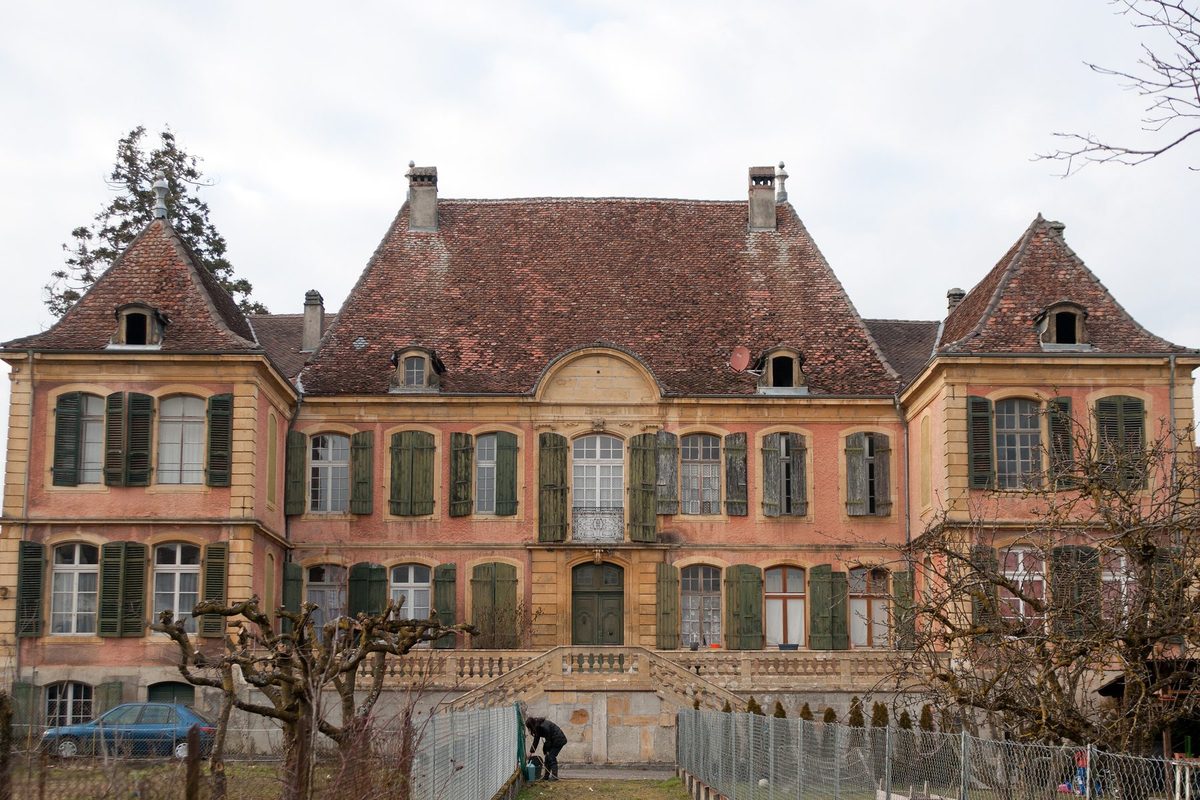
Grandcour Castle. Classical castle built in 1738 by Abram Sinner, bought in 1817 by the Oulevey family. Cultural property of national significance.[1][3]
Church of Saint-Nicolas. Church predating the 15th century, renovated in 1946, attached to the parish of Ressudens.[1][4]
Church of Notre-Dame de Ressudens. Parish church of the hamlet of Ressudens, to which Grandcour belongs. Cultural property of national significance.[1][3]
Town hall. Built in 1563, seat of the former Council of Twelve that ran the municipality.[1][4]
Village of Grandcour. The village is listed in the Federal Inventory of Swiss Heritage Sites (ISOS).[4]
Remains in Grandcour
Site of Grandcour-la-Ville. Location, 1 km south of the village, of the early medieval villa and church, abandoned when the settlement moved in the 10th century.[1][4]
Lost hamlet of Vernay. Hamlet of the municipality that disappeared in the 15th century.[1]
Protected heritage in Grandcour
Cultural property of national significance (A objects in the PCP inventory)[6]
- Château avec dépendances, bûcher, fontaine, portail, murs et jardin
- Ressudens, Eglise réformée Notre-Dame
Cultural property of regional significance (B objects)[6]
- Maison paysanne, dépendance et rural
Traditions and festivals in Grandcour
The Milice bourgeoise. In 1381 the burghers of Grandcour helped their lord Guillaume de Grandson in his conflict with the lord of Champvent. To thank them, he gave them his banner, land whose dues fund the Milice, and a cellar. The shooting society "l'honorable Milice bourgeoise de Grandcour" keeps the memory alive every first Saturday of June. After the shooting, the shooting king carries the banner in the procession, then opens the dancing on the stage set up by the Jeunesse in the centre of the village.[1][8]
The cellar auction. The Milice's cellar opens only for the festival. The right to run it during the following year's festival is auctioned among the society's members, and the sum is handed back as wine to the commune's burghers and to burghers' widows. The festival is counted among the Vaud abbayes.[8]
Sources
- Dictionnaire historique de la Suisse, Gilbert Marion, « Grandcour », version du 17.07.2007
- Statistique Vaud, « Population résidante permanente au 31 décembre 2025 »
- Office fédéral de la protection de la population, Inventaire PBC, liste cantonale Vaud (état au 1.1.2026)
- Office fédéral de la culture, ISOS, « Grandcour », fiche n° 4683 (2e version, octobre 2011)
- État de Vaud, Bureau d'information et de communication, « Organisation des préfectures et adaptation au nouveau découpage territorial », communiqué du 12.07.2007
- Federal Office for Civil Protection (FOCP), Swiss Inventory of Cultural Property (PCP), list for the canton of Vaud (as of 1.1.2026)
- IPI, Swissreg, emblems database: coat of arms of Grandcour (no. 101596)
- Official Gazette of the Canton of Vaud (FAO), "Alphabet des communes vaudoises: Grandcour"
- Register of Swiss Surnames, 3rd edition (1989), search Commune "Grandcour", Canton VD
Published by Sébastien Jörg ·
Localities of the municipality with a page
Other villages near Grandcour
Missing information, or do you have a source? Suggest a correction or addition. Every submission is checked before it's published.
Suggest a change