Hérémence
Origin of the name Hérémence
Hérémence appears in 1195 as « Aremens ». The name may correspond to an old river name, formed on an Indo-European root *er-/*or- followed by suffixes, though this is not established. In German the village was reportedly once called « Ermenz ».[1]
Founding of Hérémence
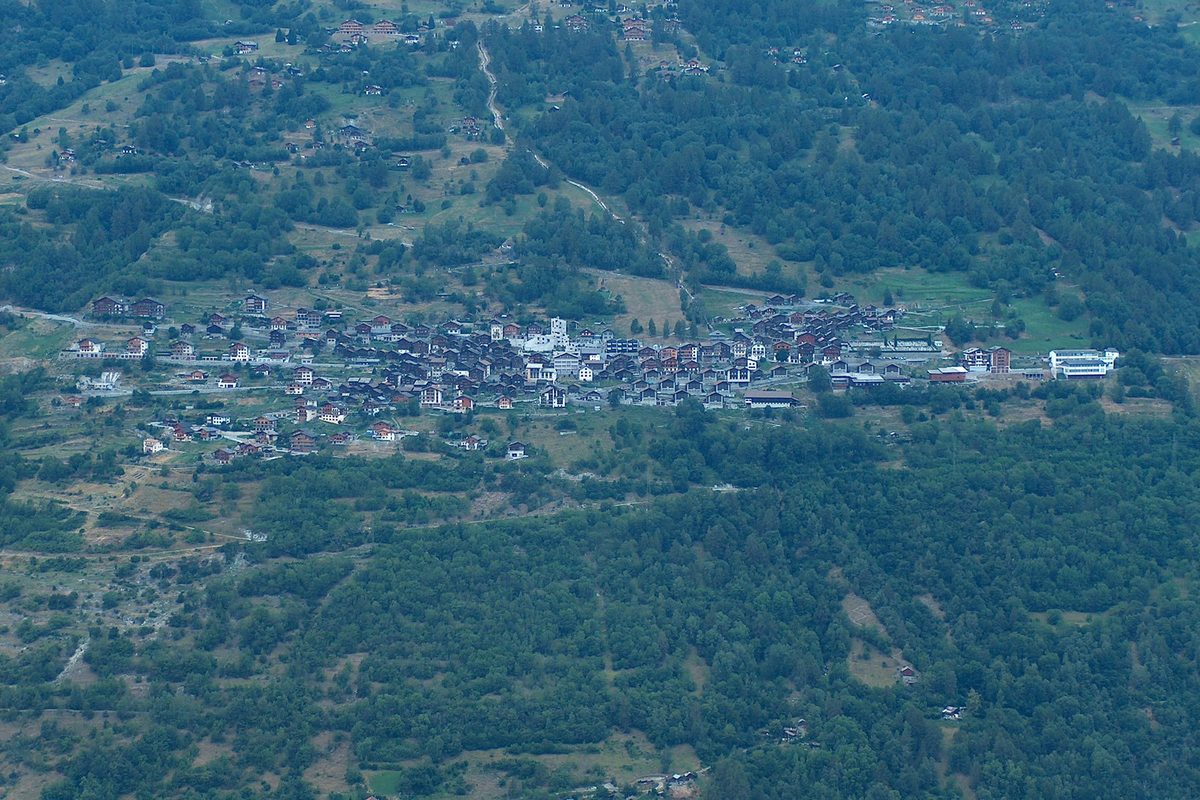
Hérémence covers the whole Dixence basin. Its hamlets (Ayer, Euseigne, Mâche, Pralong, Riod, Cerise) are spread along the left bank of the Borgne and the Dixence. It is one of the largest municipalities in the side valleys of Valais. The territory was part of the Bramois estate, given to the abbey of Saint-Maurice in 515. Around 1100 it came under the vidomne of Sion and had its own majors. Later attached to the Savoyard castellany of Conthey, the community kept wide autonomy because of its remoteness. Its inhabitants nevertheless resented the tutelage of Conthey and wanted to return to Sion, which the Valais Diet eventually accepted after the Upper Valais conquered Lower Valais.[1]
History of Hérémence
515. The Bramois estate, which includes Hérémence, is given to the abbey of Saint-Maurice.[1]
around 1100. Hérémence comes under the vidomne of Sion and has its own majors.[1]
12th century. Hérémence is said to have belonged to the parish of Saint-Pierre-hors-les-Murs in Sion.[1]
1195. Mentioned as « Aremens ».[1]
1211. First mention of the church.[1]
1268. Hérémence comes under Savoyard rule and is attached to the castellany of Conthey.[1]
1343-1438. The church is served by the parish priest of Vex.[1]
1438. In January, at the request of the parishioners put to the Council of Basel, the bishop of Sion separates the parish's property. The parish church of Saint-Nicolas is cited on this occasion.[1]
1475-1476. Victory of the Upper Valais at the Planta, then conquest of Lower Valais. Hérémence asks to return to Sion.[1]
1513. The Valais Diet accepts the return of Hérémence to Sion, confirmed in 1526.[1]
1665. The communities of Nendaz and Hérémence are merged into one large majorie.[1]
1798. After the Lower Valais revolution and the French invasion, Hérémence becomes the capital of a district.[1]
1802. Hérémence becomes the capital of a dizain bearing its name, then of a canton in 1810.[1]
1815. The dizain takes the name Hérens (a district from 1848), with Vex as its capital.[1]
1929-1935. Construction of a first dam.[1]
1950-1964. Construction of the Grande Dixence dam, which boosts the economy and brings significant revenue. Numerous workers, many of them immigrants, temporarily increase the population.[1]
1967-1971. Construction of a new parish church.[1][2]
Population of Hérémence
Sources and references: [1][3]
| 1850 | 1'137 |
| 1900 | 1'101 |
| 1930 | 1'736 |
| 1950 | 1'648 |
| 1960 | 1'868 |
| 2000 | 1'294 |
| 2025 | 1'548 |
Historic sites in Hérémence
Church of Saint-Nicolas. The parish church of Saint-Nicolas is cited in 1438. The church is mentioned from 1211. A new parish church, in brutalist architecture, was built from 1967 to 1971.[1][2]
Chapels of the hamlets. Saint-Georges in Euseigne (16th century), Saint-Sébastien in Riod and Saint-Barthélemy in Pralong (17th century), Sainte-Marie in Ayer (18th century), Saint-Jean at Le Chargeur (1929) and Sainte-Barbe in Mâche (1942), the last two linked to the dam workers.[1]
Grande Dixence dam and Lac des Dix. Dam built from 1950 to 1964 at the head of the Val des Dix, after a first dam of 1929-1935. It has become a major tourist attraction.[1]
Pyramids of Euseigne. The pyramids of Euseigne, near the hamlet of the same name, are together with the dam one of the municipality's major tourist attractions.[1]
Legends of Hérémence
The wyvern of the Val des Dix. The Val des Dix is said to owe its name to ten brigands who shod their mules backwards to fool their pursuers. Later a winged monster with green scales, the «Kwakua», devoured the cattle of the alpine pastures. Before diving it left the diamond it wore on its head on the edge of the pond. Prosper, a former soldier of Barbarossa, stole the diamond and hid in a barrel bristling with iron spikes, on which the monster wounded itself to death.[5]
The witches' sabbath. In a hamlet of Hérémence, a woman vanished every Saturday night. Her husband, Gourdin, followed her: two black goats carried them up the chimney to a feast presided over by Satan. Instead of signing the devil's great book, Gourdin drew a cross in it and woke on a hillside one Sunday morning. The tale was collected from Antoine-Marie Seppey of Hérémence.[5]
Sources
- Dictionnaire historique de la Suisse, « Hérémence » (Bernard Monnet, version du 09.04.2008)
- Inventaire fédéral des biens culturels (PBC), fiche « Eglise paroissiale St-Nicolas » (Hérémence), texte de la Société d'histoire de l'art en Suisse
- Office fédéral de la statistique (OFS), STATPOP, chiffres provisoires au 31.12.2025, via citypopulation.de
- geo.admin.ch, recherche de lieux (coordonnées)
- Solandieu, Légendes valaisannes, 1919, « La vouivre d'Hérémence » et « Le sabbat »
Localities of the municipality with a page
Other villages near Hérémence
Missing information, or do you have a source? Suggest a correction or addition. Every submission is checked before it's published.
Suggest a change