Jouxtens-Mézery
At the castle of Mézery, a salon of 26 painted panels, commissioned around 1760 for the castle of Hermenches, mainly depicts the pastimes of the nobility.
Entry based on 10 sources · Our method · Reusable text (CC BY-SA)
Origin of the name Jouxtens-Mézery
The municipality bears the names of its two localities. Mézery is mentioned in 929 as « Masiriaco », Jouxtens before 1185 as « Jotens ». The origin of these two names has not yet been explained.[1]
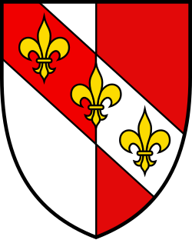
Coat of arms of Jouxtens-Mézery
Per pale argent and gules, a bend counterchanged charged with three fleurs-de-lis Or palewise. The shield is divided vertically, white on the left and red on the right. A diagonal band from top left to bottom right, red on the white and white on the red, bears three upright yellow fleurs-de-lis. Adopted in 1927, the arms take up the white and red of the Lausanne cathedral chapter, which held the territory before the Reformation. The bend and the fleurs-de-lis come from the noble Gimel family, which owned much of Jouxtens towards the end of the 15th century.[8][9]
Founding of Jouxtens-Mézery
Who founded the two villages is unknown. Mézery was occupied as early as the Roman period: a large villa with baths has left its remains there. In the Middle Ages, Jouxtens came under the chapter of Lausanne. Under the Ancien Régime the two localities remained separate: Jouxtens depended on the jurisdiction of Lausanne, while Mézery had its own seigneurial court. They only became a single municipality after the Vaud Revolution.[1]
History of Jouxtens-Mézery
Roman period. A large villa with baths stands at Mézery. Coins ranging from Augustus to Constantine have been found there.[1]
929. First mention of Mézery, in the form « Masiriaco ».[1]
10th century. Development of viticulture.
before 1185. First mention of Jouxtens, in the form « Jotens ».[1]
Middle Ages. Jouxtens comes under the chapter of Lausanne.[1]
1698. The seigneurial court of Mézery now belongs to the de Crousaz family.[1]
1750-1760. Rodolphe de Crousaz, a Lausanne architect, probably gives the castle of Mézery its present appearance.[4]
1754. Construction of the bell tower, known as the « campanile ».[1]
1798. After the Vaud Revolution, Jouxtens and Mézery form a single municipality, attached to the district of Lausanne.[1]
1801. The castle of Mézery passes to the Constant family.[4]
around 1808-1809. The painted panelling of the castle of Hermenches is moved to the castle of Mézery.[4]
1839. Construction of a school, enlarged in 1889.[1]
1887. Opening of the station on the Lausanne-Echallens-Bercher line.[1]
1939. Construction of the municipal hall.[1]
1944. The Beau-Cèdre estate is reportedly sold to the Confederation, which reportedly sets up a seed testing centre there.
1976. Completion of the church (parish chapel).
around 1980. Faced with urban expansion, residents seek to preserve the rural and residential character of the municipality through zoning restrictions.[1]
Population of Jouxtens-Mézery
Sources and references: [1][2]
| 1562 | 10 hearths (households) |
| 1620 | 8 hearths (households) |
| 1764 | 121 |
| 1798 | 122 |
| 1850 | 176 |
| 1900 | 236 |
| 1950 | 245 |
| 2000 | 1'145 |
| 2025 | 1'455 |
Families of Jouxtens-Mézery
Burgher families before 1800. Blanchard, Deluz, Marsens and Paudex, with no precise date. The Gronder of Grafenried BE were admitted in 1740, the David, from France, in 1769 and the Held, from Germany, in 1785.[10]
In the 19th century. The Auberjonois of Yverdon VD, the de Loriol of Etoy VD and the Pingoud of Lausanne VD are registered with no precise date. The others have a known year: Schmidely in 1804, Kees, from Germany, in 1829, Burger in 1834, Guinand of Les Brenets NE in 1835, Richter, from Germany, in 1837, Leuthold of Meiringen BE in 1838 and Delapierre in 1842. The Rivier of Lausanne VD followed in 1862, the d'Albis of Pully VD in 1863.[10]
From 1901 to 1962. Nineteen registrations, thirteen of them between 1951 and 1962. Italy provided the most families: Udini (1937), Rigo (1940), Imperiali (1947), Besenval (1954), Mersi (1955), Sala (1956) and Piola, the last registration, in 1962. The Berson, from the Soviet Union, were admitted in 1929 and the Gazarian, from Armenia, in 1931. They were joined by the Margot (1941), the Goetschel, from France (1951), the Messeiller (1954), then in 1956 the Pusztaszeri, from Hungary, and the Schopfer of Lauenen BE. In 1957 came the Allenbach of Adelboden BE, the Bächtold of Osterfingen SH, the Doutaz of Gruyères FR and the Garan, and in 1958 the Hänni of Grossaffoltern BE.[10]
Notable people of Jouxtens-Mézery
Voltaire, Edward Gibbon, Madame de Staël and Benjamin Constant. In the 18th century, the castle of Mézery was a centre of intellectual and social life. Voltaire, the British historian Edward Gibbon, Madame de Staël and Benjamin Constant all stayed there.[9]
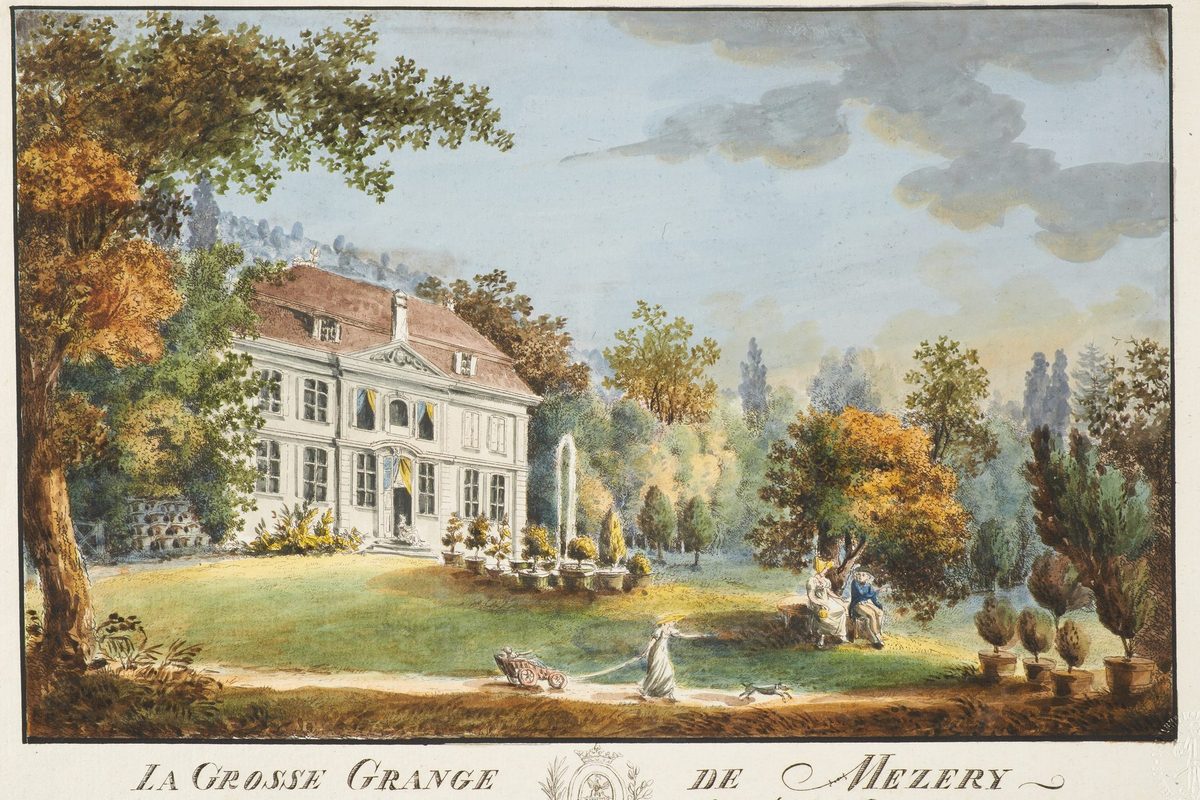
César Constant. When the Constant d'Hermenches family acquired the castle of Mézery and the Grosse Grange estate, he had the architect Henri Perregaux build two Gothic-inspired romantic follies. La Chapelle served as the porter's lodge of the Grosse Grange. The other, a sham ruin partly dug into the molasse rock, was named Abbaye Sainte-Cécile, then Abbaye Sainte-Sophie, after the owner's daughter and later his wife.[9]
René Auberjonois. The painter was one of the four surviving children of Gustave Auberjonois, who had bought the Grosse Grange estate in 1864. When his father died in 1917, the estate passed to them.[9]
Louis Rivier. A painter and glass artist who painted the frescoes in the great hall of the Palais de Rumine, he settled in Jouxtens-Mézery in the early 20th century. He was the commune's mayor for 24 years. His stained glass adorns more than 35 churches in the country.[9]
Economy of Jouxtens-Mézery, past and present
Farming villages. Jouxtens and Mézery were originally mainly farming villages. In 1864 Gustave Auberjonois built a model farm devoted to dairy production, with a national, even international reputation. About 40% of the territory lies in the agricultural zone. The village has no shop, restaurant or post office.[9]
Historic sites in Jouxtens-Mézery
Castle of Mézery. Owned by the de Crousaz family from the 16th century, it probably owes its present appearance to the architect Rodolphe de Crousaz (around 1750-1760). In the French manner, the main floor is at ground level. It passed in November 1801 to the Constant family, then belonged until 1988 to the Pückler family, related to the Constants. It holds a painted salon of 26 fir panels forming a cycle of 19 scenes, mostly noble pastimes, commissioned in the early 1760s by David-Louis Constant d'Hermenches for his castle of Hermenches and installed at Mézery in 1809. Cultural property of regional importance (Swiss PCP inventory).[4][6]
The campanile. Bell tower built in 1754.[1]
Beau-Cèdre estate. 18th-century manor house, one of the residences built in the municipality alongside the castle of Mézery. It reportedly later served as a farmhouse in the late 19th century and was sold to the Confederation in 1944 for seed testing.
Church of Jouxtens-Mézery. Chapel inaugurated in 1976; Jouxtens has always belonged to the parish of Prilly.[1]
Remains in Jouxtens-Mézery
Roman villa of Mézery. Remains of a large Roman villa with baths, where coins ranging from Emperor Augustus to Constantine have been found.[1]
Protected heritage in Jouxtens-Mézery
Cultural property of regional significance (B objects)[7]
- Château de Mézery
- Maison de maître (Rivier) avec rural et garage
Traditions and festivals in Jouxtens-Mézery
The Tchaffatsatagnes. The inhabitants go by this nickname, which means "chestnut eaters" in Vaud patois.[9]
La Fête à Jouxtens. The La Fête à Jouxtens association organises the village festival every year.[9]
The Tchaffa-Trail. The traditional race through the village, organised by the Société sportive, has taken the name Tchaffa-Trail. The same club has held a popular badminton tournament since 2008.[9]
Sources
- Dictionnaire historique de la Suisse, « Jouxtens-Mézery » (François Béboux, version du 08.05.2007)
- Statistique Vaud, « Population résidante permanente au 31 décembre 2025 »
- geo.admin.ch (swisstopo), recherche de lieux
- Béatrice Lovis, « Les boiseries peintes du château de Mézery. Le récit imagé d'une vie de seigneur dans le Pays de Vaud vers 1760 », Monuments vaudois n° 4, 2013, p. 4-22 (extrait en ligne)
- Feuille des avis officiels du canton de Vaud, « Alphabet des communes vaudoises : Jouxtens-Mézery »
- Office fédéral de la protection de la population, Inventaire PBC, liste cantonale VD (état au 1.1.2026)
- Federal Office for Civil Protection (FOCP), Swiss Inventory of Cultural Property (PCP), list for the canton of Vaud (as of 1.1.2026)
- IPI, Swissreg, emblems database: coat of arms of Jouxtens-Mézery (no. 101386)
- Official Gazette of the Canton of Vaud (FAO), "Alphabet des communes vaudoises: Jouxtens-Mézery"
- Register of Swiss Surnames, 3rd edition (1989), search Commune "Jouxtens-Mézery", Canton VD
Published by Sébastien Jörg ·
Other villages near Jouxtens-Mézery
Missing information, or do you have a source? Suggest a correction or addition. Every submission is checked before it's published.
Suggest a change