Prilly
Between 1950 and 1970 Prilly grew from 3'992 to 13'352 inhabitants: the former village west of Lausanne became a town, known for the Cery psychiatric hospital.
Entry based on 8 sources · Our method · Reusable text (CC BY-SA)
Origin of the name Prilly
The place is mentioned in 976-977 in the phrase « in uilla que uocatur presliacus », then before 1185 as « Prillie ». The suffix « -acus » points to an old Gallo-Roman estate. The first element may contain a personal name, which has not yet been established.[1]
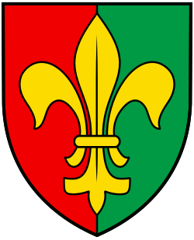
Coat of arms of Prilly
Per pale gules and vert, a fleur-de-lis Or overall. The shield is divided vertically, red on the left and green on the right. A yellow fleur-de-lis lies across both halves.[5]
Founding of Prilly
Prilly is an old estate that became a village. In the Middle Ages the chapter of Lausanne and the abbey of Saint-Maurice held land here, under the authority of the bishop of Lausanne. The lordship then passed through the hands of several noble families until the city of Lausanne bought it. The village stayed small until the railway and then the tramway arrived, which led to its industrialisation and rapid urbanisation.[1]
History of Prilly
976-977. First mention, in the phrase « in uilla que uocatur presliacus ».[1]
before 1185. The name appears in the form « Prillie ».[1]
1228. The church of Saint-Martin is mentioned.[1]
1398. The lordship belongs to Jacques de Penthéréaz, a burgher and prior of the commune of Lausanne. Part of the village then answers to the Lausanne chapter, the rest to the bishop, who has granted it to the knights of Prilly.[3]
1416. The village has 28 hearths (households).[1]
1480. The land of Prilly is shared among several lords. The nobleman Louis Gimel gradually buys up their rights, and his son François completes the reunion of the estate.[3]
1536. Bernese conquest of Vaud.[1]
1537. François Gimel pays homage to the government of Bern. After him the lordship is divided again.[3]
1550. The village has 10 hearths (households).[1]
1589. Isbrand de Crousaz brings the whole lordship together. It then passes to his granddaughter Susanne, wife of Benjamin Rosset, lord of Vufflens.[3]
1729. The heirs of Susanne and Benjamin Rosset's son sell the lordship to the city of Lausanne for 85,000 florins.[1][3]
1764. The village has 114 inhabitants.[1]
1765-1766. A temple replaces the church of Saint-Martin.[1]
1868-1873. Construction of the Cery psychiatric hospital.[1]
1858. The city of Lausanne sells the castle and estate of Prilly to a private owner.[3]
1874. Arrival of the railway.[1]
1899. Arrival of the tramway.[1]
1900. The commune has 1'569 inhabitants.[1]
Around 1900. The village itself has only 35 houses and 367 inhabitants, but the commune has 1,569, including 200 Catholics. It has more than doubled since 1870, first with the cantonal asylum at Cery, then with the growth of Lausanne. Fields and vines are still worked.[3]
1950-1970. Very strong population growth, from 3'992 to 13'352.[1]
2000. The commune has 10'955 inhabitants.[1]
Population of Prilly
Sources and references: [1][2][3]
| 1416 | 28 hearths (households) |
| 1550 | 10 hearths (households) |
| 1764 | 114 |
| 1850 | 309 |
| 1870 | 550 |
| 1888 | 1'203 |
| 1900 | 1'569 |
| 1950 | 3'992 |
| 1970 | 13'352 |
| 2000 | 10'955 |
| 2025 | 13'069 |
Families of Prilly
Citizen families before 1800. Twenty-four families. Degallier (from Versoix GE), Delaraye, Girardet, Muller and Perret are citizens with no precise date. The others are admitted in the 18th century: Vernet (from France) in 1719, Pasteur in 1725, Baudet (from Bottens VD) and Fraisse in 1735, Ricou in 1736, Roudolf and Rudolf (from Germany) in 1737, Fleurdelys (from Chavannes-près-Renens VD) in 1739, Grobéty (from Ballaigues VD) in 1740, Dégailler and Dégalier in 1756, Rouvière (from France) in 1759, Henny (from Gurzelen BE) in 1767, Triss (from Germany) in 1769, Syrvet (from Germany) in 1777, Mignot (from France) in 1778, Henninger (from Germany) in 1781, Goël (from France) in 1783 and Schneider (from France) in 1787.[7]
In the 19th century. Seven registrations, all dated: the Bréthaut, from Germany, in 1817, the Herter, from Germany, in 1820, the Rouffy of Saanen BE in 1822, the Zuber of Eriswil BE in 1836, the Hoffmann of Aarburg AG in 1841, the Inghoffer, from Hungary, in 1842 and the Holzhauer, from Germany, in 1844.[7]
From 1901 to 1962. Seventy-one registrations, from 1912 to 1962. Until 1955 most families come from abroad: ten from Italy, others from France and Germany, and two from Russia, the Baier in 1915 and the Effront in 1920. The White, in 1932, come from Great Britain. The year 1956 alone has twenty-four registrations, all of families from other cantons, mainly Bern and Fribourg. In 1957 the Tompkins join, from the United States. The last family registered, in 1962, is the Sporer, from Yugoslavia.[7]
Notable people of Prilly
Catherine Colomb (1892-1965). A novelist who spent her whole life in the Vaud region, in Yverdon, Lausanne and Prilly, she published as Catherine Colomb the trilogy Châteaux en enfance (1945), Les Esprits de la terre (1953) and Le Temps des anges (1962). Noticed by Gustave Roud and Jean Paulhan, she received the Prix Rambert in 1962.[8]
Economy of Prilly, past and present
Fields, gardens and vines. Alongside farming, Prilly grows vegetables and practises horticulture. Vines are cultivated until the 1920s.[1]
Industry. The Lausanne-Échallens-Bercher railway in 1874, then the Lausanne-Prilly tramway in 1899, bring industry. Among the firms founded are the Zwahlen & Mayr workshops, art metalwork and timber frames, active from 1906 to 1966, Sicpa SA, founded in 1927 by Maurice Amon to make printing inks, and Bobst & Fils SA in 1937. The Lausanne slaughterhouse, opened in 1945, closes in 2002.[1]
Bank, shops and commuters. In 1991 the centre of Prilly is remodelled to make room for a shopping centre. The Banque cantonale vaudoise sets up its administrative centre there in 1994. In 2000, 4'528 commuters come to work in Prilly, while 4'153 residents work elsewhere.[1]
Malley. Straddling Prilly and Renens, the Malley area is a former 16-hectare industrial wasteland. It is eventually to take in nearly 10'000 additional residents and jobs.[6]
Historic sites in Prilly
Cery psychiatric hospital. Built from 1868 to 1873, it is one of the canton's main psychiatric institutions.[1]
Prilly temple. Built in 1765-1766 to replace the church of Saint-Martin, mentioned from 1228.[1]
Linden tree on the square. In the early 20th century a linden tree stands on the village square. It is said at the time to be older than the Reformation and is known for its great age.[3]
Remains in Prilly
Bronze head of a young man. A bronze head of a young man from the 1st-2nd century, long associated with Prilly, was probably found in 1704 at Lausanne-Vidy.[1]
Roman ruins and Burgundian graves. Roman ruins and graves from the Burgundian period are recorded in the commune in the early 20th century.[3]
Protected heritage in Prilly
Cultural property of regional significance (B objects)[4]
- Cery, hôpital psychiatrique
- Temple
Sources
- Dictionnaire historique de la Suisse, « Prilly »
- Statistique Vaud, « Population résidante permanente au 31 décembre 2025 »
- Dictionnaire géographique de la Suisse, tome III (Neuchâtel, Attinger, 1905)
- Federal Office for Civil Protection (FOCP), Swiss Inventory of Cultural Property (PCP), list for the canton of Vaud (as of 1.1.2026)
- IPI, Swissreg, emblems database: coat of arms of Prilly (no. 101908)
- Official Gazette of the Canton of Vaud (FAO), "Alphabet des communes vaudoises: Prilly", issue of 13 October 2026
- Register of Swiss Surnames, 3rd edition (1989), search Commune "Prilly", Canton VD
- Dictionnaire historique de la Suisse, « Colomb, Catherine », version du 03.08.2005
Published by Sébastien Jörg ·
Other villages near Prilly
Missing information, or do you have a source? Suggest a correction or addition. Every submission is checked before it's published.
Suggest a change