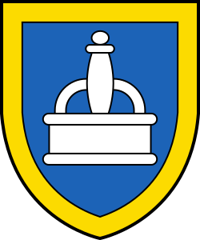
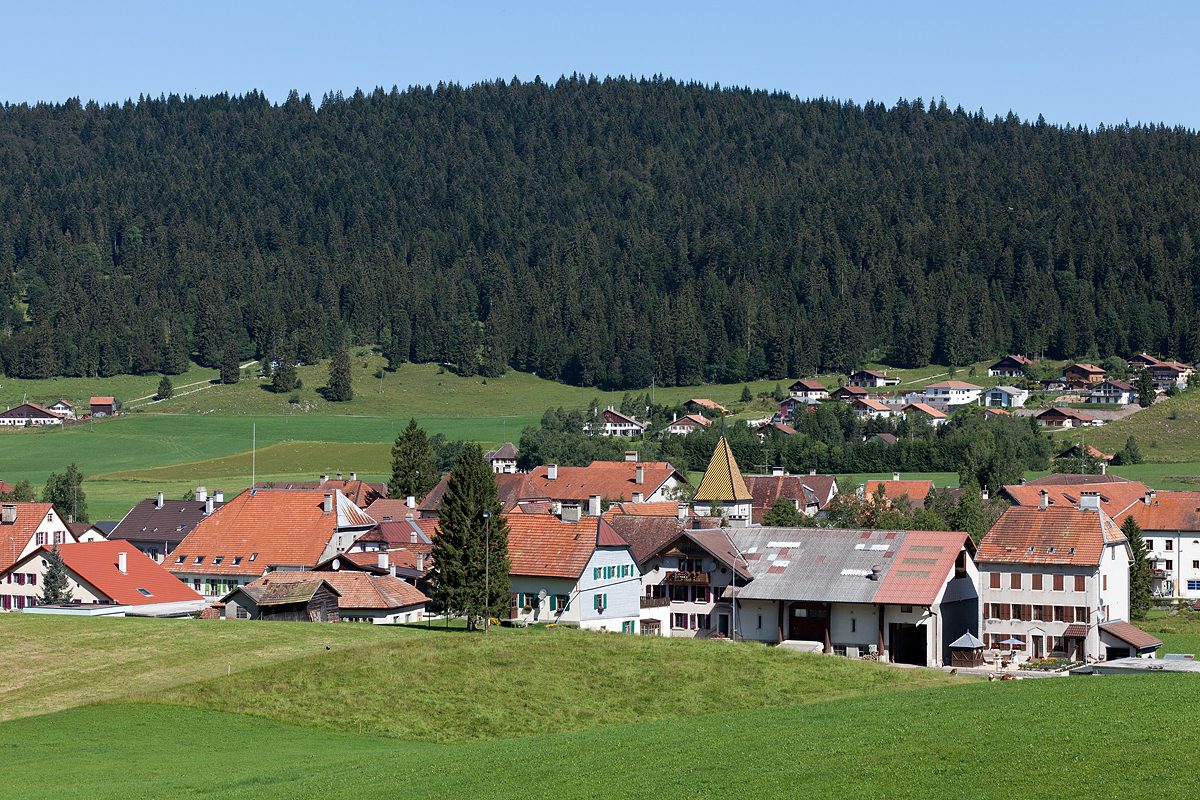
La Brévine
On 12 January 1987 La Brévine recorded -41.8 °C, its absolute cold record. The village, born of medieval land clearing, was recognised as a municipality in 1624.
Entry based on 11 sources · Our method · Reusable text (CC BY-SA)
Origin of the name La Brévine
The name comes from the Brevena stream, a word meaning « watering place » in the local patois. Since the 17th century it has designated the village, previously called La Chaux-des-Taillères. The hamlet of Bémont, part of the municipality, is recorded from 1266 in the form « Bemont ».[1]
Founding of La Brévine
The valley was opened up by land clearing, with no single known founder. Inhabitants of the Val-de-Travers began it in the 13th century. In the 14th century people mainly from Franche-Comté settled the Chaux-de-Remosse and the Chaux-des-Taillères. In the 16th century burghers of Le Locle and La Sagne followed them, while still depending on the lordship of Valangin. The territory then belonged to the castellany of Val-de-Travers. The community built its church in 1604, the parish separated from that of Le Locle in 1622, and the municipality was recognised in 1624, with the creation of the mairie of the Chaux-des-Taillères. It comprises the village, at 1'046 m, and the hamlets of Le Brouillet, Bémont, Les Taillères and La Châtagne.[1]
History of La Brévine
1266. First mention of the hamlet of Bémont, in the form « Bemont ».[1]
13th century. Inhabitants of the Val-de-Travers begin clearing the land.[1]
14th century. The Chaux-de-Remosse and the Chaux-des-Taillères are settled mainly by people from Franche-Comté.[1]
16th century. Burghers of Le Locle and La Sagne succeed the settlers from Franche-Comté and continue to depend on the lordship of Valangin.[1]
1604. The community builds its church.[1]
1622. The Protestant parish separates from that of Le Locle.[1]
1624. Creation of the mairie of the Chaux-des-Taillères and recognition of the municipality. Until then La Brévine belonged to the castellany of Val-de-Travers.[1]
1655-1665. The springs of La Châtagne (from 1655) and La Bonne Fontaine (from 1665) are used for cures until the end of the 19th century.[1]
1820. The jurisdiction of La Brévine takes in Le Cerneux-Péquignot.[1]
1821. The jurisdiction of La Brévine takes in La Chaux-du-Milieu.[1]
1831. A fire destroys thirty-one houses.[1]
mid-19th century. Lace-making and spinning mills disappear. Baths are reportedly built thanks to a subsidy from King Frederick William IV of Prussia.[1]
end of the 19th century. Watchmaking, prosperous until then, begins to decline.[1]
1975. Only the Gentil factory, specialising in precision tools, remains.[1]
1987. On 12 January La Brévine records the absolute cold record of -41.8 °C.[4]
1990. Farming and livestock still employ 41% of the working population.[1]
Population of La Brévine
Sources and references: [1][3]
| 1704 | 168 hearths (households) |
| 1750 | 1'220 |
| 1850 | 1'339 |
| 1880 | 1'703 |
| 1900 | 1'494 |
| 1950 | 1'008 |
| 1990 | 626 |
| 2000 | 647 |
| 2025 | 614 (31 December) |
Families of La Brévine
Citizen families before 1800. Thirty-five families, with no precise date: Calame, Calame-Rosset, Courvoisier-Clément, Courvoisier-Piot, de Merveilleux, Dumont, Grandjean-Perrenoud-Comtesse, Grether (of German origin), Huguenin, Huguenin-Benjamin, Huguenin-Bergenat, Huguenin-Dezot, Huguenin-Vuillemenet, Lesquereux, Matthey, Matthey-Claudet, Matthey-de-l'Etang, Matthey-des-Bornels, Matthey-Doret, Matthey-Guenet, Matthey-Henry, Matthey-Jaquet, Matthey-Jeantet, Matthey-Jonais, Montandon, Montandon-Blaiselion, Montandon-Clerc, Montandon-Varoda, Perrenoud, Perrenoud-André, Perrenoud-Jeanneret, Sandoz, Sandoz-Longjean, Sandoz-Otheneret and Sandoz-Othenin. The Matthey families alone fill eleven lines of this list.[7]
In the 19th century. The de Montmollin family and the Monot family, from France, with no precise date. Dated registrations began in 1863 with the Dohmé family. Then came the Nussbaum from Bolligen BE (1870), the Vincent (1872), the Theile (1878) and the Blum (1879), from Germany, the Quaile (1880) and the Blanc (1885), from France, and the Luger, from Austria (1886). In 1888 the Gattolliat from Provence VD, the Messerli from Wattenwil BE, the Vautravers from Romairon VD and the Vögeli from Gächlingen SH were registered. Then the Patthey from Fiez VD and the Rufener from Blumenstein BE (1889), the Fuchs from Lauterbrunnen BE and the Hirt from Münchenbuchsee BE (1890), the Choffet from France (1892), the Jung from Frutigen BE (1893), the Grossen from Kandergrund BE and the Grundisch from Saanen BE (1896), the Graber and the Sauser from Sigriswil BE (1899) and the Bähler from Uebeschi BE (1900).[7]
From 1901 to 1962. Twenty-one registrations. Six families came from Italy: Tosalli (1917), Bolengo (1948), Careti and Caretti (1953), Brigliano (1959) and Zoni (1961). Four came from France: Lambert (1911), Blondeau (1916), Covillot (1959) and Capit, the last family registered, in 1962. The Swiss families are the Ries from Staffelbach AG (1903), the Barras from Broc FR (1904), the Yersin from Rougemont VD (1906), the Neeser from Schlossrued AG (1919), the Aellen from Saanen BE (1921), the Gertsch from Lauterbrunnen BE (1927) and the Michel from Maules FR (1935). Barraud (1905), Borel (1921), Aivano and Zollinger (1941) have no stated origin.[7]
Notable people of La Brévine
David-Guillaume Huguenin (1765-1841). A watchmaker and notary, David-Guillaume Huguenin was mayor of La Brévine, his native village, without interruption from 1804 until his death, and became a councillor of state in 1831. An inventor of various machines, he wrote a Description de la juridiction de la Brévine (1795). He initiated the Fonds de la paix to help the poor (1816).[9]
Jean Jacques Sandoz (1626-1711). Born in La Brévine, Jean Jacques Sandoz studied in Basel and Orléans before becoming a notary. Ennobled in 1657 by Henri II of Orléans-Longueville, he was director of the salt administration and became a councillor of state in 1673. In 1707 he sat on the tribunal of the Three Estates during the succession of Marie de Nemours.[10]
Henri-David Chaillet (1751-1823). A theologian born in La Brévine, Henri-David Chaillet studied in Basel and Geneva and was a pastor in Neuchâtel from 1789 to 1806. A literary critic and editor of the Journal helvétique, he was a friend of Isabelle de Charrière and Benjamin Constant. In 1798 he was dean of the Vénérable Classe of Neuchâtel pastors.[11]
Economy of La Brévine, past and present
Livestock and cheese. Farming, above all livestock, still dominates. In 1990 it employed 41% of the working population. A cheese dairy and woodworkers round out these activities.[1]
Peat. From the early 18th century until 1991 the inhabitants worked the peat.[1]
Outwork. Industry arrived in the 18th century as work done at home. After lace, spinning mills and then watchmaking, only the Gentil factory, which makes precision tools, has remained since 1975.[1]
Historic sites in La Brévine
Church of La Brévine. Church built in 1604 by the community, around which the name La Brévine came to designate the village. The Protestant parish separated from that of Le Locle in 1622. The church is a cultural property of regional significance.[1][6]
Lac des Taillères. This shallow lake, about three kilometres from the village, reportedly freezes regularly in winter and becomes a skating rink.
Double house of La Grosse Maison. Double farmhouse at the place called La Grosse Maison, listed in the Swiss Inventory of Cultural Property of National Significance.[6]
Hamlet of Bémont. Hamlet of the municipality recorded from 1266 in the form « Bemont », alongside Le Brouillet, Les Taillères and La Châtagne.[1]
Protected heritage in La Brévine
Cultural property of national significance (A objects in the PCP inventory)[6]
- Maison double
Cultural property of regional significance (B objects)[6]
- La Chapelle
- Les Taillères, ferme Brandt
- Temple
Traditions and festivals in La Brévine
The Cold Festival. La Brévine has held its Cold Festival (Fête du froid) since 2012. Since 2024 it has lasted two days and takes place in even-numbered years, with a lighter format in odd-numbered years. In February 2026 about 12'000 visitors came, and 270 people swam in the Lac des Taillères, where the water was below 2 °C.[8]
Sources
- Dictionnaire historique de la Suisse, « Brévine, La »
- Dictionnaire historique de la Suisse, « Locle, Le »
- État de Neuchâtel, arrêté du 4 février 2026 homologuant le recensement cantonal de la population au 31 décembre 2025
- swissinfo.ch, « La nuit la plus glaciale de l'hiver », 1er février 2010
- Office fédéral de la protection de la population, Inventaire PBC, « Maison double » (PBC 3946)
- Office fédéral de la protection de la population, Inventaire PBC, liste cantonale de Neuchâtel (état au 1.1.2026)
- Register of Swiss Surnames, 3rd edition (1989), search Commune "La Brévine", Canton NE
- swissinfo.ch (Keystone-ATS), "Nouveau succès de la Fête du froid à La Brévine: 12'000 visiteurs", 8 February 2026
- Dictionnaire historique de la Suisse, « Huguenin, David-Guillaume », version du 08.06.2005
- Dictionnaire historique de la Suisse, « Sandoz, Jean Jacques », version du 05.11.2009
- Dictionnaire historique de la Suisse, « Chaillet, Henri-David », version du 13.07.2005
Published by Sébastien Jörg ·
Localities of the municipality with a page
Other villages near La Brévine
Missing information, or do you have a source? Suggest a correction or addition. Every submission is checked before it's published.
Suggest a change