Lac des Taillères
At the Moulin du Lac, the waters of the Lac des Taillères vanish into a sinkhole directly linked to the source of the Areuse.
Entry based on 6 sources · Our method · Reusable text (CC BY-SA)
Origin of the name Lac des Taillères
The lake shares its name with the hamlet of Les Taillères on its shore and with the former Chaux-des-Taillères, the name of the valley, recorded in 1304 as « Chaul de Estaleres » and in 1624 as « Chaux-d'Etalières ». The origin of the word « Taillères » is not explained.[1][6]
Founding of Lac des Taillères
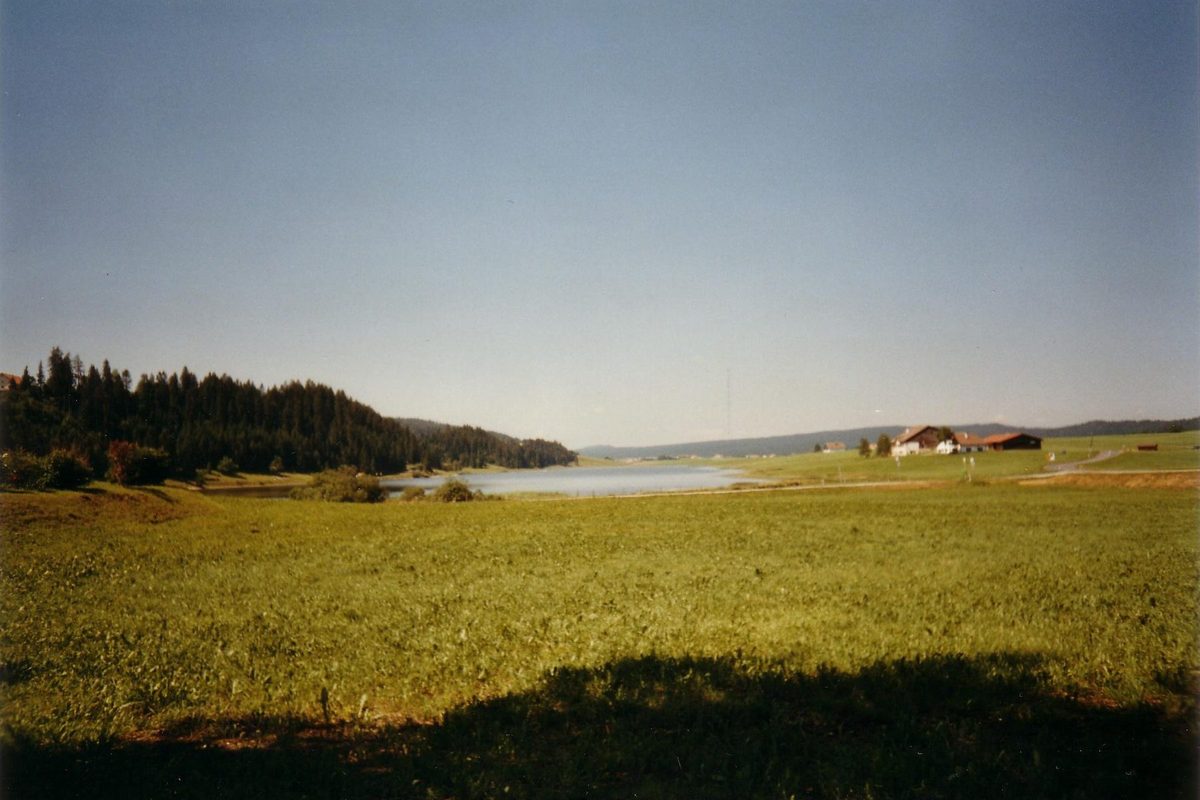
The Lac des Taillères is a natural lake in the municipality of La Brévine. It lies on an impermeable layer of Quaternary moraine clays and Tertiary molasse resting on Cretaceous sediments. It is fed by a few underground springs, runoff, rain and a small stream. Its outlet, regulated by a small weir, is directly linked to the source of the Areuse. About 1'900 m long and 250 m wide, it reportedly reaches a maximum depth of 7 to 11 m, with a sluice gate keeping its level below 1'039.5 m.[3][6]
History of Lac des Taillères
1304. The valley containing the lake is mentioned as « Chaul de Estaleres ».[1]
16th century. Mills are built at the Moulin du Lac, where the lake's waters drain into the sinkhole that serves as its outlet. They power threshers, fulling mills and saws.[3]
1964. On 10 July, the Neuchâtel Council of State bans motor navigation on the lake, considered harmful to its shores and to fishing on a body of water no larger than 1'900 m by 250 m.
2017. The revised sheet for object 1005 « Vallée de La Brévine » in the Federal Inventory of Landscapes sets the goals of preserving the outline of the slopes around the lake and the wetlands along its shores.[3]
Economy of Lac des Taillères, past and present
Peat. The flat valley floor around the lake still bears the marks of peat cutting and livestock farming. In the 18th and 19th centuries peat was used mainly to heat household stoves, and it was shipped as far as the Neuchâtel lakeshore. From the late 19th century other energy sources gradually replaced it. Horticultural peat was still extracted until 1992-1993, and the peat bogs have shrunk markedly.[3]
Meadows and pastures. Hay meadows fill the valley floor and wide wooded pastures cover the slopes. The low, fertile plots supply the fodder reserves, while the heights serve as summer pastures. Farming remains traditional, with a trend towards merging farms.[3]
Historic sites in Lac des Taillères
Le Moulin du Lac. Place where the lake's waters disappear into a sinkhole. Mills built in the 16th century powered threshers, fulling mills and saws there.[3]
The shores. The lake's shores are lined with belts of reed beds and sedge meadows.[3]
The frozen lake. In winter the frozen lake reportedly serves as a skating rink, and in summer it draws swimmers and windsurfers.
Legends of Lac des Taillères
The forest that became a lake. According to a legend, one evening in the 15th century the inhabitants of « Estaillères » were woken by a dreadful noise: the forest had turned into a stretch of water, said to be the origin of the Lac des Taillères.[5]
Sources
- Dictionnaire historique de la Suisse, « Chaux-des-Taillères, La » (Marie-Jeanne Ducommun Cernuschi), version allemande
- Dictionnaire historique de la Suisse, « Brévine, La » (Olivier Girardbille)
- Office fédéral de l'environnement, Inventaire fédéral des paysages (IFP), objet 1005 « Vallée de La Brévine », fiche révisée 2017
- Recueil systématique de la législation neuchâteloise, « Arrêté portant interdiction de la navigation à moteur sur le lac des Taillères » du 10 juillet 1964 (RSN 766.32)
- Mathilde Jaccard, « Balade » (La Brévine - Môtiers)
- geo.admin.ch, service de recherche de lieux (swisstopo)
Published by Sébastien Jörg ·
Other villages near Lac des Taillères
Missing information, or do you have a source? Suggest a correction or addition. Every submission is checked before it's published.
Suggest a change