La Cure
At the Hôtel Arbez the Franco-Swiss border runs through several rooms. Under the occupation, German soldiers could not enter its Swiss part.
Entry based on 5 sources · Our method · Reusable text (CC BY-SA)
Origin of the name La Cure
The origin of the name La Cure has not yet been explained, and its first written mention is not known. The Franco-Swiss treaty of 1862 already refers to the « lieu dit la Cure ».[5]
Founding of La Cure
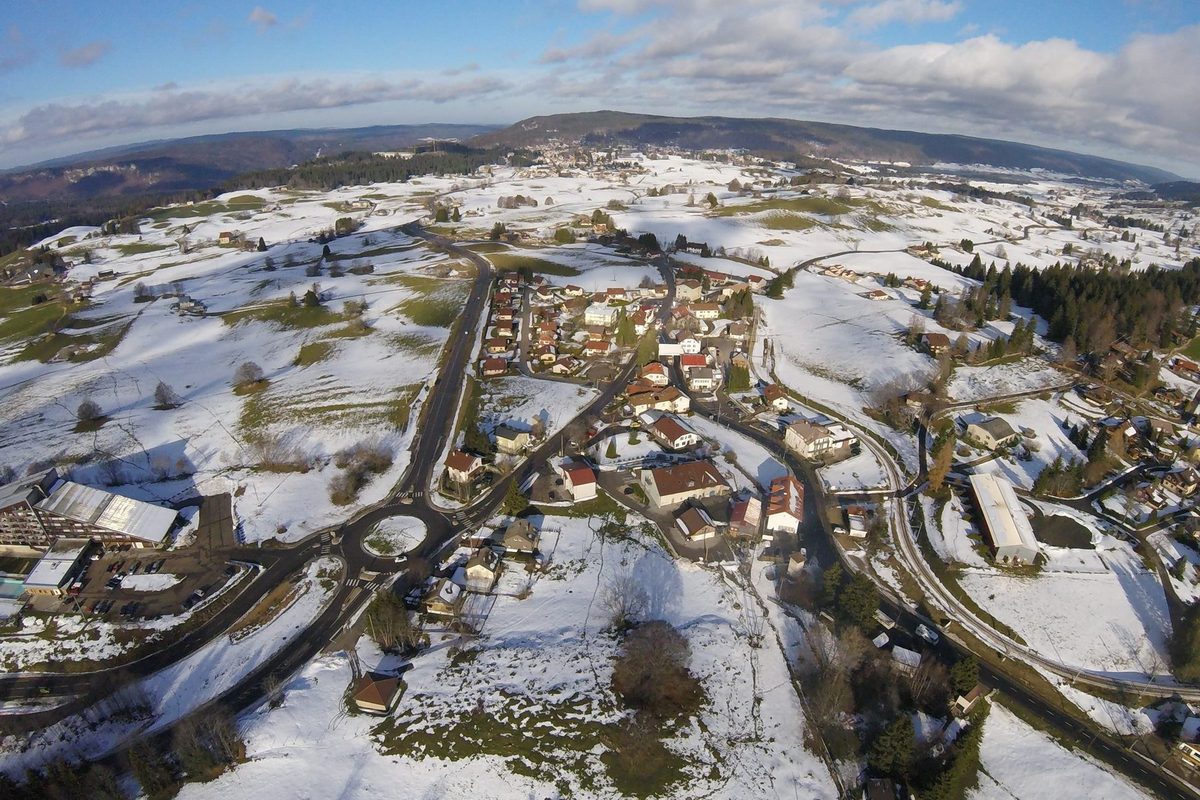
How this Jura hamlet came into being is not known. La Cure has belonged to the municipality of Saint-Cergue since the treaty on the Dappes valley, concluded between Switzerland and France on 8 December 1862 and ratified by the Vaud Grand Council on 19 December 1862. The new border line cuts through the hamlet: some buildings stand on both sides of it.[1][2][4]
History of La Cure
1862. On 8 December, treaty on the Dappes valley between Switzerland and France, ratified by the Vaud Grand Council on 19 December. La Cure is attached to Saint-Cergue. France takes back the Mont des Tuffes and its slopes, including the road from Les Rousses to the Faucille. Switzerland receives a territory of equal size, which includes the Saint-Cergue road from the « lieu dit la Cure ». No military works may be built there, and the inhabitants have one year to choose their nationality. The treaty also provides for a new road linking, near La Cure, the Saint-Cergue road with the Faucille road.[1][4][5]
1863. The landowner Alphonse Ponthus builds a house on a plot cut in two by the new border.[2]
1918. The Nyon-Saint-Cergue railway, opened in 1916, is extended to La Cure.[1]
1921. The line between La Cure and Morez opens. The same year, Jules Arbez buys the Ponthus house and turns it into a hotel.[1][2]
Second World War. After the German occupation of this part of France in 1940, German soldiers may not enter the Swiss part of the hotel. Max Arbez hides British and American soldiers there and helps Jewish families escape to Switzerland.[2]
1958. The section between La Cure and Morez closes, and La Cure becomes the terminus of the line from Nyon. The same year, Max Arbez reportedly declares the hotel, satirically, the micronation « Arbézie ».[1]
1961. On 9 December the hotel reportedly hosts preliminary negotiations for the Evian Accords.
2012. Max Arbez and his wife Angèle are reportedly recognised posthumously as Righteous Among the Nations by Yad Vashem.
Notable people of La Cure
Alphonse Ponthus. Swiss landowner whose field is cut in two by the new border. He has his house built in 1863, and French craftsmen work through the night to help him put on the roof.[2]
Max Arbez. He runs the hotel that Jules Arbez had made of the Ponthus house. During the Second World War he hides British and American soldiers upstairs, on the Swiss side, and lets Jewish families cross into Switzerland through the hotel.[2]
Economy of La Cure, past and present
Road, rail and tourism. In the commune of Saint-Cergue, people long lived from the forest and, to a lesser extent, from livestock. The Nyon to Morez road, opened in 1830, and then the railway, extended to La Cure in 1918, encouraged tourism and winter sports.[1]
The border hotel. The Hotel Arbez straddles the border and serves food from both countries. Its guests can eat and sleep in Switzerland and France at the same time.[2]
Historic sites in La Cure
Hôtel Arbez. Alphonse Ponthus built this house in 1863 on a plot cut by the new border. Jules Arbez bought it in 1921 and turned it into a hotel. The border runs through several rooms. In 1961 the hotel reportedly hosted preliminary negotiations for the Evian Accords.[2]
Terminus of the Nyon-Saint-Cergue-Morez railway. Line that reached La Cure in 1918 and was extended to Morez from 1921 to 1958. La Cure is today the terminus of the line from Nyon.[1]
Col de la Givrine. Nearby pass on the road linking Saint-Cergue to La Cure.
Remains in La Cure
Houses cut by the border. The line fixed in 1862 cuts through the hamlet: the border runs notably through the former Ponthus house, now the Hôtel Arbez.[2]
Sources
- Germain Hausmann, « Saint-Cergue », Dizionario storico della Svizzera, versione del 09.12.2009
- Anna Nelson, « Border hotel offers a taste of two cultures », swissinfo.ch, 26.06.2004
- Statistique Vaud, « Population résidante permanente au 31 décembre 2025 »
- Canton de Vaud, Décret ratifiant le traité avec la France concernant la vallée des Dappes (RSV 132.211), 19 décembre 1862
- Traité du 8 décembre 1862 entre la Confédération suisse et la France concernant la vallée des Dappes, Recueil systématique du droit fédéral (RS 0.132.349.24)
Published by Sébastien Jörg ·
Other villages near La Cure
Missing information, or do you have a source? Suggest a correction or addition. Every submission is checked before it's published.
Suggest a change