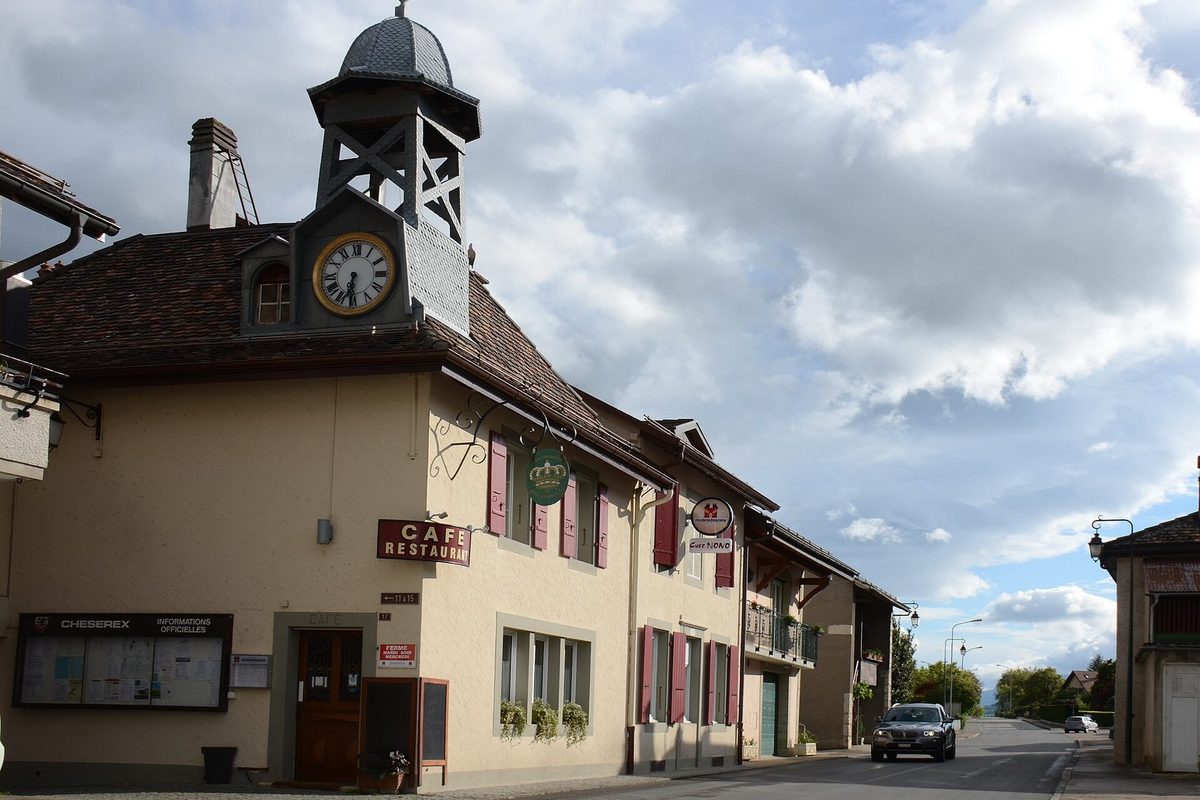
Chéserex
Chéserex is home to Bonmont, affiliated to Clairvaux in 1131: the oldest Cistercian foundation beyond the Jura.
Entry based on 10 sources · Our method · Reusable text (CC BY-SA)
Origin of the name Chéserex
The village appears in 1001/1025 as «Chiseras». The name probably comes from a Latin personal name, Casarus, owner of a rural estate, followed by the suffix of Celtic origin -akos/-acum.
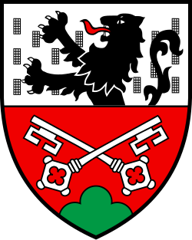
Coat of arms of Chéserex
Per fess, first argent semé of billets sable, a demi-lion of the same langued gules, second gules, two keys in saltire argent above a mount of three hills vert. The shield is divided horizontally. At the top, on a white field scattered with small black rectangles, a black lion with a red tongue rises, only its upper body visible. At the bottom, on a red field, two white keys cross above a green hill with three peaks. In 1922 the commune combined in one shield the arms of the lords of Gingins and those of the bailiwick of Bonmont.[8][9]
Founding of Chéserex
The area was already inhabited in Roman times, and an early medieval necropolis has been found there. Before 1025 Chéserex belonged to the abbey of Saint-Maurice. Peter the Venerable, abbot of Cluny, later ceded it to Bernard, abbot of Clairvaux, who handed it over to the abbey of Bonmont, founded on the municipality's territory. From then on the village's history is bound up with that of the abbey, whose rights were intertwined with those of the lord of Gingins. No founder of the village itself is known.
History of Chéserex
Roman period. Roman settlement on the territory of Chéserex.
Early Middle Ages. Early medieval necropolis.
1001-1025. First mention of the village in the form «Chiseras». It then belongs to the abbey of Saint-Maurice.
1093. Mention of a chapel, perhaps dedicated to Saint Martin, whose remains have been found.
1123. First mention of the monastic community of Bonmont.[2]
1131. Bonmont joins the Cistercian order in the filiation of Clairvaux. It is the order's oldest foundation beyond the Jura.[2]
1135-1154. Peter the Venerable, abbot of Cluny, cedes Chéserex to Bernard of Clairvaux, who hands it over to the abbey of Bonmont.
1407. The abbey of Bonmont grants the grange of Chéserex to 12 men of the village and of Gingins.
1488. A bell tower replaces the original small bell turret of the Bonmont abbey church.[2][3]
1536. Bernese conquest and Reformation: the abbey of Bonmont is secularised. Its church is then used as a store for harvests, which partly ensures its survival.[2][3]
1536-1798. Under Bernese rule Chéserex belongs to the bailiwick of Bonmont and to the castellany and parish of Gingins. The village must bear a quarter of the upkeep of the Gingins church.
1798. Chéserex is attached to the district of Nyon.
1826. The hamlet of Tranchepied is detached from Chéserex and attached to La Rippe.
1942. The church of Bonmont is listed as a historic monument.[2][3]
1982. The abbey church becomes the property of the Canton of Vaud.[2][3]
1989. Opening of a sports centre.
1995. Restoration of the Bonmont church is completed and it reopens to the public.[2]
Today. Chéserex has become a residential municipality, with many commuters to Geneva.
Population of Chéserex
Sources and references: [4]
| 1764 | 152 |
| 1850 | 218 |
| 1870 | 191 |
| 1900 | 219 |
| 1950 | 235 |
| 1970 | 281 |
| 2000 | 1'043 |
| 2025 | 1'272 |
Families of Chéserex
Citizen families before 1800. Ansermet, Brolliet, Chambrier, Fer, Guibert, Guichard and Perrier, without a precise date.[10]
In the 19th century. The Dugrandpraz family, without a precise date.[10]
From 1901 to 1962. 11 registrations. Several families come from abroad: from Italy (Lanzza in 1918 and Sculati in 1953). From Switzerland come the Anselmier family from Genève GE (1956), the Hauser family from Worb BE (1956), the Jaggi family from Gsteig BE (1956), the Kernen family from Reutigen BE (1956), the Kuffer family from Ins BE (1956), the Fuchs family from Remigen AG (1957), the Kipfer family from Lützelflüh BE (1957), the Luthi family from Linden BE (1957) and the Jakob family from Trub BE (1959). The last family registered, in 1959, is the Jakob family.[10]
Economy of Chéserex, past and present
Farms, golf and swimming pool. Five farms remain. Local jobs are few: the Bonmont golf course, the restaurants, the grocery, the swimming pool and a few service companies. Long stable, the population grows sharply from the 1970s. A wood-fired heating plant supplies the pool and most communal buildings.[9]
Historic sites in Chéserex
Bonmont Abbey. Born of the Benedictine reforms of the 11th century and attested in 1123, the community joined the Cistercian order in 1131, in the filiation of Clairvaux: it is the order's oldest foundation beyond the Jura. Its church, built in several stages from about 1140 to the end of the 12th or the beginning of the 13th century, follows a Latin-cross plan and belongs to the transition between Romanesque and Gothic. After 1488 a bell tower replaced the small original bell turret. Secularised in 1536, listed as a historic monument in 1942 and acquired by the Canton of Vaud in 1982, the church was restored from 1989 to 1995. It is listed as cultural property of national significance.[2][3][6]
Bonmont Castle. Castle built next to the former abbey at the time when Bonmont was the seat of a Bernese bailiwick, in 1736. With its manor house, three farmhouses, fountains and park, it is listed as cultural property of regional significance.[2][6]
La Florettaz. Chalet estate on the municipality's territory, at the foot of the Dôle.
Remains in Chéserex
Necropolis and chapel. An early medieval necropolis and the remains of a chapel, perhaps dedicated to Saint Martin and mentioned in 1093, have been found in Chéserex.
Coudray Castle. Nothing remains of the medieval castle of Coudray, known only from old documents.
Protected heritage in Chéserex
Cultural property of national significance (A objects in the PCP inventory)[7]
- Eglise de l'ancienne abbaye de Bonmont
Cultural property of regional significance (B objects)[7]
- Château avec maison de maître, trois maisons paysannes, fontaines et parc (ancienne abbaye de Bonmont)
Traditions and festivals in Chéserex
The Brasse-Cailloux. The people of Chéserex have been given the nickname "Brasse-Cailloux".[9]
Concerts at Bonmont. The former abbey serves the municipality as a venue. The Advent concert and the music festival take place there, and local societies also give their concerts there.[9]
Sources
- Dictionnaire historique de la Suisse, « Chéserex »
- Dictionnaire historique de la Suisse, « Bonmont »
- Etat de Vaud, Service des bâtiments, « Abbaye de Bonmont » (restauration)
- Statistique Vaud, « Population résidante permanente au 31 décembre 2025 »
- Inventaire PBC, fiche 05993 « Abbaye cistercienne Notre-Dame-de-Bonmont », texte de la Société d'histoire de l'art en Suisse
- Inventaire suisse des biens culturels d'importance nationale et régionale (PBC), liste du canton de Vaud, état au 1.1.2026
- Federal Office for Civil Protection (FOCP), Swiss Inventory of Cultural Property (PCP), list for the canton of Vaud (as of 1.1.2026)
- IPI, Swissreg, emblems database: coat of arms of Chéserex (no. 102129)
- Official Gazette of the Canton of Vaud (FAO), "Alphabet des communes vaudoises: Chéserex"
- Register of Swiss Surnames, 3rd edition (1989), search Commune "Chéserex", Canton VD
Published by Sébastien Jörg ·
Other villages near Chéserex
Missing information, or do you have a source? Suggest a correction or addition. Every submission is checked before it's published.
Suggest a change