Signy-Avenex
On the «Balcon de la Petite Côte», Signy and Avenex were crossed by the Roman aqueduct that brought the waters of Divonne to Nyon. In 1017 King Rudolph III gave them to the abbey of Saint-Maurice.
Entry based on 7 sources · Our method · Reusable text (CC BY-SA)
Coat of arms: Public domain, Wikimedia Commons
Origin of the name Signy-Avenex
Avenex appears in the archives from 926, in a judgment of Count Anselm. Signy-Avenex enters history in 1017, when Rudolph III, King of Burgundy, gives it to the abbey of Saint-Maurice. The origin of the names Signy and Avenex has not yet been explained. The inhabitants are nicknamed the Monkeys (les Singes).[1]
Coat of arms of Signy-Avenex
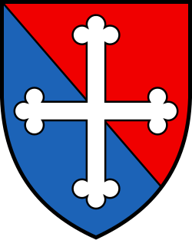
Per bend gules and azure, over all a cross botonny argent. The shield is divided diagonally from the upper left to the lower right corner, red in the upper right and blue in the lower left. A white cross with trefoil-shaped ends lies over the whole. Adopted in 1921, the arms bear the colours of Nyon, former seat of the bailiwick and then of the district. The cross, known as the cross of Saint Maurice, recalls the rights of the Abbey of Saint-Maurice over Signy.[5][6][1]
Founding of Signy-Avenex
The territory was occupied in Roman times: the aqueduct that brought the waters of Divonne to Nyon crosses it. Avenex is attested in 926, and in 1017 the Burgundian king Rudolph III gives Signy-Avenex to the abbey of Saint-Maurice. The municipality covers 195 hectares, between 434 and 489 metres above sea level. Who founded the two villages, and when, is not known.[1]
History of Signy-Avenex
Roman times. An aqueduct crosses the territory to bring the waters of Divonne to Nyon.[1]
926. Avenex is mentioned in a judgment of Count Anselm.[1]
1017. Rudolph III, King of Burgundy, gives Signy-Avenex to the abbey of Saint-Maurice.[1]
19th century. The municipality has between 77 and 92 inhabitants.[1]
1970. The municipality has about 120 to 130 inhabitants.[1]
1993. A commemorative plaque in honour of the poet Pierre-Louis Matthey is placed on the manor house of Avenex.[1]
2008. Signy-Avenex becomes part of the new district of Nyon, created by the Vaud territorial reorganisation that came into force on 1 January 2008.[3][4]
2012. The municipality has 442 inhabitants.[1]
Population of Signy-Avenex
Sources and references: [1][2]
| 19th century | 77 to 92 |
| 1970 | 120 to 130 (approx.) |
| 2012 | 442 |
| 2025 | 586 |
Families of Signy-Avenex
Burgher families before 1800. Mamboury, Rebillet and Rosset, with no precise date.[7]
From 1901 to 1962. Two Bernese families were received in 1957: the Baumgartner from Sumiswald BE and the Thuner from Worb BE.[7]
Notable people of Signy-Avenex
Pierre-Louis Matthey (1893-1970). A poet from the Matthey family of Avenex, he wrote about his attachment to the village. His works include "Seize à Vingt", "Semaine de passion", "Même sang" and "Triade". A complete new edition of his works appeared in 2016.[1][6]
Robert Matthey (1900-1982). The brother of the poet Pierre-Louis Matthey, he was a scientist of international repute.[6]
Lucie d'Avenex (1896-1982). The sister of the poet Pierre-Louis Matthey, this actress performed on every stage in French-speaking Switzerland.[6]
Economy of Signy-Avenex, past and present
From cows to vines. Until the late 1980s the municipality still has seven farms, with dairy cows, wheat, maize, sugar beet, orchards and vines. According to the FAO, six families still farm this land, which covers nearly 80% of the territory, but livestock farming has stopped. They mainly grow vines, apple and pear trees and cereals. The Avenex and Capitole estates produce wine.[6]
The En Fléchères zone. Signy-Avenex has more jobs than inhabitants, which is rare. Most of them are in the En Fléchères industrial and commercial zone near the motorway. The opening of the shopping centre in 1997 boosts employment. According to the FAO, about 90% of local jobs are held by people from elsewhere, and about 80% of the village's working residents work outside it.[6]
Historic sites in Signy-Avenex
Manor house of Avenex. Home of the important Matthey family, from which the poet and artist Pierre-Louis Matthey came. A commemorative plaque was placed there in 1993.[1]
Balcon de la Petite Côte. Signy and Avenex lie on a terrace between 434 and 489 metres above sea level, above Nyon.[1]
Remains in Signy-Avenex
Roman aqueduct. The aqueduct that brought the waters of Divonne to Nyon in Roman times crossed the territory of the municipality.[1]
Legends of Signy-Avenex
The tunnel from Nyon to Bonmont. According to a legend, an underground passage linked Nyon to the abbey of Bonmont and is said to have crossed the Roman aqueduct.[1]
The Monkeys. According to tradition, the inhabitants are nicknamed the Monkeys (les Singes) because an inhabitant of Avenex is said to have owned a monkey.
Traditions and festivals in Signy-Avenex
The 2017 millennium. In 2017 Signy celebrated its "millennium" with a large village festival in period costume.[6]
Sources
- Commune de Signy-Avenex, « D'hier à aujourd'hui »
- Statistique Vaud, « Population résidante permanente au 31 décembre 2025 »
- État de Vaud, Loi du 30 mai 2006 sur le découpage territorial (LDecTer)
- État de Vaud, communiqué « Organisation des préfectures et adaptation au nouveau découpage territorial », 12 juillet 2007
- IPI, Swissreg, emblems database: coat of arms of Signy-Avenex (no. 101591)
- Official Gazette of the Canton of Vaud (FAO), "Alphabet des communes vaudoises: Signy-Avenex"
- Register of Swiss Surnames, 3rd edition (1989), search Commune "Signy-Avenex", Canton VD
Published by Sébastien Jörg ·
Other villages near Signy-Avenex
Missing information, or do you have a source? Suggest a correction or addition. Every submission is checked before it's published.
Suggest a change