Eysins
Eysins enters history in 1001/1002, when King Rudolph III and the lords of the Kingdom of Burgundy held an assembly there.
Entry based on 8 sources · Our method · Reusable text (CC BY-SA)
Origin of the name Eysins
The locality appears in 1001/1002 as «Osinco». In 1457 it was reportedly called «Oysissi». No one has yet explained the name «Eysins». The inhabitants are called the Eysinoux and nicknamed the Poplars (les Peupliers).[1][3]
Coat of arms of Eysins
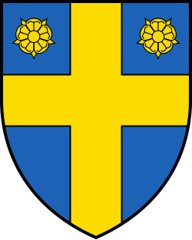
Azure a cross Or, in chief two roses of the same. On a blue field stands a yellow cross, with two yellow roses in the upper part of the shield. Adopted in 1919, the arms combine the cross of Savoy with two roses taken from the arms of the Charbonnier, one of the oldest families of Eysins. A decree of the Council of State in 1969 set the present blazon.[6][7]
Founding of Eysins
Who founded Eysins, or when, remains unknown. The area was occupied in Roman times, as a villa, an aqueduct and a necropolis show. Eysins first appears when King Rudolph III and the lords of the Kingdom of Burgundy sat there. From the 14th century until the Reformation the village depended on the Augustinian priory of Nyon. Under Bernese rule it belonged to the bailiwick of Nyon and came under the court of justice (castellany) of Nyon.[1]
History of Eysins
Roman period. A villa, an aqueduct and a necropolis show Roman occupation.[1]
1001/1002. First mention (« Osinco »): King Rudolph III and the lords of the Kingdom of Burgundy sit here.[1]
around 1000. A royal farm at Terrebonne reportedly belongs to the kings of Burgundy.
14th century. The village depends on the Augustinian priory of Nyon until the Reformation.[1]
1328. A confraternity of the Holy Spirit is active in the village; it operates until 1536.[1]
1418. Mention of a chapel of Saint George (chapelle Saint-Georges), which disappears at the Reformation.[1]
1536. Under Bernese rule Eysins belongs to the bailiwick of Nyon and comes under the castellany of Nyon.
1764. The village has 136 inhabitants.[1]
1905. The opening of the Nyon-Divonne-les-Bains railway line stimulates the development of the region.[1]
1919. Adoption of the municipal coat of arms: a cross recalling Savoy and two roses taken from the arms of the Charbonnier, one of the oldest families of Eysins.[7]
1930. A small Protestant church is built to replace the former chapel of Saint George.[1]
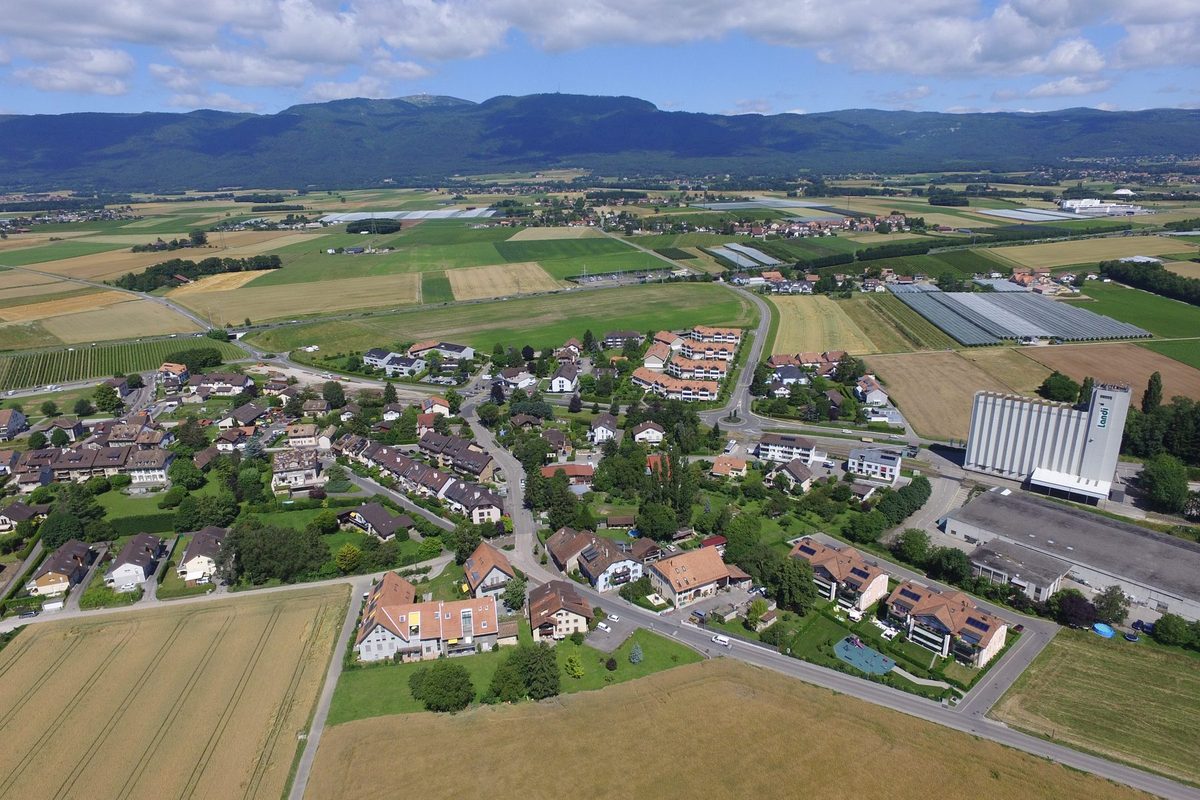
2000. The municipality has 831 inhabitants. Once agricultural and wine-growing, the village has become essentially residential, with many commuters to Geneva.[1]
2008. Eysins becomes part of the new district of Nyon, created by the Vaud territorial reorganisation that came into force on 1 January 2008.[3][4][5]
Population of Eysins
Sources and references: [1][2]
| 1764 | 136 |
| 1798 | 173 |
| 1850 | 234 |
| 1900 | 262 |
| 1950 | 278 |
| 1970 | 396 |
| 2000 | 831 |
| 2025 | 1'811 |
Families of Eysins
Burgher families before 1800. Charbonnier, Du Pontet, Dupontet, Gay, Gignoux, Granger, Olivier, Pinguely and Rosselat, with no precise date. The Charbonnier are among the oldest families of Eysins. The Tessier, from France, were admitted in 1685.[8][7]
From 1901 to 1962. No entries in the 19th century, then twenty-two families. The Tappaz, from France, open the series in 1908. Seven families are registered in 1917 and 1918: the Benusiglio, from Greece, the Blanchard and the Bugnet, from France, the Briel, from Germany, and the Preti, from Italy, in 1917, then the Hammel, from Germany, and the Stroumza, from Greece, in 1918, the year of a second Blanchard entry. Next come the Daniel, from Turkey (1921), the Tissot, from France (1924), the Lehmann (1948) and the Meyer (1951), from Germany, the Wassilevits (1951) and the Köporossy, from Hungary (1954). The last years bring mostly Bernese families: Gerber of Sumiswald, Haldimann of Eggiwil and Urfer of Thierachern in 1956, Bärtschi of Lützelflüh in 1957, Beck of Rohrbach in 1958 and Liechti of Eggiwil in 1959, the last family registered. They are joined by the Raboud of Villarsiviriaux FR (1957) and the Frasnetti, from Italy (1958).[8]
Notable people of Eysins
Juste Olivier (1807-1876). Born in Eysins. A historian, poet, writer and teacher, he published "Le Canton de Vaud. Sa vie et son histoire". Ramuz saw him as "notre seul classique vaudois" (our only Vaud classic).[7]
Urbain Olivier (1810-1888). Brother of Juste. A notary's clerk, manager of a large farming estate and syndic, he published 35 novels and short stories and lived from his pen during the last third of his life.[7]
Economy of Eysins, past and present
Cereals, vines and fruit. The village lived from farming and winegrowing. According to the FAO, only six farmers remain. They grow cereals and oilseeds, vines and fruit. Dairy cattle have disappeared, and only beef cattle are left.[1][7]
The disputed pastures. Quarrels with Signy and Nyon over the pastures began in the 14th century. They ended only 454 years later, after an eighteen-year lawsuit won by Nyon, seat of the Bernese bailiwick. Eysins also owned the Piles mountain jointly with Crans, Signy and Grens until it was sold in 1870.[7]
The railway and grain. Since 1962 the Divonne line has survived only between Nyon and Eysins. The grain collection centre of the western Lake Geneva region, a depot of the Landi farm cooperatives and a pipe factory make use of these facilities.[1]
From pipes to offices. In the 1970s the SOMO plant, the Société des métaux ouvrés de Carouge, set up here to make plastic pipes. Taken over by Ato-Fina, part of the Total group, it closed in the 2000s. A land-use plan came into force in 2009. According to the FAO, it now accounts for just over 1'400 jobs, mostly in services, and the commune has 245 businesses.[7]
Historic sites in Eysins
Monument to the Olivier brothers. A monument is said to honour the brothers Urbain and Juste Olivier, and the arms of Eysins, adopted in 1921, are said to take up the tinctures and roses of the arms of the Olivier family.
Protestant church. Small church built in 1930. It replaces the chapel of Saint George, mentioned in 1418 and gone since the Reformation.[1]
Terrebonne. Around the year 1000, a royal farm here reportedly belonged to the kings of Burgundy.
Remains in Eysins
Roman villa, aqueduct and necropolis. Roman occupation of the area left the remains of a villa, an aqueduct and a necropolis.[1]
Traditions and festivals in Eysins
Malakoffs. The communal inn, the Ecusson Vaudois, is the birthplace of malakoffs. They have been on its menu for more than a hundred years.[7]
The autumn market. The FEDA, Fête d'Eysins et des autres, organises it every year.[7]
Sources
- Germain Hausmann, « Eysins », Dictionnaire historique de la Suisse, version du 17.11.2004
- Statistique Vaud, « Population résidante permanente au 31 décembre 2025 »
- État de Vaud, Panorama, fiche de la commune d'Eysins
- Canton de Vaud, Loi sur le découpage territorial (LDecTer, RSV 132.15) du 30 mai 2006
- État de Vaud, communiqué du 12.07.2007, « Les préfètes et les préfets sont attribués aux nouveaux districts »
- IPI, Swissreg, emblems database: coat of arms of Eysins (no. 101951)
- Official Gazette of the Canton of Vaud (FAO), "Alphabet des communes vaudoises: Eysins"
- Register of Swiss Surnames, 3rd edition (1989), search Commune "Eysins", Canton VD
Published by Sébastien Jörg ·
Other villages near Eysins
Missing information, or do you have a source? Suggest a correction or addition. Every submission is checked before it's published.
Suggest a change