Borex
Borex, at the foot of the Jura near the French border, is crossed by the Roman aqueduct that carried the waters of Divonne to Nyon.
Entry based on 6 sources · Our method · Reusable text (CC BY-SA)
Coat of arms: Public domain, Wikimedia Commons
Origin of the name Borex
The village appears around 1213 as «Borrai». No etymology is known for «Borex».[1]
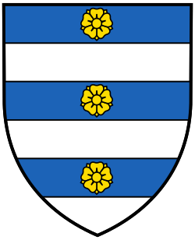
Coat of arms of Borex
Barry azure and argent, each bar azure charged with a rose Or. The shield is striped horizontally in alternating blue and white. Each blue stripe bears a yellow rose. The municipality adopted these arms in 1918. They are those of the Quisard family of Crans-près-Céligny, lords of Borex, with their stars replaced by golden roses.[4][5]
Founding of Borex
Who founded Borex, and why, is unknown. In Roman times the area was already crossed by the aqueduct that carried the waters of Divonne to Nyon (Colonia Iulia Equestris). Recorded around 1213, the village belonged in the Middle Ages to the lordship of Crassier, whose noble family is mentioned from 1123.[1][2]
History of Borex
Roman period. The aqueduct carrying the waters of Divonne to Nyon crosses the area.[1]
1123. First mention of the noble family of Crassier, whose lordship includes Borex in the Middle Ages.[1][2]
around 1213. First mention of the village, «Borrai».[1]
1429. The village has 14 hearths (households).[1]
1536-1798. Borex belongs to the Bernese bailiwick of Nyon. The municipality is run by the assembly of burghers.
1642. Bern grants part of the village as a fief to Jean-Jacques Quisard, lord of Crans.[1]
1738. This part of the village passes to the de Portes family.[1]
1764. The village has 107 inhabitants (25 hearths).[1]
1798. Borex belongs to the district of Nyon.[1]
1839. Construction of a school shared with Crassier.[2]
1905. Opening of the Nyon-Crassier-Divonne railway line, with a station at Borex.[1]
1962. Closure of the railway line.[2]
from 1970. Strong growth: the village becomes partly residential, with many commuters working mainly in Geneva.[1]
1990. 26% of the working population is still employed in farming and winegrowing.[1]
2000. The municipality has 865 inhabitants.[1]
2025. The municipality has 1'168 inhabitants on 31 December.[3]
Population of Borex
Sources and references: [1][3]
| 1429 | 14 hearths (households) |
| 1764 | 107 (25 hearths) |
| 1850 | 121 |
| 1900 | 168 |
| 1950 | 182 |
| 1960 | 201 |
| 2000 | 865 |
| 2025 | 1'168 |
Families of Borex
Quisard. In 1642 Bern grants half of Borex in fief to Jean-Jacques Quisard, of Crans. His descendants keep this land for several generations. The commune took over their coat of arms in 1918.[5]
Citizen families before 1800. Dancet, Goutroux, Guichard, Matthey, Messaz, Noguet and Rose, with no precise date.[6]
In the 19th century. A single family, the Macherich, from Germany, in 1894.[6]
Show more families (1)
From 1901 to 1962. Fifteen registrations. Until 1942 almost all the families come from abroad: from France (Ticon in 1913, Pariat in 1914, Davied in 1927), from Italy (Daglia-Zabellina in 1931, Paltani in 1932, Cortellini in 1942), from Germany (Barfuss in 1933) and even from Armenia, with the Salerian in 1929. After the Sculati, from Italy, in 1953, mainly Bernese families arrive: the Briggen of Spiez, the Jaggi of Gsteig and the Urfer of Thierachern in 1956, the Kilchherr of Kriechenwil in 1957. The Schwarzentrub, of Grenchen SO, are admitted in 1957, and the Lüthi of Linden BE close the list in 1958.[6]
Economy of Borex, past and present
From farm to commute. Borex began as a rural village. From 1905 to 1962 a station on the Nyon-Crassier-Divonne line linked it to Nyon. Growth picked up from 1970 and the municipality became partly residential. In 1990, 26% of the working population was still employed in farming and winegrowing. A large share of the inhabitants commuted, mainly to Geneva.[1]
Three farms and some businesses. Once mainly agricultural, the village now has only three farms, with fields, vineyards and orchards. Several businesses have settled here: two-wheeler sales, construction machinery hire, swimming pools, horticulture, landscaping and citrus growing. Most inhabitants work in the towns around Lake Geneva. The post office closed in 2021.[5]
Historic sites in Borex
Route of the Roman aqueduct. The territory of Borex preserves ruins of the aqueduct that carried water from Divonne to the Roman town of Nyon.[1]
Former station of the Nyon-Crassier-Divonne. Borex was served from 1905 to 1962 by the Nyon-Crassier-Divonne railway line.[1]
Remains in Borex
Roman aqueduct. Ruins of the Roman aqueduct that carried the waters of Divonne to Nyon.[1]
Legends of Borex
The «Pêcheurs-de-Lune» (Moon Fishers). According to tradition, the inhabitants owe this nickname to a tipsy villager who is said to have tried to fish the moon out of a pond. They are reportedly also called «les Casseroles», though these nicknames are uncertain.
Sources
- Dictionnaire historique de la Suisse, « Borex »
- Dictionnaire historique de la Suisse, « Crassier »
- Statistique Vaud, « Population résidante permanente au 31 décembre 2025 »
- IPI, Swissreg, emblems database: coat of arms of Borex (no. 101500)
- Official Gazette of the Canton of Vaud (FAO), "Alphabet des communes vaudoises: Borex"
- Register of Swiss Surnames, 3rd edition (1989), search Commune "Borex", Canton VD
Published by Sébastien Jörg ·
Other villages near Borex
Missing information, or do you have a source? Suggest a correction or addition. Every submission is checked before it's published.
Suggest a change