Arnex-sur-Nyon
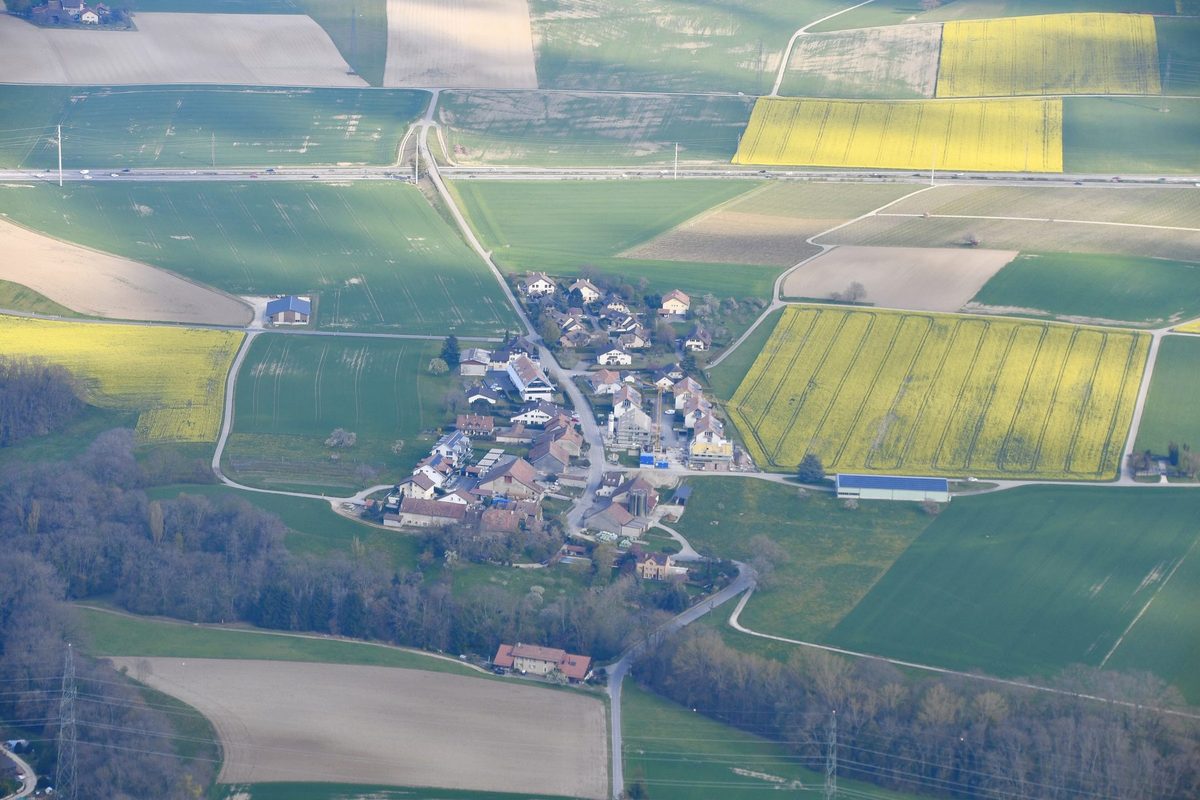
Ceded in 1432 to the priory of Ripaille by the Marquis of Saluzzo, this small farming village near Nyon passed in 1763 to the Genevan banker Antoine Saladin.
Entry based on 10 sources · Our method · Reusable text (CC BY-SA)
Origin of the name Arnex-sur-Nyon
The village appears in 1154 in the form «Arnai». A noble family bears its name («d'Arnay») from the mid-12th century. No etymology is known for «Arnex-sur-Nyon».[1][2]
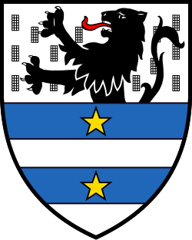
Coat of arms of Arnex-sur-Nyon
Per fess, in chief argent semé of billets sable, a lion issuant of the same langued gules, in base barry of four azure and argent, each bar azure charged with a mullet Or. Above, on a white field strewn with small black rectangles, rises a black lion with a red tongue, shown only from the waist up. Below, four horizontal bands alternate blue and white, and each blue band bears a yellow star. Adopted in 1926, the arms combine those of the Gingins and Quisard families. Arnex was partly within the old lordship of Gingins, and the Quisard family were lords of the village in the 17th and 18th centuries.[4][2]
Founding of Arnex-sur-Nyon
The village appears in written records in 1154. In the mid-12th century the nobles of Arnay, probably vassals of the lords of Prangins, are mentioned there. Who founded Arnex, and in what circumstances, is not known.[1][2]
History of Arnex-sur-Nyon
1154. First mention of the village, «Arnai».[1]
mid-12th century. Mention of the nobles of Arnay, probably vassals of the lords of Prangins.[1][2]
1295. Arnex becomes a fief of the House of Savoy. The Gingins family and the abbey of Bonmont also hold property there.[1][2]
1432. Manfroy, Marquis of Saluzzo and lord of Coppet, cedes the village to the priory of Ripaille.[1][2]
1510. The canons of Ripaille still hold possessions in Arnex.[1]
1536. Arnex is attached to the Bernese bailiwick of Nyon. The village is run by the assembly of burghers.[1]
1642. Bern grants the lordship as a fief to Jean-Jacques Quisard, lord of Crans.[1]
1738. The village has 16 houses.[1]
1763. The Quisard heirs sell the lordship to the Genevan banker Antoine Saladin (1725-1811), who keeps it until 1798.[1]
1798. Arnex belongs to the district of Nyon.[1]
1943. Land consolidation.[1]
1984. New zoning plan, with a limited extension zone for the village.[1]
1987. The municipality is authorised to plant one hectare of vines.[1]
2000. The municipality has 136 inhabitants.[1]
2025. The municipality has 274 inhabitants on 31 December.[3]
Population of Arnex-sur-Nyon
Sources and references: [1][3]
| 1738 | 16 houses |
| 1764 | 46 |
| 1850 | 100 |
| 1900 | 79 |
| 1950 | 85 |
| 1980 | 62 |
| 2000 | 136 |
| 2025 | 274 |
Families of Arnex-sur-Nyon
Bonnard. Refugees from the Dauphiné, the Bonnard became burghers of Arnex-sur-Nyon in 1753, then of Nyon in 1763. Moïse (1752-1818), the son of a refugee cloth merchant, financed the Nyon porcelain manufactory and is the ancestor of all the Vaud Bonnards. One of his descendants, Albert (Begnins 1858 - Geneva 1917), was editor-in-chief of the Journal de Genève from 1910 to 1917.[6][7]
d'Arnay. These milites of Arnex appear from the 12th century in the charters of the lords of Cossonay-Prangins. In 1237 they were vassals of the lords of Mont. The family died out in the 14th century with Jean, a squire mentioned in 1368. It has no link with the d'Arnay of Orbe.[8]
Burgher families before 1800. Bory, Caboussat, Caut, Finnaz, Lambert and Vollet appear with no precise date. Four families were received in the 18th century: the Granon, from France (1734), the Bonnard, also from France (1753), the Fallacian (1765) and the Heyer, from Germany (1768).[5]
Show more families (2)
In the 19th century. The Mauvilly are registered with no precise date, the Bouchet, from Savoy, in 1836 and the Mallet, from Geneva, in 1859.[5]
From 1901 to 1962. Twenty-two entries, eight of them in 1943 alone: the Boletti, Carmine, Nicola, Rossi, Vanni and Vizio from Italy, the Cochet from Germany and the Pettersson from Sweden. Germany also supplied the Hermsdorf (1917), Pfeiffle (1921), Schubert (1922) and Mauer (1942), Italy the Protti (1920), Antonioli (1940), Pezzi and Ungaro (1942). They were joined by the Ticon, from France (1926), the Givel (1939), the Rosay, from France (1949), another Vanni line from France (1952) and the Briggen from Spiez BE (1956). The last registered were the Kipfer, from Lützelflüh BE, in 1957.[5]
Notable people of Arnex-sur-Nyon
Antoine Saladin (Geneva 1725 - Crans 1811). An administrator of the Royal Mirror Manufactory of Saint-Gobain from 1747, he sat on the Genevan councils. He bought the seigneuries of Crans and Arnex in 1763 and retired to Crans in 1794.[9]
Claude Bonnard (Lausanne 1922 - Lausanne 1994). A burgher of Arnex-sur-Nyon and Nyon, he was a member of the Conseil d'État from 1966 to 1978, in charge of justice, police and military affairs. A national councillor from 1971 to 1987, he chaired the Liberal Party of Switzerland from 1989 to 1993.[10]
Economy of Arnex-sur-Nyon, past and present
Fields and vines. The inhabitants live mainly from fields and vines. The vineyard covers 16 hectares. Its chasselas, "Coteau d'Arnex", has won the Lauriers d'Or Terravin with every vintage since 1994. Pinot noir is also made.[1][2]
Businesses. Two farming and wine-growing operations remain, one of which still keeps dairy cattle. The village also has an agricultural contractor, a market gardener selling at the farm, two IT companies, a swimming pool builder and two investment advisory firms.[2]
Historic sites in Arnex-sur-Nyon
Rural village. Arnex, which belongs to the parish of Crassier, has kept its farming character: the 1984 zoning plan allows only a limited extension of the village.[1]
Legends of Arnex-sur-Nyon
The «Rédales». The inhabitants are nicknamed the Rédales. According to one tradition, they tried to bring a tree down away from the road by clinging to one another from its top, and fell. Nothing confirms the story.[2]
Traditions and festivals in Arnex-sur-Nyon
The Christmas tree bonfire. In early January the village's Christmas trees are burned in a shared bonfire.[2]
The 1st of August. Before the national holiday, wood for the bonfire is gathered and people go round the houses. New residents are welcomed at the ceremony.[2]
Sources
- Dictionnaire historique de la Suisse, « Arnex-sur-Nyon »
- Feuille des avis officiels du canton de Vaud, « Alphabet des communes vaudoises : Arnex-sur-Nyon »
- Statistique Vaud, « Population résidante permanente au 31 décembre 2025 »
- IPI, Swissreg, emblems database: coat of arms of Arnex-sur-Nyon (no. 102132)
- Register of Swiss Surnames, 3rd edition (1989), search Commune "Arnex-sur-Nyon", Canton VD
- Historical Dictionary of Switzerland (HDS), article "Bonnard, Moïse"
- Historical Dictionary of Switzerland (HDS), article "Bonnard, Albert"
- Historical Dictionary of Switzerland (HDS), article "Arnay, d'"
- Historical Dictionary of Switzerland (HDS), article "Saladin, Antoine"
- Historical Dictionary of Switzerland (HDS), article "Bonnard, Claude"
Published by Sébastien Jörg ·
Other villages near Arnex-sur-Nyon
Missing information, or do you have a source? Suggest a correction or addition. Every submission is checked before it's published.
Suggest a change