Crans
To set itself apart from Crans in Valais, the municipality took the name « Crans-près-Céligny » in 1935. It has since gone back to its original name, « Crans ».
Entry based on 10 sources · Our method · Reusable text (CC BY-SA)
Origin of the name Crans
The village is mentioned in 1008 as « Cranos ». What « Crans » means is still not known. In 1935 the municipality took the name « Crans-près-Céligny » to distinguish itself from Crans in Valais, mainly for postal reasons. In 2019 the motion « Vive Crans ! Réhabilitation du nom original » called for a return to the old name. The municipal council unanimously agreed on 2 December 2019, and the Council of State proposed the legal amendment in February 2020. The official name today is « Crans ».[1][2][3]
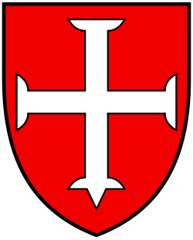
Coat of arms of Crans
Gules, a cross pattée couped and fitchy at the foot argent. On a red field, a white cross with flared arms, not touching the edges of the shield, ends in a point at the bottom. Adopted in 1921, these arms take up the cross from the seal of a 14th-century priest of Crans. The colours are those of the former chapter of Lausanne, which owned the land at the end of the second Kingdom of Burgundy.[8][9]
Founding of Crans
Who founded Crans is not known. The area was occupied very early, as a Bronze Age pin, Roman remains and Burgundian graves show. The village enters the records in 1008, in connection with an exchange of land. Its community, made up of serfs, then belonged to the chapter of Lausanne, which had it administered by its castellan of Saint-Prex. Even so, it already owned a pasture near La Dôle before 1400.[1]
History of Crans
Bronze Age. A pin from this period attests to human presence.[1]
Roman period. Roman remains on the municipal territory.[1]
Early Middle Ages. Burgundian graves.[1]
1008. Crans (« Cranos ») is mentioned in an exchange of land.[1]
after 1036. The village belongs to the chapter of Lausanne.[1]
after 1234. Crans is administered by the castellan of Saint-Prex on behalf of the chapter.[1]
before 1400. The community, although populated by serfs, owns a pasture near La Dôle.[1]
before 1500. A small church is built.[1]
1536-1798. After the Reformation, Crans belongs to the Bernese bailiwick of Nyon. The municipality is governed by the assembly of burghers.[1]
1542. Bern creates a lordship of Crans (with high jurisdiction in 1663).[1]
1553. The church, first served by the pastor of Céligny, becomes an annex of the parish of Nyon.[1]
1584. The church becomes an annex of Crassier.[1]
1763. The lordship passes from the Quisard family to the Saladin family.[1]
1764-1769. The Saladin family has a French-style château built.[1]
1798. Crans becomes part of the district of Nyon.[1]
1858. The Lausanne-Geneva railway line opens.[1]
1888. A railway halt opens at Crans.[1]
1935. The municipality takes the name « Crans-près-Céligny » to distinguish itself from Crans in Valais.[2][3]
1948. The church again becomes an annex of the parish of Nyon.[1]
2019-2020. The municipal council (2 December 2019) and then the Council of State (February 2020) set in motion the return to the name « Crans ».[2]
Population of Crans
Sources and references: [1][6]
| 1764 | 192 |
| 1850 | 286 |
| 1900 | 350 |
| 1950 | 364 |
| 2000 | 1'963 |
| 2025 | 2'483 |
Families of Crans
Quisard. After the Reformation Bern made Crans a lordship. Urbain Quisard, a Savoyard notary settled in Nyon, bought the territory, and his family kept it for 221 years, until the sale of 1763.[9][1]
Saladin. The Genevan financier Antoine Saladin bought the estate of Crans in 1763 for 45'000 écus. He had the present château built there.[9][4]
Citizen families before 1800. Bory, Demoinsel, Gay, Levrat, Luquiens, Nicodet, Olivier, Pollet and Vulliez, without a precise date.[10]
Show more families (2)
In the 19th century. The Berthout van Berchem family (from Genève GE) obtains citizenship in 1856.[10]
From 1901 to 1962. 11 registrations. Several families come from abroad: from Italy (Bertolotti in 1951 and Taddei in 1956) and from France (Favre in 1922). From Switzerland come the Eschler family from Boltigen BE, the Hämmerli family from Tschugg BE, the Junker family from Lotzwil BE, the Kislig family from Seftigen BE and the Wachsmuth family from Genève GE (1956), the Glatz family from Röthenbach im Emmental BE and the Glauser family from Zauggenried BE (1957) and the Lerch family from Rüegsau BE (1958). The last family registered, in 1958, is the Lerch family.[10]
Notable people of Crans
Jean van Berchem (1902-1992). The son of the château's owners, this artist created the painted decoration of the church in 1936, including the choir window.[9]
Economy of Crans, past and present
Farmers, winegrowers, craftsmen. Until the mid-20th century, Crans remains a village of farmers, winegrowers and craftsmen. The municipality also owns the Cuvaloup alpine pasture, on Gingins land, with 66 hectares of forest.[9]
Commuters and harbour. 86% of the working population is employed in the service sector, mostly as commuters. The harbour has 200 berths.[9]
Historic sites in Crans
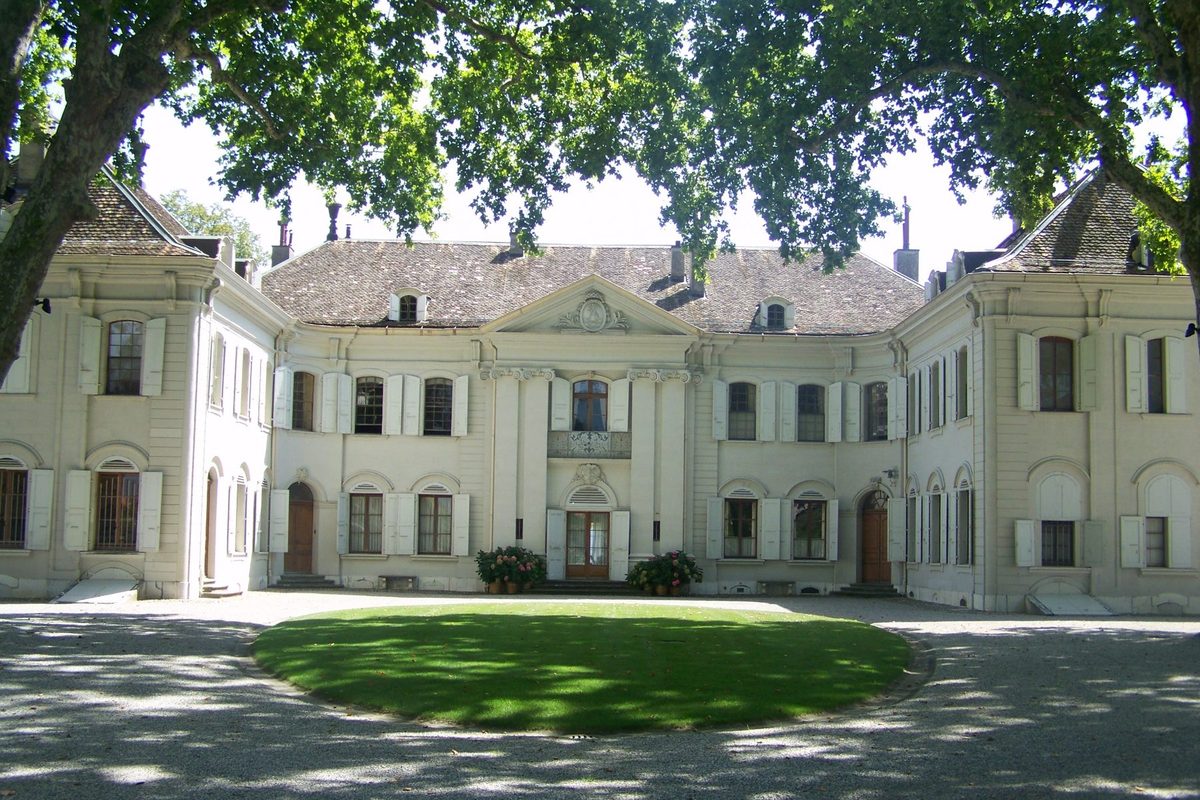
Château de Crans. Built from 1764 to 1769 for the Genevan Antoine Saladin, who had bought the lordship in 1763, on the site of older buildings. Outbuildings and grounds date from 1768-1770. The plans are attributed to the Genevan architect Jean-Louis Bovet. After his death in 1766, the work was directed by the mason Jean-Jacques Vaucher-Faton. The main block is flanked by two large corner pavilions, with a courtyard of honour on the mountain side and gardens to the south. It is one of the finest examples of 18th-century civil architecture in French-speaking Switzerland, and a cultural property of national importance (federal PCP inventory). It reportedly replaced an older 16th-century Quisard manor.[1][5]
Church (temple) of Crans. Small church built before 1500 and reportedly mentioned around 1200. After the Reformation it was attached in turn to Céligny, Nyon (1553), Crassier (1584) and Nyon again (1948). An alteration in 1889 and a 1936 ceiling decorated with panels painted by Jean van Berchem are also reported.[1]
Remains in Crans
Prehistoric, Roman and Burgundian traces. A Bronze Age pin, Roman remains and Burgundian graves show occupation of the site long before the first written mention in 1008.[1]
Protected heritage in Crans
Cultural property of national significance (A objects in the PCP inventory)[7]
- Château avec deux dépendances, maison paysanne, dépendance horticole, rural, deux pavillons, bassin et deux fontaines (Crans-près-Céligny)
Legends of Crans
The « Crows » of Crans. The inhabitants are nicknamed « Corbeaux » (crows) or « Fouette-Corbeaux » (crow-whippers). According to a locally handed-down story, crows are said to have flown towards Crans to show who owned a walnut tree on the boundary with a neighbouring municipality.
Sources
- « Crans-près-Céligny », Dictionnaire historique de la Suisse (DHS)
- Conseil d'État du canton de Vaud, Exposé des motifs et projet de loi modifiant la loi du 30 mai 2006 sur le découpage territorial (LDecTer), n° 208, février 2020
- Grand Conseil vaudois, rapport de commission sur le changement de nom de Crans-près-Céligny, juin 2020
- Inventaire fédéral des biens culturels (PBC), fiche 6031, château de Crans, texte de la Société d'histoire de l'art en Suisse
- Office fédéral de la protection de la population, Inventaire suisse des biens culturels d'importance nationale et régionale, liste du canton de Vaud (état au 1.1.2026)
- Statistique Vaud, « Population résidante permanente au 31 décembre 2025 »
- Federal Office for Civil Protection (FOCP), Swiss Inventory of Cultural Property (PCP), list for the canton of Vaud (as of 1.1.2026)
- IPI, Swissreg, emblems database: coat of arms of Crans-près-Céligny (no. 101525)
- Official Gazette of the Canton of Vaud (FAO), "Alphabet des communes vaudoises: Crans"
- Register of Swiss Surnames, 3rd edition (1989), search Commune "Crans-près-Céligny", Canton VD
Published by Sébastien Jörg ·
Other villages near Crans
Missing information, or do you have a source? Suggest a correction or addition. Every submission is checked before it's published.
Suggest a change