Garengo
Origin of the name Garengo
The origin of the name is not known.
Founding of Garengo
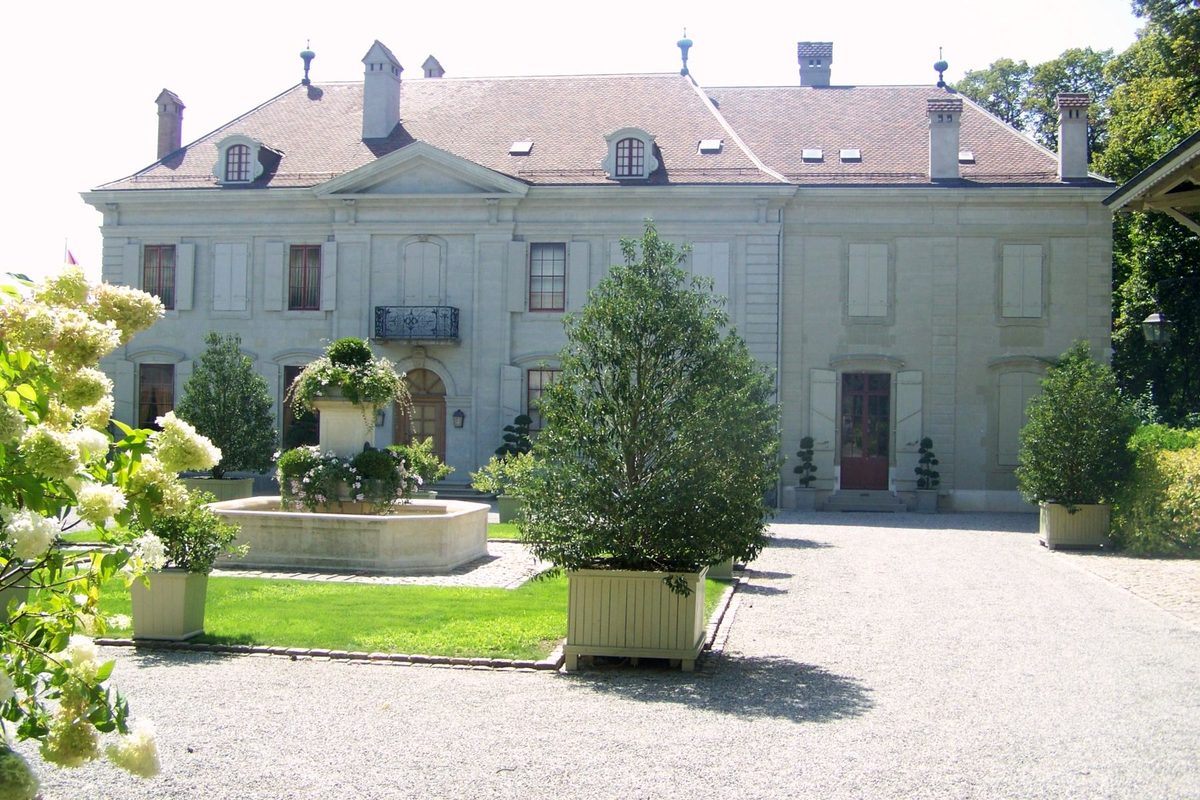
The Garengo estate, in the municipality of Céligny, occupies the site of the medieval fortified house of the nobles of Céligny, which overlooked the family mill on the Brassus (or Brassu) canal. When the Navilles bought the estate, the old seigneurial tower house was still standing. They had it pulled down and replaced by a classical mansion for Étienne Naville, a banker in London, and his brother Pierre. The estate was extended and altered in the 19th century, then passed to the pianist Ernest Schelling and later to Ernst Schmidheiny.[1][2][3]
History of Garengo
1163. First mention of the noble family of Céligny, whose fortified house stood on the site of the Garengo mansion. Its members appear in 1163 and 1179 as witnesses or donors to Bonmont Abbey.[2][3]
1461. From this date the Brassus, a second branch of the Canal du Grenier, feeds the Céligny family's mill at Garengo.[3]
Late 15th century. The main line of the Céligny family dies out with Jean.[3]
1545. Urbain Quisard, lord of Crans, wants to build a new water intake. The Céligny family and the villagers oppose a route that would have reduced the water for the Garengo mill, and another route is chosen.[3]
1758. The Naville family acquires the estate. The old seigneurial tower house, still standing, is demolished.[2]
Around 1759-1760. Construction of the classical mansion for Étienne Naville, a banker in London, and his brother Pierre.[1][3]
Around 1840. The new owner, Ami Bernard-Saint-Ours, buys the neighbouring property, whose houses are demolished. The outbuildings are rebuilt and the main building is extended by an annex.[1]
Around 1865. Conversion of the outbuildings, probably by Francis Gindroz, for the banker Édouard Hentsch.[1]
19th century. The Garengo mill, which worked until the 19th century, is destroyed.[3]
1877. Construction of a retaining wall below the terraced gardens, following the line of the original feudal spur.[1]
1910. The pianist Ernest Schelling buys the estate, where he receives many figures from the world of music; a veranda is added.[1][3]
1939. After a fire, the mansion is restored.[1]
1946. Ernst Schmidheiny and his wife Lucie, at first tenants, buy Garengo from Ernest Schelling's widow. The interior is decorated by the Paris firm Jansen.[1][3]
Historic sites in Garengo
Garengo mansion. Classical two-storey main building with a hipped roof, built around 1759-1760 for Étienne Naville, extended around 1840 and altered in the 20th century.[1][2]
Brassus canal. Branch of the Canal du Grenier that fed the Garengo mill from 1461. It still supplies most of the fountains of the village of Céligny.[2][3]
Remains in Garengo
Wall of the feudal spur. The retaining wall built from 1877 below the terraced gardens follows the line of the spur on which the fortified house of the nobles of Céligny stood.[1]
Sources
- Inventaire suisse des biens culturels d'importance nationale et régionale (PBC), « Garengo » (texte du Guide artistique de la Suisse, SHAS)
- Office fédéral de la culture, Inventaire fédéral des sites construits d'importance nationale à protéger en Suisse (ISOS), « Céligny » (3e version, février 2019)
- Commune de Céligny, « Bienvenue à Céligny » (brochure communale)
- geo.admin.ch, service de recherche de swisstopo (route de Céligny 75, Céligny, coordonnées)
Other villages near Garengo
Missing information, or do you have a source? Suggest a correction or addition. Every submission is checked before it's published.
Suggest a change