Bogis-Bossey
The Château de Bossey once belonged to Madame de Staël, housed Polish officers during the war and has been home to the Ecumenical Institute since 1946.
Entry based on 8 sources · Our method · Reusable text (CC BY-SA)
Coat of arms: Public domain, Wikimedia Commons
Origin of the name Bogis-Bossey
The municipality brings together two localities and bears both their names: Bogis, the main village near the border with the Pays de Gex, and Bossey, a hamlet made up of the château, the Hostellerie, Petit-Bossey and Belle-Ferme. Where these names come from has not yet been explained.[1]
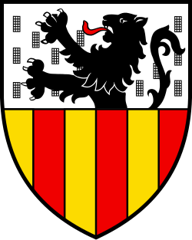
Coat of arms of Bogis-Bossey
Per fess, first argent semé of billets sable, a lion issuant of the same langued gules, second paly Or and gules. The shield is divided horizontally. At the top, on a white field scattered with small black rectangles, a black lion emerges, showing only its upper body, with a red tongue. At the bottom, vertical yellow and red stripes alternate. The municipality adopted these arms in 1928. They combine the lion of the lords of Gingins with the yellow and red pales of the Turrettini, the family that owned Bossey.[6][7]
Founding of Bogis-Bossey
Bogis-Bossey has no known founder. Both localities grew up as possessions of the Cistercian abbey of Bonmont. Humbert de Grammont, bishop of Geneva, gave it the estate of Bossey. Bogis became a « grange » (farm estate) of the abbey, whose lands were later granted in abergement, that is, conceded to settlers who worked them. Bossey stayed with the abbey until Bern made it a lordship.[1][3]
History of Bogis-Bossey
1125. Humbert de Grammont, bishop of Geneva, gives the estate of Bossey to Bonmont Abbey.[3]
12th century. Bogis is a « grange » of Bonmont Abbey. The lands are later granted in abergement to settlers.[1]
1542. Bern makes Bossey a lordship for the preacher Antoine Saunier.[1]
1711. The lordship becomes a castellany of the bailiwick of Bonmont.[1]
1722. The Geneva family Turrettini builds the Château de Bossey.[1]
1764. The municipality has 89 inhabitants.[1]
1798. Bogis-Bossey is attached to the district of Nyon.[1]
1809. Madame de Staël buys the Bossey estate for her son Auguste, who sells it two years later.[3]
1930-1939. The château is rented by Smith College, an American women's college, for a one-year study programme.[3]
Second World War. Polish officers who took refuge in Switzerland after the fall of France are housed at the château.[3]
1946. The Ecumenical Institute of Bossey, linked to the World Council of Churches, moves into the château. It officially opened on 25 October 1946; 5 October is also given, so the date is uncertain.[3][4]
1985. The municipality has only five farmers left.[1]
1990. Bogis-Bossey has become residential: 87% of the working population are commuters.[1]
2000. The municipality has 847 inhabitants.[1]
2025. The municipality has 961 inhabitants on 31 December.[2]
Population of Bogis-Bossey
Sources and references: [1][2]
| 1764 | 89 |
| 1850 | 131 |
| 1900 | 147 |
| 1950 | 123 |
| 2000 | 847 |
| 2025 | 961 |
Families of Bogis-Bossey
Turrettini. A Geneva family that becomes owner of Bossey in the 17th century. The estate then forms a lordship of its own. In 1928 the commune takes the yellow and red pales of the Turrettini into its coat of arms.[7]
Citizen families before 1800. Bourguignon, Dancet and Duvillard, with no precise date, then the Bohy in 1786.[8]
In the 19th century. A single family, the Mugnier, with no precise date.[8]
Show more families (1)
From 1901 to 1962. A single registration: the Aebi, from Seeberg BE, in 1957.[8]
Economy of Bogis-Bossey, past and present
Vines, woods and hospitality. The Cistercian monks of Bonmont were already growing vines on this land. Some inhabitants still make a living from farming, forestry and winegrowing. The Belle-Ferme estate combines farming, vineyards and guest rooms. The Château de Bossey houses a hotel, a restaurant and a conference centre.[7]
From farms to commuters. Bogis began as a farm of the abbey of Bonmont. By 1985 only five farmers were left. Bogis-Bossey then very quickly became residential: in 1990, 87% of the working population worked elsewhere and commuted.[1]
Historic sites in Bogis-Bossey
Château de Bossey. Manor house built in 1722 by the Geneva family Turrettini. A 12th-century round tower remains of the medieval complex. The estate passed through many hands, including those of Madame de Staël in 1809. In the 1930s it was rented by an American women's college, during the Second World War it housed Polish officers and, from 1946, the Ecumenical Institute of Bossey of the World Council of Churches.[1][3]
Hamlet of Bossey. Hamlet comprising the Château de Bossey, the Hostellerie, Petit-Bossey and Belle-Ferme.[1]
Protected heritage in Bogis-Bossey
Cultural property of regional significance (B objects)[5]
- Carré de fermes avec rural, volière et fontaine
Sources
- Dictionnaire historique de la Suisse, « Bogis-Bossey »
- Statistique Vaud, « Population résidante permanente au 31 décembre 2025 »
- Hans-Ruedi Weber, Robert K. Welsh, « The Story of Bossey: A Laboratory for Ecumenical Life », édition mise à jour, WCC Publications, 2016
- Conseil œcuménique des Églises, Ulrich Matthei, « 80 years of Bossey: the heart of ecumenism » (2026)
- Federal Office for Civil Protection (FOCP), Swiss Inventory of Cultural Property (PCP), list for the canton of Vaud (as of 1.1.2026)
- IPI, Swissreg, emblems database: coat of arms of Bogis-Bossey (no. 102130)
- Official Gazette of the Canton of Vaud (FAO), "Alphabet des communes vaudoises: Bogis-Bossey"
- Register of Swiss Surnames, 3rd edition (1989), search Commune "Bogis-Bossey", Canton VD
Published by Sébastien Jörg ·
Other villages near Bogis-Bossey
Missing information, or do you have a source? Suggest a correction or addition. Every submission is checked before it's published.
Suggest a change