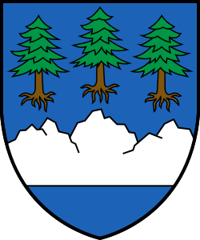
Lax
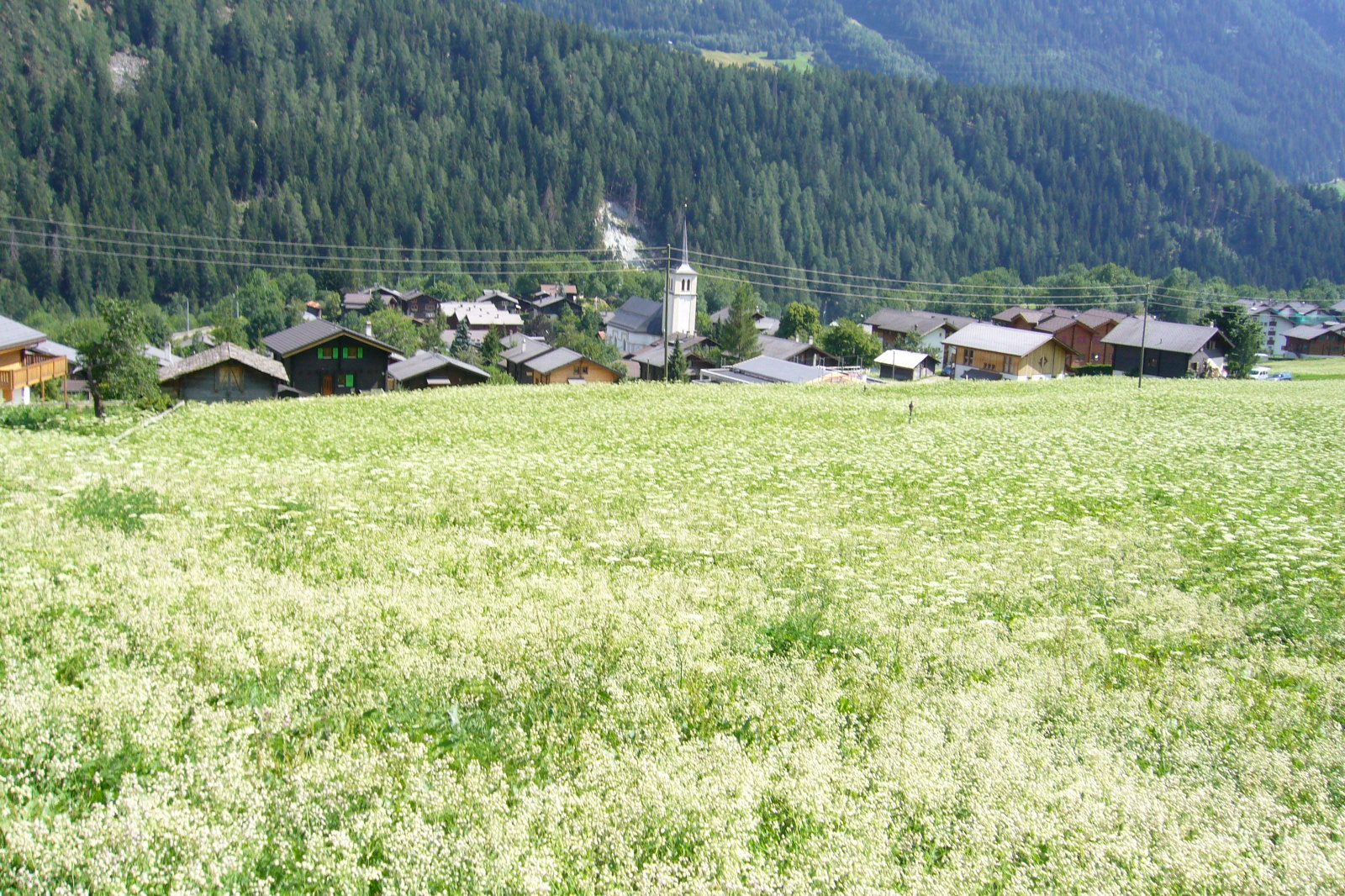
Origin of the name Lax
The place appears in 1295 as « Lacx ». The name reportedly comes from Latin lacus, in the sense of hollow or pond, and would refer to the depression below the village.[1]
Founding of Lax
Who founded Lax, on a terrace on the right bank of the Rhone above the Deisch step that closes off the lower Goms, is not known. Water governed village life: the Deischbach, shared with Martisberg, made irrigation difficult and caused disputes. An irrigation channel (bisse) was built in 1336, the first water rights date from 1347, and in 1590 an arbitration settled the division between the two municipalities. In 1350 the place depended on the bishop of Sion for tax purposes. The municipality adopted its first regulation in 1436. The plague of 1565-1566 claimed many victims. Originally part of the parish of Ernen, Lax became a rectorate in 1691, then a parish in 1873. In 1799 its defenders were the last to resist the French invasion, on the Deischberg and in the Lax-Graben. Tourism grew in the second half of the 20th century, notably with the Zillwald holiday estate. Approved by popular vote on 15 June 2025 and ratified by the Grand Council, the merger of Bellwald, Fiesch and Lax into the municipality of Unnergoms will take effect on 1 January 2027.[1][2]
History of Lax
1295. Recorded as « Lacx ».[1]
1336. An irrigation channel is built to bring water from the Deischbach.[1]
1347. First water rights.[1]
1350. Lax depends on the bishop of Sion for tax purposes.[1]
1436. First municipal regulation.[1]
1565-1566. The plague claims many victims.[1]
1590. An arbitration settles the division of the Deischbach water with Martisberg.[1]
1691. Lax, until then in the parish of Ernen, becomes a rectorate.[1]
1744. A Capuchin friary is founded.[1]
1746. The friary is abandoned after the Capuchins are expelled from the Goms dizain.[1]
1799. Lax is the last place to resist the invasion of the French troops, on the Deischberg and in the Lax-Graben.[1]
1873. Lax becomes a parish.[1]
1874. Completion of the neo-Gothic church.[1]
1959. Martisberg joins the parish of Lax.[1]
1972-1974. Construction of the Zillwald holiday estate.[1]
2025. On 15 June the voters of Lax approve the merger with Bellwald and Fiesch by 91.8 %, effective 1 January 2027.[2]
Population of Lax
Sources and references: [1][3]
| 1850 | 167 inhabitants |
| 1900 | 191 inhabitants |
| 1950 | 222 inhabitants |
| 2000 | 290 inhabitants |
| 2025 | 340 inhabitants |
Historic sites in Lax
Parish church. Neo-Gothic church completed in 1874, shortly after Lax became a parish (1873).[1]
Monument of 1799. Monument recalling the resistance of the inhabitants, the last to oppose the French invasion on the Deischberg and in the Lax-Graben.[1]
Guntern house and Kraeig house. Two fine houses in the village, the 16th century Guntern house and the 17th century Kraeig house.[1]
Walnut trees of Lax. Walnut trees grow at Lax. These frost-sensitive trees are reportedly found nowhere else in the Goms.
Sources
- Dictionnaire historique de la Suisse, « Lax » (Alois Grichting, trad. Elena Vuille-Mondada, version du 08.05.2017)
- Radio Lac / ATS, « Le parlement entérine une fusion à trois dans le Haut-Valais » (4.5.2026)
- Office fédéral de la statistique (OFS), STATPOP, chiffres provisoires au 31.12.2025, via citypopulation.de
- geo.admin.ch, recherche de lieux (coordonnées)
Other villages near Lax
Missing information, or do you have a source? Suggest a correction or addition. Every submission is checked before it's published.
Suggest a change