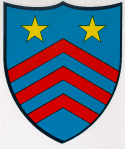
Les Geneveys-sur-Coffrane
Félix Flisch founded Felco here in 1945 in a former factory. The Felco 2 pruning shears, launched in 1948, won the Swiss Grand Award for Design in 2018.
Entry based on 20 sources · Our method · Reusable text (CC BY-SA)
Coat of arms: Public domain, Wikimedia Commons
Origin of the name Les Geneveys-sur-Coffrane
The village is mentioned in 1342 in the form « Geneveis sus Corfranoz », meaning « the Geneveys above Coffrane ». A form « Les Genevois sus Corfrano » is reportedly also recorded in 1370. The addition « sur Coffrane » distinguishes it from Les Hauts-Geneveys, recorded the same year as « Geneveis sus Fontannes ». The origin of the word « Geneveys » is not established: it has been linked to settlers from the Geneva area, or derived from genévrier (juniper) or from chenevier (a place where hemp was grown). None of these hypotheses is proven.[1][4]
Founding of Les Geneveys-sur-Coffrane
A Neolithic hammer-axe shows that the site was frequented very early, but no foundation charter or founder is known. The village appears on the lands of the lordship of Valangin, later the mairie of Valangin. Its inhabitants had the status of francs-habergeants, which is linked to the clearing of new land granted by the lord of Valangin. The commune was formed before 1402. For more than three centuries it formed a joint commune with Coffrane and Montmollin to manage the forests. The village belonged to the parish of Corcelles, then to that of Coffrane.[1][4]
History of Les Geneveys-sur-Coffrane
Neolithic. A Neolithic hammer-axe found on the territory shows a very early human presence.[1]
1342. First known written mention, in the form « Geneveis sus Corfranoz ».[1]
1402. The commune already exists by this date. Its inhabitants have the status of francs-habergeants.[1]
1486. Start of the joint commune formed with Coffrane and Montmollin to manage the forests.[1]
1520. The countess of Valangin grants the Splayes estate for the sole use of the people of Les Geneveys. The grant gives rise to a century-long dispute with the neighbouring villages.[1]
1531. The village has 24 hearths (households).[1]
1592. The lordship of Valangin, to which the village belongs, is united with the county of Neuchâtel.[15]
1707. Sovereignty over the principality of Neuchâtel is awarded to the King of Prussia.
1750. The village has 201 inhabitants.[1]
1827. End of the joint commune: the forests are divided between the three villages by drawing lots.[1]
1838. The village leaves the parish of Corcelles for that of Coffrane, re-established that year.[1]
1850. The village has 230 inhabitants.[1]
1860. Opening of the Neuchâtel-La Chaux-de-Fonds railway line, with a station at Les Geneveys-sur-Coffrane.[1]
19th century. In the second half of the century, a first industrial boom: factories making watch dials, furniture, bricks and cement pipes, a sand trade and a brewery.[1]
1900. The village has 473 inhabitants.[1]
Interwar period. A zoological amusement park operates in the village.[1]
1945. Félix Flisch founds the Felco company in a disused former dial factory to make pruning shears. After 1945 watchmaking, machine tools and construction replace the village's old industries.[1][9][10][11]
1948. Launch of the Felco 2 pruning shears, the company's flagship product, since sold in more than 19 million units.[9][10]
1950. The village has 605 inhabitants.[1]
1959-1966. Design of the Centre du Louverain, meeting and training centre of the Reformed Church of Neuchâtel, by the architect André Gaillard (preliminary design 1959 to 1961, final design 1963 to 1966).[3][8]
1970. A residential area develops; a bronze sculpture by Robert Hainard, Le Lynx, is placed in front of the school.[1][3]
1990. The village has 1'480 inhabitants.[1]
2012. The Reformed Evangelical Church of Neuchâtel sells its shares in the Centre du Louverain. On 31 December the municipality has 1'611 inhabitants.[7]
2013. On 1 January Les Geneveys-sur-Coffrane merges with fourteen other municipalities of the district to form the municipality of Val-de-Ruz.[1][2]
2015. Felco installs a solar power plant on the roof of its factory.[9][10]
2018. The Felco 2 pruning shears receive the Swiss Grand Award for Design.[9][10]
Population of Les Geneveys-sur-Coffrane
Sources and references: [1]
| 1531 | 24 hearths (households) |
| 1750 | 201 |
| 1850 | 230 |
| 1900 | 473 |
| 1950 | 605 |
| 1990 | 1'480 |
| 2000 | 1'409 |
| 2008 | 1'543 |
| 2012 | 1'611 |
Families of Les Geneveys-sur-Coffrane
Perregaux. A family from Les Geneveys-sur-Coffrane, where it appears from the 15th century, later citizens of Valangin and Neuchâtel. Its village branch gave rise to the Travers branch, from which those of Boudevilliers and Geneva descend. The Valangin line, descended from Claude, a citizen of Valangin in 1557, produced notables and administrative officials. An officer in French service, Charles Albert Henri (1757-1831) was the first of the family to sit on the Council of State, in 1807.[18]
De Montmollin. A Neuchâtel family from the village of Montmollin, settled in Neuchâtel by the early 15th century. Among many others, it holds citizenship of Les Geneveys-sur-Coffrane. Ennobled in 1657, it sat on the Council of State from the 17th century and had the most members there in the 18th century.[19]
Citizen families before 1800. Darbre, Dubied, L'Eplattenier, Némitz, Perregaux and Perregaux-Dielf, with no precise date. The Register dates the registration of the de Montmollin to 1690.[20]
Show more families (2)
In the 19th century. The Rode and the Sigrist (from Sigriswil BE), with no precise date.[20]
From 1901 to 1962. Nineteen registrations, from 1903 to 1951. Germany supplied the most families: Guth (1903), Seifert (1932), Seitert (1937), Mahaim (1938) and Fauser (1943). From Italy came the Fascio (1921), the Pagliani (1927) and the Rossetti (1940 and 1946). Six families were from Bern: Ramseyer from Eggiwil (1918), Fluckiger from Auswil (1927), Geissler from Ins (1928), Romy from Sorvilier (1933), Monnier from Sonceboz-Sombeval (1935) and Jung from Aeschi bei Spiez (1938). They were joined by the Arrigo from Caneggio TI (1917), the Kramer from Galmiz FR (1933), the Montenier (1930) and the Sandoz (1944). The last to be registered, in 1951, were the Restelli, from France.[20]
Economy of Les Geneveys-sur-Coffrane, past and present
An industrial village. The village's growth is tied to industry. It arrived in two waves, in the second half of the 19th century and after 1945.[1]
Felco secateurs. Based in the village since 1945, Felco employed about 200 people in 2017. Most of them live in Les Geneveys-sur-Coffrane or the neighbouring villages. The factory makes over a million pruning and cutting tools a year and exports more than 90% of them to over 120 countries.[11]
Historic sites in Les Geneveys-sur-Coffrane
Centre du Louverain. Designed by the architect André Gaillard for the Reformed Church of Neuchâtel (design work from 1959 to 1966), this meeting and training centre consists of three buildings arranged in an L around a central element with a tetrahedral roof, which houses among other things a chapel. In 1967 the chapel received stained glass by Jean Bouille. In 2012 the Church sold its shares in the centre.[3][7][8]
Catholic chapel of the Bon Pasteur. Catholic chapel of the village, designed by the architect Dino Biancolin.[3]
Les Geneveys-sur-Coffrane station. Opened in 1860 on the Neuchâtel-La Chaux-de-Fonds line, the station has served the village ever since.[1]
Splayes estate. Estate granted in 1520 by the countess of Valangin for the sole use of the people of Les Geneveys. The grant fuelled a century-long dispute with the neighbouring villages.[1]
Mont Racine. A 1'439-metre summit overlooking the village to the north-west, with a wide view over the Jura ridges. Hiking trails link it with the villages of the Val-de-Ruz.[3]
Former dial factory (Felco headquarters). Disused industrial building bought in 1945 by Félix Flisch to manufacture Felco pruning shears. It has remained the headquarters of the company, which makes more than one million tools a year.[9][10][11]
Remains in Les Geneveys-sur-Coffrane
Neolithic hammer-axe. This Neolithic hammer-axe, found on the territory of the former municipality, is the oldest evidence of human presence at Les Geneveys-sur-Coffrane, several thousand years before the first written mention of the village.[1]
Sources
- Dictionnaire historique de la Suisse, « Les Geneveys-sur-Coffrane »
- Commune de Val-de-Ruz - La commune en bref
- Commune de Val-de-Ruz - À voir ou visiter
- Chemins chouettes du Val-de-Ruz - Panneau villages (PDF patrimonial)
- Paroisse réformée du Val-de-Ruz (EREN) - Temple de Coffrane
- Réformés.ch - Centre du Louverain
- Réformés.ch - La vente du Louverain soulage l'EREN
- Archives Morphé (EPFL) - Les Geneveys-sur-Coffrane / Centre Le Louverain
- Felco World - Historique de l'entreprise
- Felco Canada - Histoire de l'entreprise
- SWI swissinfo.ch - Comment une entreprise suisse a conquis le marché des sécateurs
- habitants.ch - Les Geneveys-sur-Coffrane et ses habitants les Girafes
- État de Neuchâtel, arrêté du 6 février 2013 portant homologation des résultats du recensement cantonal de la population du 31 décembre 2012
- État de Neuchâtel, arrêté du 4 février 2026 homologuant le recensement cantonal de la population au 31 décembre 2025
- Dictionnaire historique de la Suisse, « Valangin (seigneurie) » (Maurice Evard, 05.03.2014)
- Ville de Neuchâtel, « Repères historiques »
- État de Neuchâtel, arrêté du 21 janvier 2009 portant homologation des résultats du recensement cantonal de la population du 31 décembre 2008
- Historical Dictionary of Switzerland, "Perregaux" (Myriam Volorio Perriard, version of 18.03.2016)
- Historical Dictionary of Switzerland, "Montmollin, de" (Myriam Volorio Perriard, German version of 18.04.2008)
- Register of Swiss Surnames, 3rd edition (1989), search Commune "Les Geneveys-sur-Coffrane", Canton NE
Published by Sébastien Jörg ·
Other villages near Les Geneveys-sur-Coffrane
Missing information, or do you have a source? Suggest a correction or addition. Every submission is checked before it's published.
Suggest a change