Les Planchettes
In the 19th century Les Planchettes was the main timber supplier of the region's sawmills. In 2005 the primary sector still provided 53 % of its jobs.
Entry based on 7 sources · Our method · Reusable text (CC BY-SA)
Origin of the name Les Planchettes
The place first appears in writing in 1455, in the form « Les Planchotes ».[1]
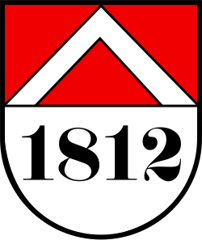
Coat of arms of Les Planchettes
The arms bear the date 1812, the year the parish set itself up as a « corps de commune ». The deed founding the commune was signed on 25 May 1812. The red « triangle » on the shield is not really one: it is formed by two white rafters. The commune explains them by its many forests, which made it the main timber supplier to the region's sawmills. A rafter is indeed a piece of roof framing, the main element of a roof, which carries the tiles.[5]
Founding of Les Planchettes
The territory belonged to the Clos de la Franchise, created in 1372 by Jean II d'Aarberg, and was probably cleared in the 14th century by people from Le Locle, La Sagne and Les Brenets. It consisted of two quarters: the Grand Quartier, to the west, was part of the mairie of Les Brenets. Le Dazenet, to the east, of the mairie of Le Locle and later also of that of Les Brenets. The municipality was created in 1812. There is no known founder or founding act for Les Planchettes.[1]
History of Les Planchettes
1372. The territory is included in the Clos de la Franchise created by Jean II d'Aarberg.[1]
14th century. Probable clearance by people from Le Locle, La Sagne and Les Brenets.[1]
1455. First mention, in the form « Les Planchotes ».[1]
1547. Mention of mills.[1]
17th century. Two guardhouses watch the border, at Moron near the viewpoint and at Le Dazenet, at Les Râpes. The latter was said to be the finest and largest of the Neuchâtel guardhouses. It was crenellated and flanked by a turret.[3]
1702. Creation of the parish and construction of the temple. Marie de Nemours sets up the parish on 12 August.[1][3]
18th century. Barley is grown, with a little oats and wheat. The pastures are used to fatten oxen for the butchers of Geneva and Basel.[1]
1812. Creation of the municipality of Les Planchettes. The principality's government creates it on 25 May.[1][3]
1814-1840. Pastor Daniel-Édouard Reynier turns his manse into an observatory for his weather records. A friend of the astronomer Herschel and the optician Guinand, he corresponds with the Greenwich observatory.[3]
1821. Le Dazenet also comes under the mairie of Les Brenets.[1]
1832. The municipality is entirely attached to the mairie of La Chaux-de-Fonds.[1]
19th century. Thanks to its many forests, Les Planchettes is the main timber supplier of the region's sawmills.[1]
1858. A fine road now links the village to La Chaux-de-Fonds.[3]
1877. Construction of a church.[1]
1953. Commissioning of the Franco-Swiss Le Châtelot hydroelectric dam on the Doubs.[1]
2005. The primary sector provides 53 % of jobs.[1]
Population of Les Planchettes
Sources and references: [1][2]
| 1850 | 430 |
| 1870 | 535 |
| 1900 | 495 |
| 1950 | 313 |
| 2000 | 225 |
| 2025 | 187 (31 December) |
Families of Les Planchettes
Citizen families before 1800. Bersot, Borle, Brandt, Calame, Delachaux-dit-Gay, Delachaux-dit-Peter, Droz, Dubois-dit-Bonclaude, Dubois-dit-Cosandier, Ducommun-dit-Boudry, Ducommun-dit-Tinnon, Guinand, Guyot, Humbert-Droz-dit-Walter, Jeanmaire, Lesquereux, Matthey, Mélanjoie-dit-Savoie, Montandon, Perret-Gentil, Robert, Sandoz-Gendre and Tissot-Daguette, with no precise date. Nearly half bear a compound name, often with "dit".[7]
In the 19th century. The Jacopin and the Ducommun-dit-l'Allemand, along with the Bühler (from Sigriswil BE), the Della-Casa (from Stabio TI), the Grobéty (from Vallorbe VD), the Junod (from Travers NE) and the Perret (from La Sagne NE), with no precise date.[7]
From 1901 to 1962. Ten registrations. The Bel, from France, were registered in 1903, 1935 and 1953, the Kitzinger, also from France, in 1925. They were followed by the Stauffer from Sigriswil BE (1914), the Collaud from Saint-Aubin FR (1931), the Yerly from Treyvaux FR (1932), the Balmer from Mühleberg BE (1933), a second Calame family (1940) and the Blanchut (1956). The last two came from abroad: the Viala from France in 1961 and the Lannoy from Belgium in 1962.[7]
Notable people of Les Planchettes
Moïse Lesquereux and Abraham Ducommun-dit-Verron. In 1702 they built the church around which the new parish took shape. The first did the masonry, the second the timber framing.[5]
Economy of Les Planchettes, past and present
Barley and oxen. The land is a series of ploughed or mown plateaus. In the 18th century barley was the main crop, and the pastures fattened oxen for the butchers of Geneva and Basel. In 2005 the primary sector still provided 53% of jobs.[1][5]
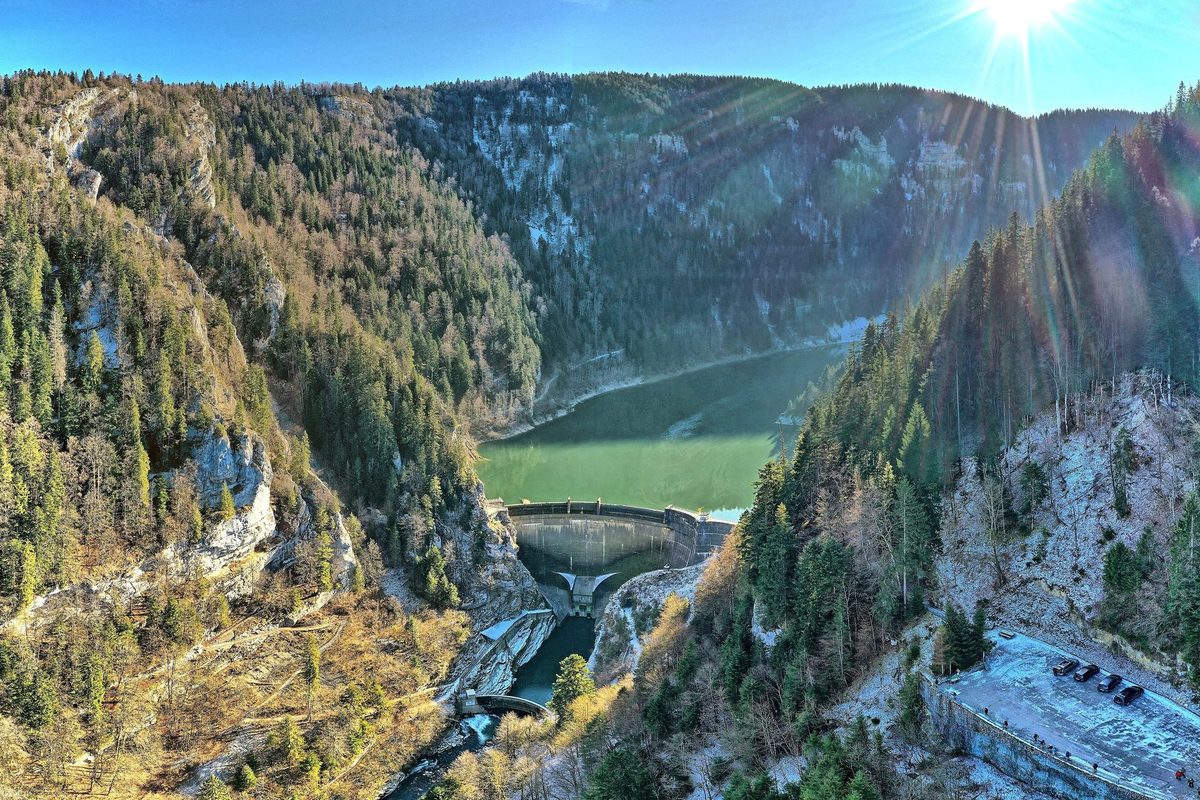
Le Châtelot. After a first agreement between Switzerland and France in 1930, the Confederation granted the concession to the Société des Forces Motrices du Châtelot in 1947, and France in 1954. The 74-metre arch dam holds up to 16 million m³ of water. The Torret power station, in service like the dam since 1953, produces 100 GWh a year on average. As no road could be built, a funicular with gradients sometimes over 100% links it to a station about 1 km from the village. All the heavy building materials were carried up by this funicular.[1][6]
Historic sites in Les Planchettes
Temple. Temple built in 1702, when the parish was created.[1]
Le Châtelot dam. Franco-Swiss hydroelectric dam commissioned in 1953, the largest in the Doubs valley.[1]
The Grand Quartier and Le Dazenet. The two historic quarters of the municipality, which came under the mairie of Les Brenets and that of Le Locle respectively before being attached to La Chaux-de-Fonds in 1832. The ruins of the Dazenet guardhouse can still be seen at Les Râpes, on the path to the old Delachaux mill.[1][3]
Protected heritage in Les Planchettes
Cultural property of regional significance (B objects)[4]
- Temple
Sources
- Dictionnaire historique de la Suisse, « Les Planchettes »
- État de Neuchâtel, arrêté du 4 février 2026 homologuant le recensement cantonal de la population au 31 décembre 2025
- Dictionnaire géographique de la Suisse, tome III (Neuchâtel, Attinger, 1905)
- Federal Office for Civil Protection (FOCP), Swiss Inventory of Cultural Property (PCP), list for the canton of Neuchâtel (as of 1.1.2026)
- Commune of Les Planchettes, « Historique »
- Commune of Les Planchettes, « Le Châtelot »
- Register of Swiss Surnames, 3rd edition (1989), search Commune "Les Planchettes", Canton NE
Published by Sébastien Jörg ·
Localities of the municipality with a page
Other villages near Les Planchettes
Missing information, or do you have a source? Suggest a correction or addition. Every submission is checked before it's published.
Suggest a change