
La Chaux-de-Fonds
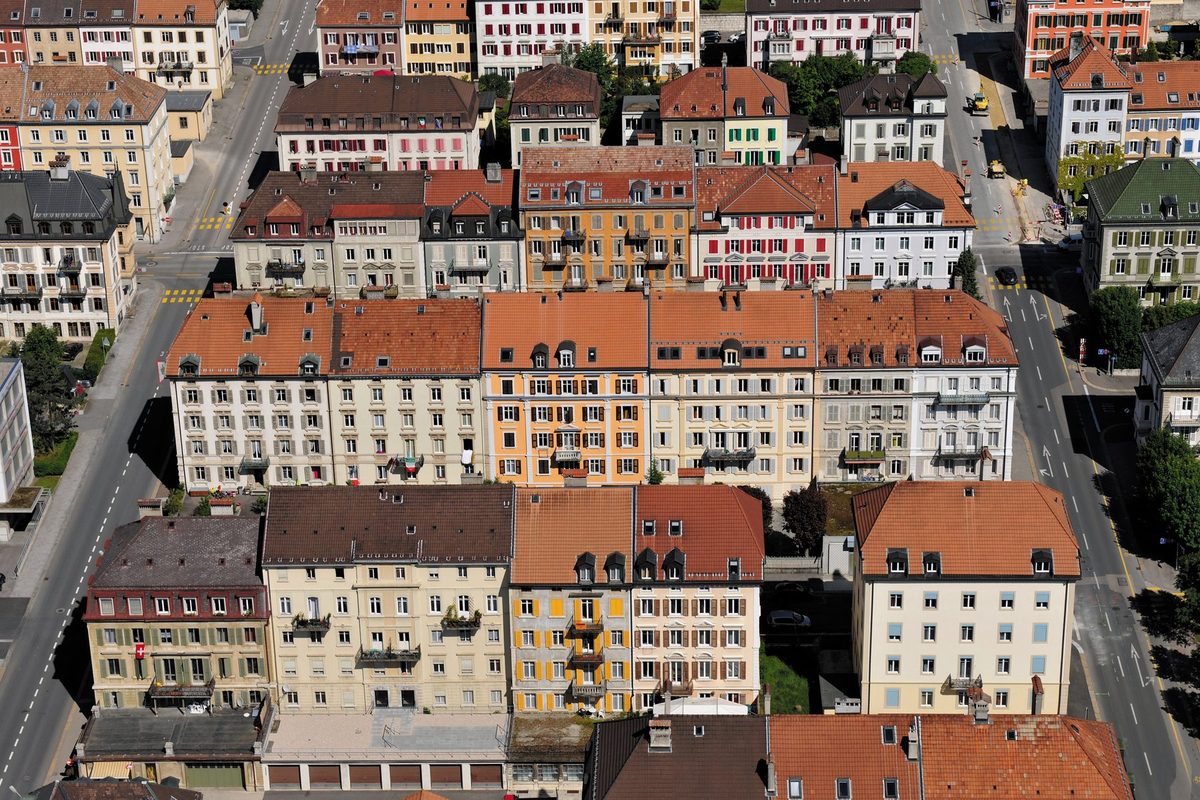
Destroyed by fire in 1794, the village was rebuilt on a grid around watchmaking. Le Corbusier's birthplace became a UNESCO World Heritage site in 2009 together with Le Locle.
Entry based on 20 sources · Our method · Reusable text (CC BY-SA)
Origin of the name La Chaux-de-Fonds
The place appears around 1350 as "la Chaz de Fonz", then in 1378 as "Chault de Font". The exact meaning of the name is not established. "chaux" is often linked to a regional term for a pasture or bare ground on the Jura heights, and "fonds" to a valley floor or a spring, but this reading is still to be confirmed.[1]
Coat of arms of La Chaux-de-Fonds
First, azure three mullets of five points in fess argent. Second, argent a beehive Or flanked by bees of the same. Third, chequy azure and argent, of seven tracts and three. At the top are three white stars on blue, in the middle a yellow beehive with yellow bees on white, at the bottom a blue and white chequerboard. According to the official description, the eleven blue squares stand for the eleven historic quarters of the former municipal district. The shield is topped by the white Swiss cross radiating gold.[16]
Founding of La Chaux-de-Fonds
La Chaux-de-Fonds was not born of a founding act. People from the Val-de-Ruz settled here late, from the middle of the 14th century, on land belonging to the lord of Valangin. In the 15th and 16th centuries a second wave of settlement of the Neuchâtel Jura set out from the "Clos de la Franchise". The village then received a church, consecrated by the bishop of Besançon, and a parish whose boundaries René de Challant fixed. Henri II d'Orléans-Longueville finally made it a separate mairie, an administrative and judicial district whose first mayor was Abraham Robert. Watchmaking, arriving from Geneva in the early 18th century, would turn this mountain village into a large industrial town, especially after its reconstruction.[1]
History of La Chaux-de-Fonds
10'300-9000 BC. Epipalaeolithic occupation of the Grotte du Bichon. A human skull was discovered there in 1956. The so-called "Grotte des boîtiers" has yielded remains from the same period.[1]
mid-14th century. Settlement of the site begins with people from the Val-de-Ruz, on the lands of the lord of Valangin.[1]
around 1350. First known mention of the place, in the form "la Chaz de Fonz".[1]
1372. A charter of franchises is granted to the inhabitants of the valleys of Le Locle and La Sagne. In the 15th and 16th centuries a second wave of settlement of the Neuchâtel mountains sets out from the "Clos de la Franchise".[1]
1528. A first church is built, dedicated to Saint Humbert (perhaps Saint Imier) and consecrated by the bishop of Besançon.[1]
1531. The place has about 35 inhabitants.[1]
1530s. Adoption of the Reformation.[1]
1550. René de Challant fixes the parish boundaries.[1]
2 December 1656. Henri II d'Orléans-Longueville signs the act establishing the mairie of La Chaux-de-Fonds. Abraham Robert becomes its first mayor.[1]
1688. The first communal school opens.[1]
early 18th century. Watchmaking, spreading from Geneva, takes root in the village. Leading figures include Josué Robert, "watchmaker to the king", and Pierre Jaquet-Droz, famous with his family for his automata.[1]
1750. The population reaches 2'363.[1]
night of 4-5 May 1794. An accidental fire destroys 52 buildings, including the temple and the parsonage, leaving more than 170 families homeless but causing no deaths. The engraver Moïse Perret-Gentil gives the impetus for the reconstruction, carried out following a geometric plan.[1][3]
1812. Creation of the commune of Les Planchettes.[1]
1834. Foundation of the Catholic parish.[1]
1835. Town plan by Charles-Henri Junod, organising the town's growth in a grid of parallel streets mixing housing and workshops.[1]
1 March 1848. During the Neuchâtel revolution, a republican column from the mountains led by Fritz Courvoisier marches down on Neuchâtel. La Chaux-de-Fonds then becomes the economic hub of the canton.[1][6]
1850. The population reaches 12'638.[1]
1851. Creation of the municipality, with a General Council of 40 members.[1]
1857. Arrival of the railway.[1]
1865. Foundation of the watchmaking school.[1]
1878. Birth in La Chaux-de-Fonds of Louis Chevrolet (1878-1941), the future car maker.[7]
1887. Arrival of drinking water collected in the Areuse gorges, celebrated in 1888 by the Grande Fontaine. In the same year Charles-Édouard Jeanneret, the future Le Corbusier (1887-1965), is born.[1][11]
1896. Inauguration of the great synagogue.[1]
1905. Charles L'Eplattenier opens the Cours supérieur d'art et de décoration at the art school. His students develop the "Style sapin" there, a local variant of Art Nouveau inspired by the natural surroundings of the region.[11][12]
1900. The commune of Les Eplatures (about 1'500 inhabitants) is incorporated into La Chaux-de-Fonds.[1]
1910. The population reaches 37'751.[1]
1912. Le Corbusier builds the Villa Jeanneret-Perret, known as the "Maison blanche", for his parents.[11]
1912. The Social Democratic party becomes dominant in local politics.[1]
1916-1917. Le Corbusier builds the Villa Schwob, known as the "Villa turque".[11]
1918. The town takes part in the general strike.[1]
1919. The Grand-Temple is destroyed by fire.[1]
1921. The Grand-Temple, destroyed by the fire of 1919, is rebuilt. Date uncertain.
1934. Creation of ORIN, a body intended to diversify the local economy.[1]
1944. Foundation of the Club 44.[1]
1955. Inauguration of the Salle de musique, renowned for its acoustics.[1][13]
1970. The population reaches its historic peak: 42'347.[1]
1974. Opening of the International Museum of Horology.[1]
1975. The watchmaking crisis hits the town hard: in one year it loses more than 1'000 inhabitants and more than 2'000 jobs.[1]
June 2009. "La Chaux-de-Fonds / Le Locle, Watchmaking Town Planning" is inscribed on the UNESCO World Heritage List.[2][15]
Population of La Chaux-de-Fonds
Sources and references: [1][4][5]
| 1531 | 35 (about) |
| 1615 | 355 |
| 1661 | 495 |
| 1715 | 702 |
| 1750 | 2'363 |
| 1775 | 3'234 |
| 1800 | 4'927 |
| 1825 | 5'858 |
| 1850 | 12'638 |
| 1880 | 23'818 |
| 1910 | 37'751 |
| 1930 | 35'252 |
| 1950 | 33'300 |
| 1970 | 42'347 |
| 1990 | 36'894 |
| 2000 | 37'016 |
| 2025 | 37'844 |
Families of La Chaux-de-Fonds
Citizen families before 1800. The Register lists 1'275 citizen families of La Chaux-de-Fonds, 52 of them from before 1800. They include the Robert, Perret-Gentil and Courvoisier families, names that often recur in the town's history. Two old families have a registration date: the de Chambrier family in 1659 and the Tissot-Vougeux family in 1771.[17]
Notable people of La Chaux-de-Fonds
Abraham Robert (1619-1679). A notary and secretary of the Council of State, he was chosen by Governor Jacques d'Estavayer-Molondin as the first mayor of La Chaux-de-Fonds. He left a description of the border of the Montagnes de Valangin.[1]
Charles L'Eplattenier. A teacher at the School of Art, he took part in embellishing the town and in creating the Museum of Fine Arts. The young Charles-Édouard Jeanneret attended his advanced course from 1905.[1][11]
Le Corbusier (La Chaux-de-Fonds 1887 - Roquebrune-Cap-Martin 1965). Born Charles-Édouard Jeanneret, he entered the School of Art in 1902 and worked with Charles L'Eplattenier until 1912. He also taught at the School of Art. In 1917 he settled for good in Paris, and he took French nationality in 1930.[11][1]
Louis Chevrolet (La Chaux-de-Fonds 1878 - Detroit 1941). In 1887 he moved with his father to Beaune, in Burgundy. He went to Canada in 1900 and to the United States in 1901. A racing driver, he founded the Chevrolet Motor Company in 1911 with the financier William Crapo Durant. His Frontenac cars won the Indianapolis 500 in 1920 and 1921.[7]
Paul Pettavel. A pastor, he led the Union chrétienne of La Chaux-de-Fonds.[1]
Charles Naine. He led the Socialist Party, which kept its majority in the town in 1921.[1]
Jules Humbert-Droz. He spoke on 14 November 1918, the last day of the general strike, and then joined the Communist Party.[1]
Economy of La Chaux-de-Fonds, past and present
Livestock. In the Middle Ages and the 16th century people lived mainly from livestock, supplemented by mills on the banks of the Doubs. In the 19th century the town was also the largest farming municipality in the canton. Its farmers still mostly raise livestock.[1]
Fairs and lace. A weekly market and three annual fairs were authorised in 1656. The place was a trading crossroads between Neuchâtel, Franche-Comté and the Prince-Bishopric of Basel. Around the mid-18th century some 500 lacemakers worked in the area. Facing competition from watchmaking, only 300 were left around 1800.[1]
Watchmaking. From the early 18th century watchmaking was organised as établissage: each craftsman made one part of the watch at home. Around 1750 there were 68 clockmakers, 8 cabinetmakers and 4 bronze founders, and clocks were sold at the fairs. In 1870 watchmaking employed 4'505 of the 8'954 working people. In Marx's phrase, the town became « a single watch factory ». At the end of the century scattered production gave way to small mechanised factories.[1]
Crises and diversification. In early 1933 the canton had more than 14'000 unemployed. The ORIN, set up in 1934 with Le Locle, brought in new manufacturing, including radio sets. Before the Second World War these factories employed nearly 500 people and absorbed half of female unemployment. The 1975 crisis hit watchmaking hardest. In 2000 industry provided less than half of all jobs.[1]
Disasters and major events in La Chaux-de-Fonds
The fire of 1794. The fire broke out in today's Rue Fritz-Courvoisier, then called Rue des Juifs. The houses, mostly wooden, stood close together and firefighting means were limited. The village was almost entirely destroyed. Sixteen houses escaped the flames. Neighbouring towns sent help.[3]
The military occupations of the First World War. From 1917 the war and hardship revived tensions. Following antimilitarist demonstrations and rallies in support of the socialist Ernest Paul Graber, the town was occupied by troops twice.[1]
Historic sites in La Chaux-de-Fonds
Watchmaking town planning (UNESCO World Heritage). Rebuilt after the fire of 1794 and then extended according to the plan of Charles-Henri Junod (1835), the town is laid out in parallel strips where housing and workshops are intermingled. Together with Le Locle, it has been on the World Heritage List since June 2009 as an outstanding example of an urban ensemble entirely devoted to watchmaking. Karl Marx referred to it in Capital as a huge "factory-town".[1][2]
International Museum of Horology. Opened in 1974, it traces the development of the technique and art of time measurement.[1]
Le Corbusier's houses. Born in the town in 1887, Charles-Édouard Jeanneret, known as Le Corbusier, built his first works here: Villa Fallet (1906-1907), Villas Stotzer and Jacquemet (1907-1908), Villa Jeanneret-Perret or "Maison blanche" (1912) and Villa Schwob or "Villa turque" (1916-1917).[11]
Grande Fontaine. Monument of 1888 commemorating the arrival in 1887 of drinking water collected in the Areuse gorges, a decisive step for a mountain town with no river.
Grand-Temple. The church was rebuilt after the fire of 1919, in the heart of the old village that the fire of 1794 had destroyed, church and tower included. The present tower reportedly dates from the late 18th century, though this is not certain. It is listed in the federal inventory of cultural property of regional significance.[1][10]
Salle de musique. Opened in 1955, it is renowned for its exceptional acoustics and has hosted a great many recordings.[1][13]
Remains in La Chaux-de-Fonds
Grotte du Bichon. This cave has yielded traces of Epipalaeolithic occupation (10'300-9000 BC) and a human skull discovered in 1956. The so-called "Grotte des boîtiers" has also provided remains from this period. They are the oldest evidence of human presence on the commune's territory.[1]
Tower of the Grand-Temple. It reportedly dates from the late 18th century, after the fire of 1794 that had destroyed the church and its old tower. It would thus be older than the present church, rebuilt after the fire of 1919.
Protected heritage in La Chaux-de-Fonds
Cultural property of national significance (A objects in the PCP inventory)[10]
- Abattoirs
- Ancien Manège (habitation collective ouvrière depuis 1868)
- Ancienne fabrique de bijouterie Bonnet avec bâtiment adjassent et villa
- Ancienne usine Spillmann SA
- Bibliothèque de la Ville de la Chaux-de-Fonds
- Club 44 et Cercle de l'Union
- Collection d'arts industriels (CAI) et les Fonds anciens de l'Ecole d'arts appliqués (EAA) de La Chaux-de-Fonds
- Crématoire et cimetière
- Domaine des Arbres
- Ferme des Brandt
Show the other 17
- Ferme Haute Fie, Maison carrée
- Ferme les Crêtets
- Grande Fontaine
- Immeubles Numaga (133 logements)
- Loge l'Amitié
- Maison Blanche
- Musée des Beaux-Arts
- Musée international d'horlogerie
- Muzoo (Musée d'histoire naturelle)
- Synagogue
- Théâtre et salle de musique
- Usine électrique
- Villa Anatole Schwob
- Villa Fallet
- Villa Gallet avec jardin
- Villa Jaquemet
- Villa Stotzer
Cultural property of regional significance (B objects)[10]
- Ancien Hôpital et anciens Ateliers d'Art Réunis
- Ancienne fabrique Eberhard et Maison de l'Aigle
- Anciens Grand magasin Grosch & Greiff, puis Au Printemps
- Archives de la Ville
- Bibliothèque de la Ville
- Bikini Test, anciens moulins de La Chaux ou Perret-Gentil
- Building 54
- Cinéma La Scala
- Fontaine à la Place du Bois
- Gare
Show the other 10
- Grand-Temple
- Grotte du Bichon, site paléolithique
- Le Bas Monsieur, ferme dite de la Grand'mère Sandoz
- Les Foulets, ferme dite Le David Favre, no 18
- Musée d'histoire
- Musée paysan et artisanal
- Pavillon de musique, parc des Crétêts
- Temple Allemand
- Temple Saint-Jean
- Universo 3, Fabrique des Trois Tours
Traditions and festivals in La Chaux-de-Fonds
The Braderie. It began in 1932, during the Great Depression, when the town had about 8'000 unemployed people out of 40'000 inhabitants. Shopkeepers sold off unsold goods cheaply, and workers could buy for less. Since 1946 it has been held every two years, on the first Sunday of September in odd-numbered years. Renamed Fête de la montre in 1965, it is now called Horlofolies.[18]
Snow sculptures. Snow building competitions have been held in the town since the early 20th century, and those of 1906-1907, 1914-1915 and 1933-1934 are well documented. Revived in 1986, then in 2015 with the Imagineige association, they were added in 2017 to the list of living traditions in Switzerland. Participants shape by hand, without paint or power tools, piles of snow supplied by the town, and the works melt where they stand.[19][20]
Sources
- Dictionnaire historique de la Suisse, « Chaux-de-Fonds, La »
- UNESCO, « La Chaux-de-Fonds / Le Locle, urbanisme horloger »
- RTN, « L'incendie de La Chaux-de-Fonds, 230 ans plus tard » (4 mai 2024)
- Portail statistique du canton de Neuchâtel, « La population en 2025 »
- État de Neuchâtel, arrêté du 4 février 2026 homologuant le recensement cantonal de la population au 31 décembre 2025
- Dictionnaire historique de la Suisse, « Courvoisier, Fritz » (Eric-André Klauser)
- Dictionnaire historique de la Suisse, « Chevrolet, Louis » (Thomas Fuchs)
- La Chaux-de-Fonds, son passé et son présent : notes et souvenirs historiques publiés à l'occasion du centième anniversaire de l'incendie du 5 mai 1794, Imprimerie du National Suisse, 1894 (RERO DOC)
- Office fédéral de la protection de la population, Inventaire PBC, « Fontaine monumentale » (PBC 3965), texte de la Société d'histoire de l'art en Suisse
- Office fédéral de la protection de la population, Inventaire PBC, liste cantonale de Neuchâtel (état au 1.1.2026)
- Museum für Gestaltung Zürich, « Le Corbusier : biographie et œuvre » (2020, d'après Vitra Design Museum)
- Ville de La Chaux-de-Fonds, Réseau Art Nouveau Network, « City of La Chaux-de-Fonds »
- Orchestre de la Suisse Romande, « L'Heure bleue, Salle de musique »
- Musée international d'horlogerie, site officiel
- Ville du Locle, « Unesco »
- IPI, Swissreg, emblems database: coat of arms of La Chaux-de-Fonds (no. 102902)
- Register of Swiss Surnames, 3rd edition (1989), search Commune "La Chaux-de-Fonds", Canton NE
- Republic and Canton of Neuchâtel, Service de la cohésion multiculturelle, fact sheet "Braderie et fête de la montre" ("4 saisons" series)
- Federal Office of Culture, Living Traditions in Switzerland, "Snow sculptures and constructions in La Chaux-de-Fonds"
- lcdf27.ch, "Imagineige, l'ultime édition"
Published by Sébastien Jörg ·
Localities of the municipality with a page
Other villages near La Chaux-de-Fonds
Missing information, or do you have a source? Suggest a correction or addition. Every submission is checked before it's published.
Suggest a change