La Sagne
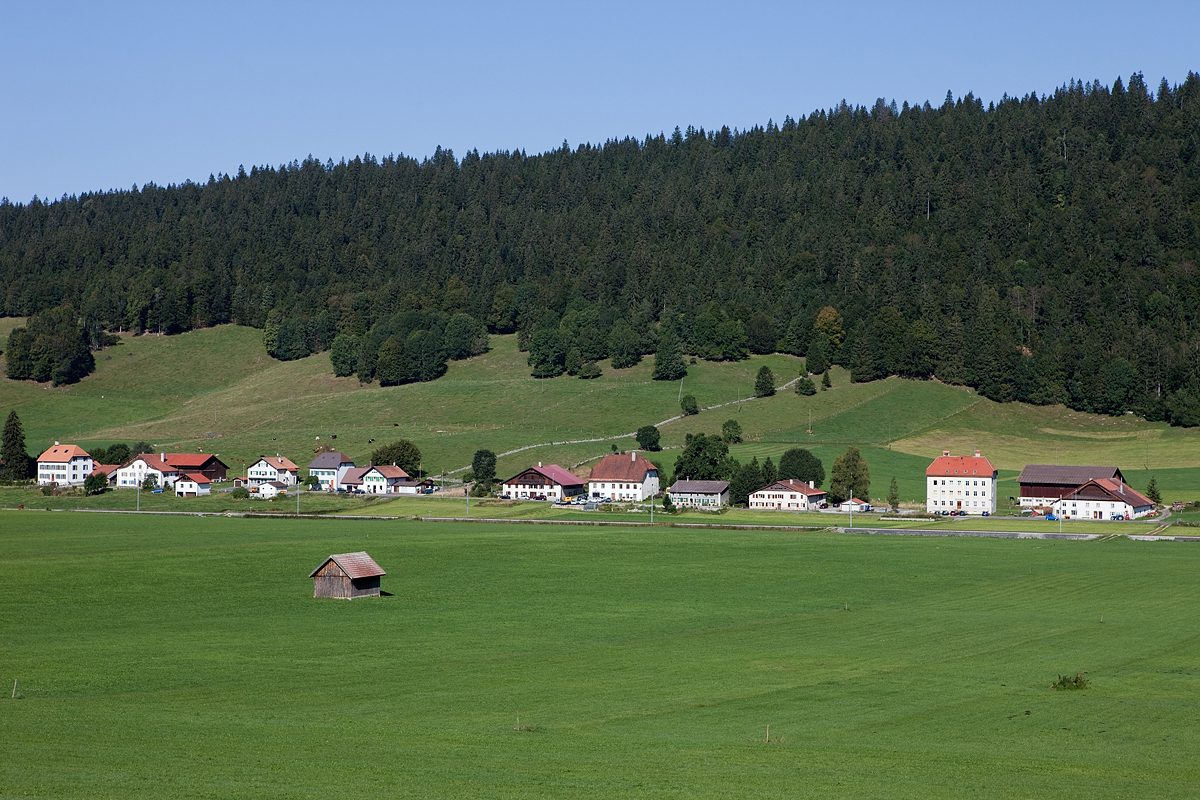
The royalist uprising of 1856 set out from La Sagne, a long street village in the Neuchâtel Mountains first mentioned in 1332.
Entry based on 7 sources · Our method · Reusable text (CC BY-SA)
Origin of the name La Sagne
The name first appears in writing in 1332, in the form « la Sagne ». The regional word « sagne » refers to an area of marshy ground, often worked for peat. It comes from a Gaulish term meaning « marshy ground ». The link with the marshes of the valley is likely but not established.[1][2]
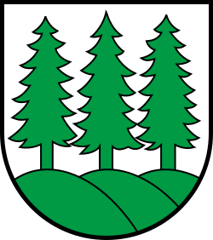
Coat of arms of La Sagne
Argent, three fir trees vert on a mount of three vert. On a white field, three green fir trees grow on three green hills. These arms already appear on the communion cups made for the parish in 1693 by the Neuchâtel goldsmith Pierre Lucas. They have not changed since.[5]
Founding of La Sagne
No founder or founding act is known for La Sagne. Land clearance certainly began in the 11th or 12th century, but La Sagne only appears in 1332, when Jean I d'Aarberg, lord of Valangin, refers to the francs-habergeants of Le Locle and La Sagne. Jean II d'Aarberg later granted them franchises improving their condition and delimited a territory called the Clos de la franchise. From the 14th century La Sagne formed a mairie.[1]
History of La Sagne
11th-12th century. Probable start of land clearance in the valley.[1]
1332. First mention: Jean I d'Aarberg, lord of Valangin, refers to the francs-habergeants of Le Locle and La Sagne.[1]
1351. Mention of a chapel of Saint Catherine, a daughter chapel of Le Locle.[1]
1363. Jean II d'Aarberg grants the inhabitants franchises improving their condition.[1]
1372. New franchises and delimitation of the territory called the Clos de la franchise.[1]
14th century. A first water mill is recorded. La Sagne becomes the seat of a mairie, which lasts until 1848.[1]
1499. Establishment of the parish of La Sagne.[1]
1502. Many families of La Sagne acquire the burghership of Valangin.[1]
1521-1526. Construction of the present church, dated 1521 and 1526.[1]
1659. From this date, new arable land is reclaimed from the marshes.[1]
18th century. The inhabitants work in lacemaking, then in watchmaking.[1]
19th century. Growth of cattle breeding, cheesemaking, the timber trade and peat extraction.[1]
1848. End of the mairie of La Sagne.[1]
1856. The royalist uprising starts from La Sagne.[1]
1880. Founding of a history museum.[1]
1889. Opening of the Les Ponts-de-Martel - La Sagne - La Chaux-de-Fonds railway line.[1]
1950. Electrification of the railway line.[1]
1982. Reopening of the history museum.[1]
2005. The primary sector still provides 32 % of jobs.[1]
Population of La Sagne
Sources and references: [1][3]
| 1750 | 1'195 |
| 1850 | 1'800 |
| 1900 | 1'565 |
| 1950 | 1'057 |
| 2000 | 997 |
| 2025 | 1'089 (31 December) |
Families of La Sagne
Citizen families before 1800. Forty-four families, including the Jean-Richard and Jean-Richard-dit-Bressel families. Only one entry carries a date: the Convert family from Auvernier NE, entered in 1560.[6]
In the 19th century. Berger, Bourquin, Fivaz, Friolet, Grandjean and Jacot, with no precise date, like the Droz-dit-Busset family from Le Locle NE and the Jacot-Guillarmod family from La Ferrière BE. In 1889 four families from Bern arrive: the Botteron from Nods, the Hirschy from Trub, the Sarbach from Adelboden and the Zaugg from Trub. They are followed by the Stauffer from Homberg BE (1890), the Herbelin from France and the Hirschi from Rüschegg BE (1891), the Dumuid from Monnaz VD (1894), the Aellen from Saanen BE and the Bieri from Schangnau BE (1898), and finally the Houriet from Mont-Tramelan BE (1899).[6]
From 1901 to 1962. Fifty-two entries. The canton of Bern supplies eleven, Italy eight, France six, Germany five and the canton of Vaud four. The Klötzl family came from Austria (1953) and the de Founès family from Turkey (1957). A second Hirschy family from Trub BE was entered in 1933. The last entry, in 1961, is the Vieille family from France.[6]
Notable people of La Sagne
Daniel JeanRichard (La Sagne - Le Locle 1741). The son of David, a farmer, he moved back to his father's home in La Sagne between 1688 and 1690. He is recorded there as a master watchmaker in 1692. He moved to Le Locle in 1705 and is regarded as the founder of the Neuchâtel watch industry.[7]
Economy of La Sagne, past and present
The mills. A first water mill was turning at La Sagne in the 14th century. From the 16th to the 19th century there were about half a dozen. A windmill is also mentioned in the early 16th century.[1]
From marsh to cheese dairy. From 1659 new farmland was won from the marshes. In the 18th century people worked at lacemaking, then watchmaking. The 19th century saw livestock farming, cheesemaking, the timber trade and peat cutting grow. La Sagne remains above all agricultural: in 2005 farming and forestry still provided 32% of jobs.[1]
Disasters and major events in La Sagne
The royalist uprising of 1856. After 1848 the people of La Sagne stayed loyal to the Ancien Régime. In 1856 the royalist uprising started from the village.[1]
Historic sites in La Sagne
Church of La Sagne. Church dated 1521 and 1526, built after the parish was established in 1499. It succeeded the chapel of Saint Catherine, a daughter chapel of Le Locle mentioned from 1351.[1]
History museum. Museum founded in 1880 and reopened in 1982.[1]
The street village. Extended street village in the eastern part of the valley of La Sagne and Les Ponts-de-Martel, including Les Cœudres, Le Crêt, Miéville, La Sagne-Église and La Corbatière.[1]
The marshes of the valley. From 1659, new arable land is reclaimed from the marshes. In the 19th century, peat is extracted there.[1]
Protected heritage in La Sagne
Cultural property of national significance (A objects in the PCP inventory)[4]
- Maison double des Maisons Neuves
- Temple
Cultural property of regional significance (B objects)[4]
- Archives communales
- Ferme Convert, Maison du Justicier
- Hôtel de Commune
- Hôtel de la Croix-Blanche
- Les Bressels, ferme
Sources
- Dictionnaire historique de la Suisse, « La Sagne »
- La langue française, « Sagne » (définition et étymologie)
- État de Neuchâtel, arrêté du 4 février 2026 homologuant le recensement cantonal de la population au 31 décembre 2025
- Federal Office for Civil Protection (FOCP), Swiss Inventory of Cultural Property (PCP), list for the canton of Neuchâtel (as of 1.1.2026)
- Olivier Clottu, "Trois armoiries communales neuchâteloises anciennes"
- Register of Swiss Surnames, 3rd edition (1989), search Commune "La Sagne", Canton NE
- Neue Deutsche Biographie, vol. 10 (1974), article "JeanRichard, Daniel" (Deutsche Biographie online)
Published by Sébastien Jörg ·
Localities of the municipality with a page
Other villages near La Sagne
Missing information, or do you have a source? Suggest a correction or addition. Every submission is checked before it's published.
Suggest a change