Les Hauts-Geneveys
For half a century the francs-habergeants of Les Hauts-Geneveys stood up to the lord of Valangin, until Bern imposed a settlement in 1478.
Entry based on 16 sources · Our method · Reusable text (CC BY-SA)
Origin of the name Les Hauts-Geneveys
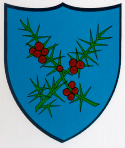
The village appears in 1342 as « Geneveis sus Fontannes », meaning « the Geneveys above Fontaines », the parish to which it belonged. A form « Geneveis » is reportedly also found for 1354. In 1599 comes « Haultz Geneveys », close to the present name: the element « Hauts » (upper) distinguishes it from Les Geneveys-sur-Coffrane, lower down. The origin of the word « Geneveys » is not established. It is seen either as the memory of settlers from Geneva or as a place where junipers (genévriers) grew. The municipal coat of arms, two sprigs of juniper, takes up the second hypothesis without proving it.[1][13]
Founding of Les Hauts-Geneveys
The village appears in 1342 on the lands of the lordship of Valangin, to which it belongs, later the mairie of Valangin. The commune is mentioned from 1402. Its inhabitants, the Geneveysans, enjoyed the status of francs-habergeants. Their dues and services set them against the lord of Valangin, Jean III d'Aarberg, for half a century, until a settlement imposed by Bern in 1478: the community was thus organised enough to defend its rights against its lord. In religious matters the village belonged from the start to the parish of Fontaines. No foundation charter or founder is known.[1]
History of Les Hauts-Geneveys
1342. First known mention of the village, in the form « Geneveis sus Fontannes ».[1]
1402. The commune is mentioned; its inhabitants have the status of francs-habergeants.[1]
1478. Bern settles the half-century conflict between the Geneveysans and the lord of Valangin, Jean III d'Aarberg, over their dues and services.[1]
1531. The village has 27 hearths (households).[1]
1592. The lordship of Valangin, to which the village belongs, is joined to the county of Neuchâtel.[11]
1599. The village is mentioned in the form « Haultz Geneveys ».[1]
1707. Sovereignty over the principality of Neuchâtel is awarded to the King of Prussia.
1750. The village has 146 inhabitants.[1]
1806. The principality of Neuchâtel is ceded by the king of Prussia to Napoleon I, who gives it to Marshal Berthier.[12]
1815. The Federal Pact confirms Neuchâtel's entry into the Confederation as the 21st canton, admitted on 12 September 1814. It remains a principality of the King of Prussia.[12]
1850. The village has 379 inhabitants.[1]
1857. The Treaty of Paris ends Prussian sovereignty over Neuchâtel.[12]
1859-1860. The village becomes a station on the Jura-Industriel line between Neuchâtel and La Chaux-de-Fonds.[1]
1900. The village has 486 inhabitants. Back from Argentina, the economist Silvio Gesell settles here as a farmer and writer, until 1906.[1]
1903. The Val-de-Ruz tramway opens, a regional railway linking Les Hauts-Geneveys to Villiers.[1][10]
1907-1911. Silvio Gesell lives in Argentina again (1906-1911), then in Germany, and returns to Les Hauts-Geneveys from 1914 to 1919. People's Commissioner for Finance of the Bavarian Council Republic in 1919, he is afterwards no longer allowed to return to Switzerland.
1948. The Val-de-Ruz tramway is replaced by a trolleybus.[1][10]
1950. The village has 455 inhabitants.[1]
1961. The village, attached since its origins to the parish of Fontaines, joins that of Fontainemelon.[1]
1975. Start of a population growth that leads to the building of residential districts.[1]
1986. A regional bus line replaces the trolleybus.[1][10]
1994-1995. The access road to the Vue-des-Alpes road tunnel, which passes under the village, is built in 1994. The tunnel (3'250 metres), whose southern portal is at the Les Hauts-Geneveys junction, reportedly opened in 1995.[1]
2000. The village has 983 inhabitants.[1]
2011. The merger agreement of the Val-de-Ruz municipalities is approved in a popular vote, with more than 64 % voting yes.[10]
2012. On 31 December, last census of the independent municipality: 920 inhabitants.
2013. On 1 January Les Hauts-Geneveys merges with fourteen other municipalities of the district to form the municipality of Val-de-Ruz.[1][2][10]
around 2019. The chapel of Les Hauts-Geneveys ceases to be used for regular worship.
2022. Two organ builders, Guillaume Roulet and Johannes Roehrig, and a glass artist, Dominique Brandt, propose turning the chapel into a workshop and concert or lecture hall, at an estimated cost of 250'000 francs.[3]
Population of Les Hauts-Geneveys
Sources and references: [1]
| 1531 | 27 hearths (households) |
| 1750 | 146 |
| 1850 | 379 |
| 1900 | 486 |
| 1950 | 455 |
| 2000 | 983 |
| 2012 | 920 |
Families of Les Hauts-Geneveys
Citizen families before 1800. Andrié, Mojon and Morel, with no precise date.[15]
In the 19th century. The Vuillème, with no precise date. The Martenet were registered in 1861, the Knutti from Diemtigen BE in 1896 and the Stram from Aeschi bei Spiez BE in 1898.[15]
From 1901 to 1962. Twenty-seven registrations, including eleven families from Bern: Polier from Frutigen (1905), Moser from Grossaffoltern (1921), Meyer from Heiligenschwendi (1927), Schneider from Buchholterberg (1928), Isler from Aeschi bei Spiez (1931), Reichen from Frutigen, Schenk from Eggiwil and Thommen from Brienz (1932), Burgdorfer from Vinelz and Widmer from Sumiswald (1933), Luginbühl from Rubigen (1934). In the same year, 1927, another Meyer family, from Ulmiz FR, was registered. Other Swiss families came from Ichertswil SO (Sieber, 1906), Corban JU (Bron, 1911), Tuttwil TG (Kocherhans, 1926), Valeyres-sous-Rances VD (Turin, 1926), Wila ZH (Senn, 1934) and Brenles VD (Corthésy, 1950). Italy was represented by the Luraschi (1926), Sala (1931), Favalli (1942) and Pozzi (1958), France by the Bastide (1907) and Pierre (1953). A second Mojon family, from Austria, was registered in 1941, the Schilling from Germany in 1944 and the Daasvatn from Norway in 1952. The last registration was that of the Pozzi, in 1958.[15]
Economy of Les Hauts-Geneveys, past and present
Grain. The Société d'agriculture du Val-de-Ruz runs a grain collection centre in the village.[1]
Tête-de-Ran. The area includes Tête-de-Ran, a place for tourism and winter sports.[1]
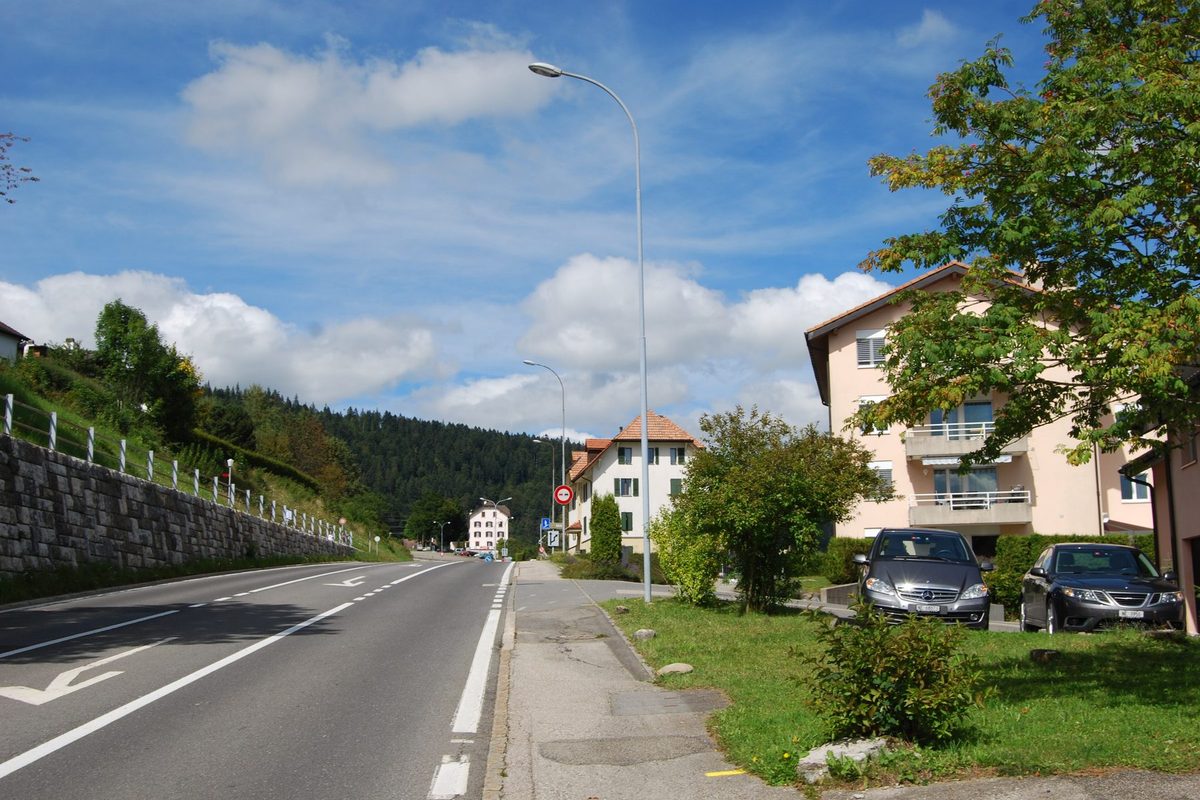
Rail and road. Served by rail since 1859-1860, the village is cut into several districts by the SBB line and the Neuchâtel-La Chaux-de-Fonds road.[1]
Historic sites in Les Hauts-Geneveys
Les Hauts-Geneveys station. A station on the Jura-Industriel line since 1859-1860, Les Hauts-Geneveys station lies on the Neuchâtel-La Chaux-de-Fonds line. The SBB line cuts the village into several districts.[1]
Tête-de-Ran. This summit of the Neuchâtel Jura, rising to 1'422 metres, lay within the former municipal territory of Les Hauts-Geneveys. Together with the nearby Vue-des-Alpes pass, Tête-de-Ran is a place for tourism and winter sports.[1]
The Vue-des-Alpes pass and tunnel. The Vue-des-Alpes pass, a renowned viewpoint over the Plateau and the Alps, lies very close to the village. A 3'250-metre road tunnel, reportedly opened in 1995, runs under the pass. Its access road, built in 1994, passes under the village and its southern portal is at the Les Hauts-Geneveys junction.[1]
Silvio Gesell at Les Hauts-Geneveys. The economist and social reformer Silvio Gesell (1862-1930), author of The Natural Economic Order, lives at Les Hauts-Geneveys as a farmer and writer from 1900 to 1906, then from 1914 to 1919, between stays in Argentina and Germany. People's Commissioner for Finance of the Bavarian Council Republic in 1919, he is afterwards no longer allowed to return to Switzerland.
The former Val-de-Ruz tramway. From 1903 to 1948 a regional railway, the Val-de-Ruz tramway, linked Les Hauts-Geneveys to Villiers. Replaced by a trolleybus in 1948 and then by a regional bus line in 1986, it has disappeared from the landscape.[1][10]
Remains in Les Hauts-Geneveys
The cave in the Vue-des-Alpes tunnel. This large natural cavity was uncovered when the Vue-des-Alpes road tunnel was dug in the 1990s. Invisible from the road, it can only be visited on tours organised from time to time by the Société de développement des Hauts-Geneveys. It is a geological, not an archaeological, feature.[5]
The chapel of Les Hauts-Geneveys. The village has its own chapel, although it belonged to the parish of Fontaines and, from 1961, to that of Fontainemelon. No longer used for regular worship from around 2019, it was the subject in 2022 of a plan to turn it into a workshop and concert or lecture hall. Nobody knows when it was built.[1][3]
Legends of Les Hauts-Geneveys
The Sunday nose. A young man from Les Hauts-Geneveys accused an old woman of putting the devil into a pig, which then had to be slaughtered. She took her revenge. Every Saturday evening the lad's nose began to swell, and it only went down again on Monday morning. He had spent each week waiting to see his sweetheart on Sunday, and now had to give up evening gatherings and dances, while the village girls pointed at him.[14]
Traditions and festivals in Les Hauts-Geneveys
The Gollières hut. The Société de développement des Hauts-Geneveys runs activities at the Gollières hut. It holds a night market there, whose 16th edition took place on 4 June 2026, and also celebrates St Nicholas there.[16]
Sources
- Dictionnaire historique de la Suisse, « Les Hauts-Geneveys »
- La commune en bref - Val-de-Ruz (site officiel)
- Un second souffle pour la chapelle des Hauts-Geneveys - RTN
- Chapelle des Hauts-Geneveys - Paroisse Val-de-Ruz (EREN)
- Visite de la grotte de La Vue-des-Alpes - Société de développement des Hauts-Geneveys
- Dans les entrailles du tunnel sous La Vue-des-Alpes, une vaste grotte invisible des automobilistes - ArcInfo
- État de Neuchâtel, arrêté du 6 février 2013 portant homologation des résultats du recensement cantonal de la population du 31 décembre 2012
- État de Neuchâtel, arrêté du 4 février 2026 homologuant le recensement cantonal de la population au 31 décembre 2025
- Dictionnaire historique de la Suisse, « Gesell, Silvio » (Ruedi Brassel-Moser, remanié le 07.11.2005)
- Dictionnaire historique de la Suisse, « Val-de-Ruz (vallée) » (Maurice Evard, remanié le 05.02.2014)
- Dictionnaire historique de la Suisse, « Valangin (seigneurie) » (Maurice Evard, 05.03.2014)
- Ville de Neuchâtel, « Repères historiques »
- Chemins des Chouettes du Val-de-Ruz, panneau « Villages vaudruziens : blasons, noms, surnoms »
- J.-H. Bonhôte, « Superstitions neuchâteloises », Musée neuchâtelois, 1865, p. 21
- Register of Swiss Surnames, 3rd edition (1989), search Commune "Les Hauts-Geneveys", Canton NE
- Société de développement des Hauts-Geneveys, "Activités année en cours" (2026 programme)
Published by Sébastien Jörg ·
Other villages near Les Hauts-Geneveys
Missing information, or do you have a source? Suggest a correction or addition. Every submission is checked before it's published.
Suggest a change