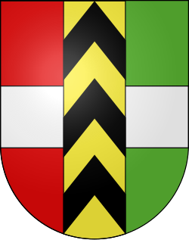
Fontainemelon
In 1793 Fontainemelon gained an ébauche factory described as the oldest in Switzerland. By 1815 more than half the village worked in watchmaking.
Entry based on 14 sources · Our method · Reusable text (CC BY-SA)
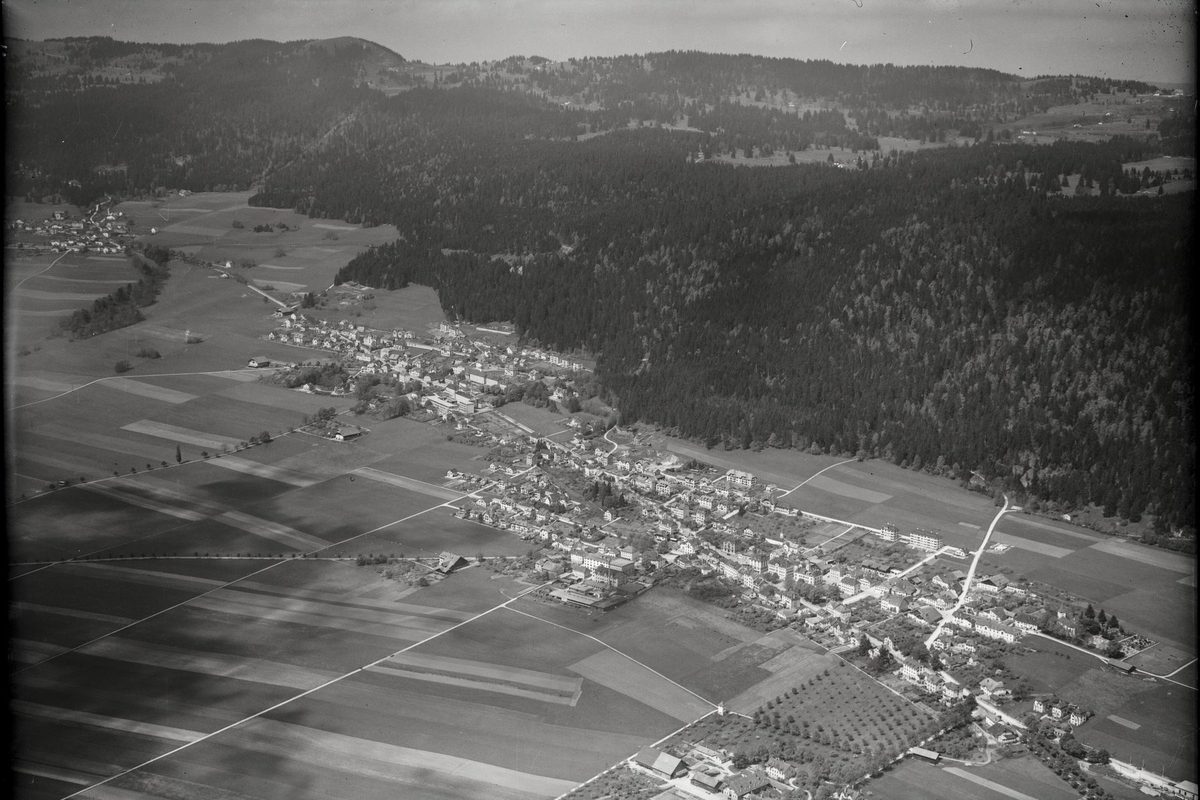
Origin of the name Fontainemelon
The name is recorded around 1350 as « Fontainnemelom » and in 1358 as « Fontannamillon ». The first element is said to refer to the word fontaine (spring, fountain), for the many small springs of a territory with no watercourse. The second element remains unexplained. The idea of a corruption of « mille fontaines » (a thousand springs) is an isolated hypothesis and not established.[1][2]
Founding of Fontainemelon
Like most villages of the Val-de-Ruz, Fontainemelon has no known founder: it is a rural settlement that grew out of medieval land clearing. In 1358, Jean d'Aarberg, lord of Valangin, granted cleared land at Fontainemelon against a quitrent. The village belonged to the lordship, then to the mairie of Valangin, and became a municipality in 1860. Its transformation dates from October 1793, when the brothers Isaac and David Benguerel dit Perroud, together with Julien and François Humbert-Droz, founded the Benguerel & Humbert watch manufactory there, a movement blank (ébauche) factory described as the oldest in Switzerland. By 1815, more than half of the population worked in watchmaking.[1][2][3][4][5][6]
History of Fontainemelon
around 1350. First known written mention of the place, in the form Fontainnemelom.[1]
1358. The name appears as « Fontannamillon ». The same year, Jean d'Aarberg, lord of Valangin, grants cleared land at Fontainemelon against a quitrent.[1][5]
1592. The lordship of Valangin, to which Fontainemelon belongs, is joined to the county of Neuchâtel.[12]
October 1793. Founding of the Benguerel & Humbert watch manufactory by Isaac and David Benguerel dit Perroud and by Julien and François Humbert-Droz. It is described as the first movement blank factory in Switzerland.[2][3][4][5][6]
1797. The company employs around 120 workers, possibly up to 200, a good many of whom still work from home under the établissage (outwork) system.[2][3]
1812. Departure of the Benguerel brothers. The company becomes Humbert Frères.[2]
1815. More than half of the village population works in watchmaking.[1]
1816. Construction of the factory's first building, with a turret and a bell that struck the hours. Dates vary between 1816 and 1826.[2][5]
1821. Jacob Robert-Tissot, who married Mélanie Humbert-Droz, daughter of one of the founders, joins the company.[3]
1 January 1825. The factory is taken over by the Robert family and reorganised as Robert & Cie. It then produces 60'000 pieces with 160 workers.[1][2][5]
1838. Robert & Cie buys the Eguet Frères factory in Corgémont in order to benefit from the hydraulic power of the Suze river.[2][5]
1852. Founding of a consumer cooperative.[1]
1860. Fontainemelon becomes a municipality. The same year, Louis Favre builds the Les Loges railway tunnel, whose southern opening lies in Fontainemelon.[1]
1862. Introduction of steam power in the workshops.[2][5]
1876. Transformation into a joint-stock company under the name Fabrique d'Horlogerie de Fontainemelon SA (FHF). The company then employs 400 workers and produces 240'000 ébauches per year, figures that may also date from 1881.[1][2][3][4][5]
around 1900. Under the impetus of Paul Robert, the factory introduces mass production methods inspired by American factories.[2]
April 1900. The architect Eugène Prince presents the plans for the village's future temple, whose building, parsonage and cemetery are donated to the municipality by the Robert family, the site being chosen by the municipal council.[8]
1900. Fontainemelon, previously part of the parish of Fontaines-Cernier and from 1875 of that of Cernier, becomes an independent parish.[1]
6 July 1902. Consecration of the church of Fontainemelon, whose tower is neo-Romanesque. The parsonage dates from the same year.[1][8]
1903. The village is served by the Val-de-Ruz tramway, replaced by the trolleybus in 1948 and then by buses in 1986.[1]
1913. Production of one million movement blanks by 1'030 workers.[3][4]
1925. Merger with the Charles Hahn & Cie house of Le Landeron, which becomes a branch of the FHF.
27 December 1926. The FHF joins with A. Schild SA and Adolphe Michel SA, both of Granges, to found the holding company Ébauches SA in Neuchâtel.[2][3][4][11]
1931. Ébauches SA joins the umbrella group ASUAG (Allgemeine Gesellschaft der Schweizerischen Uhrenindustrie AG).[11]
1940. Production of two million movement blanks by 1'100 workers.
1958. The village begins to spread over the former agricultural zone, with areas of apartment blocks and villas.[1]
1962. Production of six million movement blanks by 1'175 workers.
1968-1969. Ébauches SA has 23 subsidiaries in Switzerland, 3 abroad and 10'000 employees.[11]
1974. Ébauches SA holds around 25% of the world market for mechanical movements.[11]
1979. The FHF develops the « mini quartz » movement.[2]
1978-1985. Progressive restructuring of the Swiss watchmaking industry, marked by the quartz crisis: the activities of Ébauches SA and the FHF are combined within ETA SA Fabrique d'Ébauches.[4][11]
1983. Ébauches SA and ASUAG merge with SSIH to form Asuag-SSIH, which takes the name SMH, Société suisse de microélectronique et d'horlogerie, in 1985.[4][11]
1984. The Fontainemelon factory is taken over by ETA SA.[1]
1985. Complete dissolution of Ébauches SA into SMH. Fontainemelon's activities are definitively integrated into ETA SA, which becomes the group's sole movement production entity.[2][4][7]
1994. Opening of the Vue-des-Alpes road tunnel, whose southern portal lies in Fontainemelon.[1]
1995. A fire destroys the south wing of the ETA production centre in Fontainemelon.[2]
1997. Inauguration of a new production building on the site, following reconstruction after the 1995 fire.
1998. SMH is renamed Swatch Group.[4]
2003. ETA SA Fabrique d'Ébauches is renamed ETA Manufacture Horlogère Suisse SA, still within the Swatch Group.[4]
1 January 2013. Fontainemelon merges with Boudevilliers, Cernier, Chézard-Saint-Martin, Coffrane, Dombresson, Engollon, Fenin-Vilars-Saules, Fontaines, Les Geneveys-sur-Coffrane, Les Hauts-Geneveys, Montmollin, Le Pâquier, Savagnier and Villiers to form the new municipality of Val-de-Ruz. Fontainemelon loses its status as an independent municipality and becomes a locality of Val-de-Ruz.[1][9]
Population of Fontainemelon
Sources and references: [1]
| 1531 | 14 hearths (households) |
| 1750 | 62 |
| 1850 | 490 |
| 1900 | 794 |
| 1950 | 973 |
| 1990 | 1'481 |
| 2000 | 1'605 |
| 2012 | 1'633 |
Families of Fontainemelon
Robert. Jacob Robert-Tissot, whom the factory's history calls its "true founder", marries Mélanie, daughter of Julien Humbert-Droz, head of Humbert frères. He brings in his nephews Henri and Auguste Robert, who are given power of attorney in 1846. Later the Robert name returns to the company name with Auguste-Charles and Paul Robert. Maurice, son of Auguste-Charles, joins the factory's management in 1922.[5]
Citizen families before 1800. Only two families, the Benguerel-dit-Jacot and the Benguerel-dit-Perroud, with no precise date.[14]
In the 19th century. The Armand, Couleru, Drescher, Dreyfuss, Favre, Hahn, Kraft, Lévy, Picard, Wehrlé, Weill and Wilhelm, as well as the Meyer (from Laufen BE) and the Robert-Tissot (from La Chaux-de-Fonds NE) are registered with no precise date. From 1880 to 1885 eleven families arrive, four of them from Germany and five with no stated origin. The dated list begins with the Waldner in 1880, the Bertin and the Weber in 1881, the Mattlé (from Austria) in 1882, the Muffang in 1883 and the Becker (from Germany), the Bihler (from Germany) and the Huttenlocher in 1884. Then come the Anslinger (from Germany), the Mannwiller (from Germany) and the Stempfel (from France) in 1885, the Bueche (from Court BE) and the Kocher (from Aegerten BE) in 1889, the Schrack (from Wahlern BE) in 1891, the Vogt (from Grenchen SO) in 1892 and the Keller (from Oberthal BE) and the Wittwer (from Ausserbirrmoos BE) in 1893. Next the Abplanalp (from Meiringen BE), the Fesselet (from France) and the Henzi (from Meinisberg BE) in 1894 and the Ruschetta (from Italy) in 1896. The last entry, in 1900, concerns the Hohenauer (from Austria).[14]
Show more families (1)
From 1901 to 1962. Fifty-one families, twenty-seven of them from Bern. Aargau and Vaud provide four each. Two families from Poland close the list, in 1958 and 1959.[14]
Economy of Fontainemelon, past and present
From fields to workbench. Before watchmaking Fontainemelon was a farming settlement, born of the ten cleared plots that the lord of Valangin granted in 1358. The first ébauche makers still worked largely at home. An inventory of 1797 lists about 200 workers, more than half of them working at home and paid by the piece. Sales were mostly for cash: every Saturday a partner drove a cart to La Chaux-de-Fonds to sell the ébauches.[5]
The big factory. The « grande fabrique », built in 1827, employed up to 400 workers. In 1893 the firm bought a modern machine shop at the World's Fair in Chicago. Five years later 800 workers turned out 870'000 movements.[5]
Housing and welfare. From 1814 three buildings in the village held flats. The factory later backed the building of workers' houses, one of the oldest consumer cooperatives in Switzerland and a local savings bank. It also funded a sickness and death benefit fund, a free private hospital, a crèche and a pension fund.[5]
Watchmaking crises. The village depended on the factory and felt its slumps. Crises struck in 1862, 1892 and 1898. The union founded in 1887 collapsed in 1891 during a watchmaking crisis, and another followed in 1909. After 1914 and again after 1939, unemployment, falling prices and loss-making years returned.[5]
Disasters and major events in Fontainemelon
The ETA factory fire of 1995. On the morning of 5 September 1995 an explosion occurred in the ébauche transfer workshop of the ETA factory. The fire destroyed half of the west wing. Around a hundred firefighters were deployed and five people were slightly injured. A hundred and seventy employees were put on short-time work.[13]
Historic sites in Fontainemelon
The Temple of Fontainemelon. Built between 1900 and 1902 to the plans of the architect Eugène Prince, this temple, whose tower is neo-Romanesque, owes its existence to the population growth linked to the industrial boom: until then, inhabitants had to travel to Cernier for religious services. The temple, the parsonage and the adjoining cemetery were donated to the municipality by the Robert family, then at the head of the ébauche factory. The building, consecrated on 6 July 1902, has a central nave with a gable roof flanked by a bell tower offset to the north, as well as two rose windows with heraldic stained glass.[8]
The industrial site of the ébauche factory. Around the factory founded in 1793 grew an entire industrial district: workshops, administrative buildings and workers' housing, which shaped the village's urban fabric from the 19th century onward. Occupied successively by Robert & Cie, the Fabrique d'Horlogerie de Fontainemelon SA (FHF), Ébauches SA and then ETA SA of the Swatch group, the site remains today an active watchmaking production center, making it one of the rare Swiss examples of nearly uninterrupted industrial continuity since the end of the 18th century.[1][2]
The hamlet of Les Loges. A small hamlet and alpine pasture on the heights above the village, at 1'230 metres, part of which belonged to the municipal territory of Fontainemelon. Its name is said to come from loge, a term for a shelter for livestock and herders during summer grazing.
Remains in Fontainemelon
The factory's turret and bell (1816). The factory's first building was topped by a turret with a bell that struck the hours, long a symbol of the company and the village. Nobody knows when it disappeared. Its construction is dated to 1816, sometimes to 1826.[2][5]
Traces of the 1995 fire and its reconstruction. In 1995 a fire destroyed the south wing of the ETA production centre in Fontainemelon. A new building was inaugurated there in 1997, on an industrial site in use since 1793.[2]
Sources
- Dictionnaire historique de la Suisse (HLS), article Fontainemelon
- Grail Watch, How Tiny Fontainemelon Dominated Swiss Watchmaking in the 19th Century
- Vintage Watch Straps, Fabrique d'Horlogerie Fontainemelon (FHF)
- Dictionnaire du Jura, ETA SA Manufacture Horlogère Suisse
- Société d'histoire de Montmollin, La fabrique de Fontainemelon, 157 ans d'existence (PDF)
- Gold'Or, La Fabrique d'Horlogerie de Fontainemelon a 225 ans
- ETA SA, page Entreprise / Histoire
- Paroisse réformée Val-de-Ruz, Temple de Fontainemelon
- Commune de Val-de-Ruz, La commune en bref
- État de Neuchâtel, arrêté du 6 février 2013 portant homologation des résultats du recensement cantonal de la population du 31 décembre 2012
- Dictionnaire historique de la Suisse, « Ebauches » (German Vogt, version du 02.07.2009)
- Dictionnaire historique de la Suisse, « Valangin (seigneurie) » (Maurice Evard, version du 05.03.2014)
- L'Express (Neuchâtel), 6 September 1995, p. 15, « Une usine en enfer »
- Register of Swiss Surnames, 3rd edition (1989), search Commune "Fontainemelon", Canton NE
Published by Sébastien Jörg ·
Other villages near Fontainemelon
Missing information, or do you have a source? Suggest a correction or addition. Every submission is checked before it's published.
Suggest a change