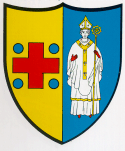
Chézard-Saint-Martin
Born in Chézard-Saint-Martin, Ami Girard led some 200 volunteers from the Erguël on 1 March 1848 in the expedition that overthrew the monarchy in Neuchâtel.
Entry based on 10 sources · Our method · Reusable text (CC BY-SA)
Origin of the name Chézard-Saint-Martin
The name joins two place names. Saint-Martin, recorded in 998 as « Sancto Martino », comes from the patron of the church, Saint Martin of Tours. The two Chézards appear later: Petit-Chézard in 1143 as « Esser », Grand-Chézard in 1285 as « Chesas ». Like Chesalles, Chézard is said to derive from the Late Latin « casale », a rural estate or group of farm buildings, though this is not established.[1][4]
Founding of Chézard-Saint-Martin
A 2nd-century Roman villa attests early occupation of the area. The church of Saint-Martin, already a parish church by the end of the 10th century, depended on the priory of Bevaix. Three villages, Saint-Martin, Grand-Chézard and Petit-Chézard, formed the municipality and jointly regulated the use and upkeep of forests and pastures, bake ovens, roads and fountains. In the early 14th century the prior of Môtiers held court at Chézard two years out of three. The Pertuis pass links the Erguël to Neuchâtel across the territory. Chézard-Saint-Martin has no known founder.[1]
History of Chézard-Saint-Martin
2nd century. A Roman villa is built in the area. It will be discovered in 1870.[1]
998. First mention of Saint-Martin, in the form « Sancto Martino »: the church is already a parish church and depends on the priory of Bevaix.[1][3]
1143. First mention of Petit-Chézard, in the form « Esser ».[1]
1285. First mention of Grand-Chézard, in the form « Chesas ».[1]
early 14th century. The prior of Môtiers holds court at Chézard two years out of three.[1]
15th-16th century. A rectangular choir is built onto the church of Saint-Martin.[3]
1531. The three villages jointly regulate the use of forests and pastures. Chézard-Saint-Martin then has 28 hearths.[1]
1629. The three villages jointly regulate bake ovens and roads.[1]
1633. The baptismal font of the temple is carved.[3]
1681. Construction of the present bell tower, dated by an inscription on its south front.[3]
1684. Rebuilding of the church of Saint-Martin: the medieval choir is demolished and the nave enlarged.[1][3]
1693. A stained-glass window with the arms of the burghers of Valangin adorns the temple. It is now kept at the Musée d'art et d'histoire de Neuchâtel.[3]
1715. Jean Labran introduces calico (indienne) printing.[1]
18th century. Bernese farmers settle on the heights.[1]
1753. Grand-Chézard is detached from the parish of Fontaines-Cernier.[1]
1755. A stair rail leading to the temple gallery is installed.[3]
1782. The three villages jointly regulate the use and upkeep of the fountains.[1]
1819-1900. Life of Ami Girard, born in Chézard-Saint-Martin: on 1 March 1848 he leads some 200 volunteers from the Erguël in the expedition that overthrows the monarchy in Neuchâtel, and later sits on the Council of State and the National Council.[9]
around 1895. A watch factory works with the village's small watchmaking workshops.[1]
1922-1924. Land consolidation, after a first half of the 20th century marked by stagnation.[1]
1926-1957. Henri-Wilhelm Jacot is reportedly municipal administrator during these years.
1956. Chézard-Saint-Martin gradually becomes a residential locality, with a few apartment blocks, many detached houses and some small businesses.[1]
1970-1976. Stained glass by Paul Duckert, of the Taizé workshop, is installed in the temple.[3]
1998. Publication of the book « Chézard-Saint-Martin » by Maurice Evard, for the millennium of the first mention of Saint-Martin.[5]
21 March 2011. The fifteen Val-de-Ruz municipalities reportedly sign their merger agreement on this day.
1 January 2013. Chézard-Saint-Martin merges with Boudevilliers, Cernier, Coffrane, Dombresson, Engollon, Fenin-Vilars-Saules, Fontainemelon, Fontaines, Le Pâquier, Les Geneveys-sur-Coffrane, Les Hauts-Geneveys, Montmollin, Savagnier and Villiers to form the municipality of Val-de-Ruz.[1][7]
Population of Chézard-Saint-Martin
Sources and references: [1]
| 1531 | 28 hearths (households) |
| 1850 | 777 |
| 1900 | 1'061 |
| 1941 | 920 |
| 1950 | 974 |
| 2000 | 1'601 |
| 2012 | 1'820 |
Families of Chézard-Saint-Martin
Burgher families before 1800. Berthoud-dit-Gallon, Chollet, Evard, Favre, Girard, Mauley, Quinche and Tripet, with no precise date.[10]
In the 19th century. The Salquin family, with no precise date. The Haller family, from Germany, is registered first, in 1865, then the Labram family, also from Germany, in 1874 and the Debrot family (from Brot-Dessous NE) in 1875. In 1888 come the Brand (from Lauenen BE) and Gautschi (from Gontenschwil AG) families, in 1889 the Bachmann (from Brenzikofen BE), and in 1890 the Cand (from Rances VD), Felder (from Ruswil LU) and Terraz (from France) families. Then follow the Blumer (from Engi GL) in 1893, the Linder (from Reichenbach im Kandertal BE) in 1894, the Kaufmann (from Grindelwald BE) in 1895, the Gex (from Daillens VD) and Hurni (from Gurbrü BE) in 1896, the Mattenberger (from Birr AG) in 1897 and the Schär (from Walterswil BE) in 1900.[10]
From 1901 to 1962. Twenty-eight entries, half of them Bernese families: Tanner (Lützelflüh, 1903), Ellenberger (Landiswil) and Tüscher (Kallnach) in 1906, Jaggi (Orpund, 1919), Hänni (Reichenbach im Kandertal, 1922), Mora (Kirchenthurnen, 1923), Meyer (Heiligenschwendi, 1925), Aeschlimann (Langnau im Emmental) and Gafner (Beatenberg) in 1926, Christen (Langnau im Emmental, 1927), Jaquet (Nods, 1929), Hoffmann (Saint-Imier, 1930), Colin (Lamboing, 1957) and Klatt (Walterswil, 1960). The Solca (from Coldrerio TI) arrive in 1906, the Aubelay (from Crissier VD) in 1911, the Blum (from Beggingen SH) and Javet (from Vully-le-Bas FR) in 1916, the Corti (from Agno TI) in 1919, the Bornand (from Sainte-Croix VD) in 1925, the Nater (from Engishofen TG) in 1926 and the Jost (from Gunzwil LU) in 1927. The Weinmann (1912) and Feltz (1918) families come from Germany, the Sigalini (1924), Beltrami (1936) and Siliprandi (1959) from Italy. The last family registered, in 1961, is the Binninger family from France.[10]
Notable people of Chézard-Saint-Martin
Ami Girard (Chézard-Saint-Martin 1819 - Renan 1900). A burgher of the village, son of Marie Mauley and of a captain and innkeeper in Renan whose inn welcomed the Neuchâtel exiles of 1831. After commercial studies in Lörrach and Biel, he sat in the constituent assembly of 1848 and the Grand Council (1848-1854), then served as prefect of La Chaux-de-Fonds (1851-1852) and state councillor (1852-1853). A national councillor from 1860 to 1869, he became a colonel in 1867.[9]
Economy of Chézard-Saint-Martin, past and present
Grain and cattle. Grain was grown on the valley floor. The uplands were used for livestock, and Bernese farmers settled there in the 18th century. From the 14th century the three villages jointly managed the use and upkeep of forests and pastures.[1]
Calico and watchmaking. Calico printing, the printing of cotton cloth, arrived with Jean Labran in 1715. Around 1895 a watch factory worked with the village's small watchmaking workshops.[1]
Towards a residential village. The first half of the 20th century was a period of stagnation, marked by the land consolidation of 1922-1924. From 1956 Chézard-Saint-Martin gradually became a place to live, with many detached houses, a few blocks of flats and some small trades. The villages spread over farmland while agriculture became mechanised.[1][6]
Historic sites in Chézard-Saint-Martin
The temple of Saint-Martin. A parish church since 998, it keeps Romanesque masonry in places. Its rectangular 15th-16th-century choir was demolished in 1684 when the nave was enlarged. The bell tower dates from 1681 and the baptismal font from 1633. The 1693 window with the arms of the burghers of Valangin is kept at the Musée d'art et d'histoire de Neuchâtel. The windows received stained glass by Paul Duckert in 1970-1976.[1][3]
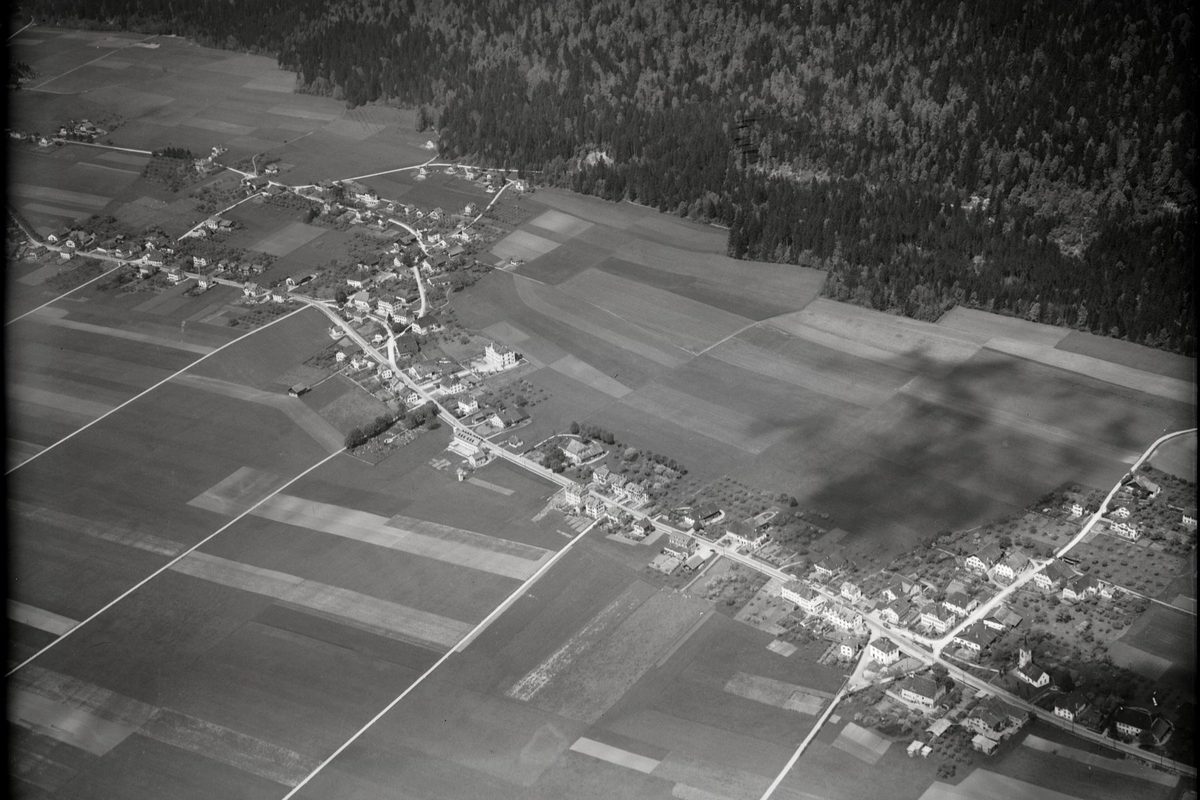
The village of Saint-Martin. A former street village, Saint-Martin keeps a linear layout that is still legible despite the apartment blocks built in the 20th century, which brought it closer to Cernier and Fontainemelon.[6]
Rue Jean-Labran. The main street is named after Jean Labran, who introduced calico printing in 1715. Two farmhouses, at numbers 4 and 6, are listed as cultural property of national importance.[1][8]
The Pertuis pass. This pass links the Erguël, in the Bernese Jura, to Neuchâtel. Bernese farmers settled on the heights from the 18th century.[1]
Remains in Chézard-Saint-Martin
The Roman villa. A 2nd-century Roman villa was discovered in 1870 in the territory of the former municipality.[1]
The Romanesque masonry of the temple. Romanesque masonry survives in the oldest part of the temple of Saint-Martin, heavily altered in 1681-1684.[3]
Protected heritage in Chézard-Saint-Martin
Cultural property of national significance (A objects in the PCP inventory)[8]
- Ferme
Sources
- Dictionnaire historique de la Suisse, « Chézard-Saint-Martin » (Maurice Evard), version allemande
- État de Neuchâtel, arrêté du 6 février 2013 portant homologation des résultats du recensement cantonal de la population du 31 décembre 2012
- Église réformée évangélique neuchâteloise (EREN), paroisse Val-de-Ruz, « Temple de Saint-Martin »
- Chemins des Chouettes du Val-de-Ruz, panneau « Villages vaudruziens : blasons, noms, surnoms »
- Éditions de la Chatière, fiche du livre « Chézard-Saint-Martin » de Maurice Evard (1998)
- Parc régional Chasseral, « Chézard-Saint-Martin : entre tradition rurale et développement »
- Commune de Val-de-Ruz, « La commune en bref »
- Office fédéral de la protection de la population, Inventaire suisse des biens culturels d'importance nationale et régionale (PBC), liste du canton de Neuchâtel (état au 1.1.2026)
- Dictionnaire historique de la Suisse, « Girard, Ami » (Eric-André Klauser, version du 21.11.2005)
- Register of Swiss Surnames, 3rd edition (1989), search Commune "Chézard-Saint-Martin", Canton NE
Published by Sébastien Jörg ·
Other villages near Chézard-Saint-Martin
Missing information, or do you have a source? Suggest a correction or addition. Every submission is checked before it's published.
Suggest a change