Cernier
A farming village until around 1870, Cernier became the seat of the Val-de-Ruz district in 1877, with prefecture, court and agricultural school. Today it is the main town of the municipality of Val-de-Ruz.
Entry based on 24 sources · Our method · Reusable text (CC BY-SA)
Origin of the name Cernier
The name appears in 1324 as « Cernies ». For « Cernier », no etymology is certain. It is sometimes linked to the Jura term « cernil », a plot enclosed by hedges or dry-stone walls. Another hypothesis points to a personal name « Cernius » or to the Latin « circinare », to encircle. Neither is confirmed, but both point to the idea of a bounded agricultural area.[1][11]
Founding of Cernier
Neither a founder nor a founding date is known: Cernier grew gradually in the Middle Ages from the agricultural clearing of the Val-de-Ruz. The count of Valangin reportedly had the land cleared in the 14th century. The village then belonged to the lordship of Valangin, later to the Mairie of the same name. Its territory extends over the plain (750-800 m) and the mountain, with the hamlet of Montagne de Cernier (1'190 m). Agricultural until around 1870, Cernier then developed with the trade in fabrics and furniture, the furniture factory and the regional institutions (prefecture, court, agricultural school) that made it the centre of the Val-de-Ruz.[1]
History of Cernier
1324. First written mention of the village as « Cernies ». Cernier then belongs to the lordship of Valangin.[1]
14th century. The count of Valangin reportedly had the communal land cleared so that its population could farm it.
early 16th century. Reconstruction, probably at this time, of the polygonal choir with star vaults of the Cernier temple, which replaces the former rectangular choir.
1531. The village has 29 hearths (households), the first known population figure.[1]
around 1535. The church of Cernier (later Notre-Dame) converts to the Protestant Reformation. It remains an annex of the parish of Fontaines until 1875.[1]
1646. Installation of the temple's nave door, in basket-arch form, still visible today.[6][7]
1689 and 1691. Installation in the temple of two armorial stained-glass windows bearing the arms of the pastors Rognon (1689) and Boyve (1691).[6][7]
1734. Reconstruction of the north wall and part of the south wall of the temple, leading to the disappearance of a former north chapel.[6]
1750. 279 inhabitants recorded.[1]
1774. The temple tower is rebuilt in cut stone.[6]
1813. About twenty stray dragoons of Archduke John of Austria reportedly caused damage and alarm in the village.
1850. 633 inhabitants.[1]
around 1870. Until then an essentially agricultural village, Cernier sees the arrival of a fabric and furniture sales house, which would later become the Jules Perrenoud & Cie furniture factory.[1]
1875. The church of Cernier is detached from the parish of Fontaines and becomes an autonomous parish.[1]
1877. Cernier becomes the county seat of the district of Val-de-Ruz and the seat of the prefecture (until 1935), as well as of the district court.[1]
1880. Opening of an inter-municipal secondary school, forerunner of the present-day Centre scolaire de La Fontenelle.[1]
1884. Restoration of the temple by the architect Eugène Colomb, who raises the nave walls to the level of those of the choir.[6]
1885. Founding of the communal agricultural school, inaugurated on 12 October with the support of the municipality and eleven neighbouring municipalities of the Val-de-Ruz.[1][9]
1886. The agricultural school is taken over by the canton. The same year, the fabric and furniture sales house set up around 1870 becomes a furniture factory. The Jules Perrenoud & Cie company was, however, reportedly founded as early as 1867.[1]
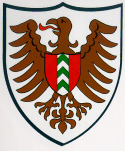
1889. To mark its status as district capital, the village reportedly adopted arms adapted from those of Count Louis de Neuchâtel, with a bird that gave rise to the inhabitants' nickname, « les Éperviers ».[11]
1897. Construction of the Town Hall, which houses the municipal administration and the justice of the peace.
1900. 1'361 inhabitants. Around 1900, Cernier has many shops.[1]
1903. Commissioning of the « Régional du Val-de-Ruz », a narrow-gauge railway linking Les Hauts-Geneveys to Villiers via Cernier. The network's depot was reportedly in Cernier.[1][18]
1905. The agricultural school acquires its first greenhouse and develops winter theoretical instruction followed by about ten pupils.[9]
1908. Construction of the Catholic church of Cernier (or 1908-1909), the centre of the Catholic parish of the Val-de-Ruz, in a style known as « chalet neuchâtelois », with stained-glass windows by the Geneva glass-painter C. Jourdin.[1][8]
1911. Opening of a branch of the Banque cantonale neuchâteloise in Cernier.[1]
early 20th century. The architect Jean-Ulysse Debély (1873-1932) strongly marks the village's urban planning and architecture, notably along the rue Frédéric-Soguel, which became the locality's main thoroughfare.[14]
1920. 1'563 inhabitants. The same year, the regional company reportedly put its first bus line into service, departing from Cernier.[1]
1922. Opening, on 4 November, of a boarding school at the agricultural school.[9]
1948. The Régional's tramway is replaced by trolleybuses.[1][18]
1950. 1'440 inhabitants, a slight decline compared with 1920 before the demographic recovery of the second half of the 20th century.[1]
from 1960. Building boom, with high-density and residential districts. Cernier develops its trade and becomes the regional centre of the Val-de-Ruz.[1]
1964. The agricultural school acquires carpentry workshops. The sculpture « Les Galets » is installed at the future site of La Fontenelle.[5][9]
1966. Mechanics workshops, a large hall and offices of the agricultural extension service are added to the agricultural school site.[9]
1972. The Centre scolaire secondaire de La Fontenelle, which brings together eleven municipalities of the Val-de-Ruz, takes its present form. The sculpture « Ondes réfléchies » is installed there.[1][5]
1986. The trolleybus is replaced by a bus service.[1][18]
1991. Installation on the village square of the sculpture « La petite suite » by Patrick Honegger, near the 18th-century fountain.[5]
1995. The agricultural school is reorganised under the name « Site de Cernier ».[9]
2000. 1'921 inhabitants.[1]
2006. The Site de Cernier takes the name « Evologia ».[9]
2006-2007. Construction of the Mycorama, a museum devoted to mushrooms, inaugurated in October 2007 on the Evologia site.
2007. New stained-glass windows by the glass-painter Aloys Perregaux, born in Cernier in 1938, are inaugurated in the temple on the occasion of the Reformation service, possibly on 9 June.[6][7][16]
around 2011-2014. The Mycorama closes, probably in this year, owing to insufficient visitor numbers. The building is now an exhibition hall (Passage des Cèpes).
2012. The TransRUN regional S-Bahn (RER) project, which would have served the Val-de-Ruz, was reportedly rejected by popular referendum that year.
2012. 2'285 inhabitants in the cantonal census of 31 December 2012, the last before the merger.
1 January 2013. Cernier merges with Boudevilliers, Chézard-Saint-Martin, Coffrane, Dombresson, Engollon, Fenin-Vilars-Saules, Fontainemelon, Fontaines, Les Geneveys-sur-Coffrane, Les Hauts-Geneveys, Montmollin, Le Pâquier, Savagnier and Villiers to form the municipality of Val-de-Ruz, of which it becomes the administrative county seat.[1][2][3][4]
2013. Evologia is integrated into the canton of Neuchâtel's Department of Agriculture and develops socio-professional reintegration programmes in addition to its agricultural training mission.[9]
2014. Beginning of the restoration of the dry-stone walls of the Montagne de Cernier.[5]
2025. The municipality of Val-de-Ruz, of which Cernier is the county seat, has 17'533 inhabitants, making it the third municipality of the canton of Neuchâtel by population.[4][19]
Population of Cernier
Sources and references: [1]
| 1531 | 29 hearths (households) |
| 1750 | 279 |
| 1850 | 633 |
| 1900 | 1'361 |
| 1920 | 1'563 |
| 1950 | 1'440 |
| 2000 | 1'921 |
| 2012 | 2'285 |
Families of Cernier
Burgher families before 1800. Debély, Soguel, Soguel-dit-Picard, Soguel-dit-Piquard and Veuve, with no precise date.[21]
In the 19th century. Comtesse, Junet, Kléber, Ludi, Monnier and Némitz, as well as the Robert-Tissot family (from La Chaux-de-Fonds NE), with no precise date. Dated entries begin in 1877 with the Bloch family from Germany. Then come the André (from France) and Ernst (from Russia) families in 1882, the Jebens (from Germany) in 1885, and the Fesselet and Perrey (from France) and Giroud (from Grandevent VD) families in 1890. In 1894 the Herdi (from Holziken AG), Michet (from Rougemont VD), Rollat (from Montfavergier JU) and Schneeberger (from Ochlenberg BE) families arrive. The Lepp (from Germany), Rosset (from Montagny-la-Ville FR) and Vitus (from France) families are registered in 1895, the Berger (from Eclépens VD), Dreyer (from Trub BE) and Weber (from Brüttelen BE) families in 1897, and the Payot family (from Corcelles-près-Concise VD) in 1899.[21]
From 1901 to 1962. Sixty-six families. Half come from the canton of Bern, eleven of them from the Emmental. Nine families come from Italy, between 1901 and 1957. Others arrive from Germany, France, Denmark (1916) and Czechoslovakia (1958). The last entry, in 1962, is the Chéhab Daly family from Lebanon.[21]
Notable people of Cernier
Aloys Perregaux (Cernier 1938). Painter and engraver, also a journalist, art historian and teacher. He made the stained-glass windows of the Saignelégier temple (1999 and 2001) and ten windows of the Dombresson temple.[16]
Economy of Cernier, past and present
Farming and the agricultural school. Cernier remained a mainly farming village until around 1870. The agricultural school opened in 1885 then made it a place of agricultural training for the canton. Under the name Evologia, the site receives 70 to 80 people a day on reintegration programmes.[1][9]
Furniture and trade. Around 1870 a shop selling fabrics and furniture opened in the village and became a furniture factory in 1886. By about 1900 Cernier already had many shops. The cantonal bank opened a branch there in 1911. After 1960 trade grew further and the village became the regional centre of Val-de-Ruz.[1]
The Régional. From 1903 the narrow-gauge Régional du Val-de-Ruz railway linked Cernier with Les Hauts-Geneveys station and with Villiers. Trolleybuses replaced it in 1948, then buses in 1986.[1]
Historic sites in Cernier
The temple (Notre-Dame church). The church of Notre-Dame, long a dependency of the parish of Fontaines, became Protestant around 1535 and an independent parish in 1875. Its polygonal choir with star vaults probably dates from the early 16th century, the tower was rebuilt in 1774 and the nave restored in 1884 by the architect Eugène Colomb. It contains a nave door dated 1646, 17th-century armorial stained-glass windows, and modern stained-glass windows by Aloys Perregaux inaugurated in 2007, on themes such as the Annunciation and the Resurrection.[1][5][6][7]
The Catholic church. Built in 1908 (or 1908-1909) as the centre of the Catholic parish of the Val-de-Ruz, in a style known as « chalet neuchâtelois », combining cut stone with a wood-panelled interior. Its stained-glass windows, by the Geneva glass-painter C. Jourdin, depict the patron saints of the former parishes of the Val-de-Ruz.[5][8]
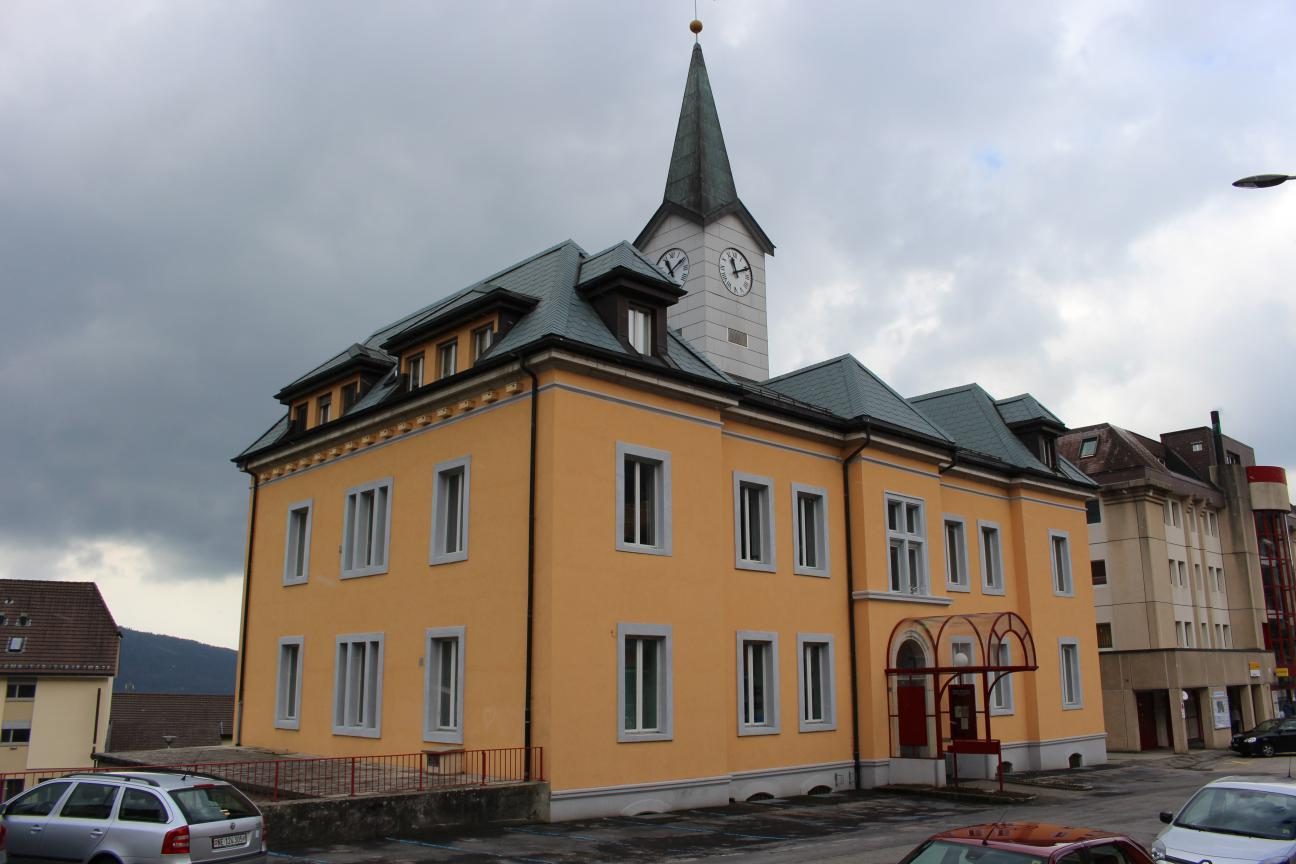
The Town Hall. Built in 1897 on the rue de l'Épervier, it has housed the municipal administration ever since and long accommodated the justice of the peace, at the time when Cernier was district county seat and seat of the prefecture (1877-1935).
Evologia, the former Cantonal School of Agriculture. Founded in 1885 at the initiative of the municipality and eleven neighbouring municipalities, inaugurated on 12 October of the same year and taken over by the canton in 1886, the school trained generations of Neuchâtel farmers. Renamed « Site de Cernier » in 1995 and then « Evologia » in 2006, the estate today houses a training centre, a park of old domestic animal breeds and socio-professional reintegration activities.[1][5][9]
The village square. The historic centre of the locality, it brings together an 18th-century fountain and the contemporary sculpture « La petite suite » by Patrick Honegger, installed in 1991.[5]
The Centre scolaire de La Fontenelle. An inter-municipal secondary school complex bringing together eleven municipalities of the Val-de-Ruz, whose present form dates from 1972. It houses public artworks, including the sculptures « Les Galets » (1964) and « Ondes réfléchies » (1972).[1][5]
The former route of the « Régional du Val-de-Ruz ». From 1903, Cernier was the central point of this narrow-gauge railway linking Les Hauts-Geneveys to Villiers, which shaped the village's development, particularly along the rue Frédéric-Soguel, which became the main thoroughfare, before being replaced by a trolleybus in 1948 and then by buses in 1986.[1][18]
Remains in Cernier
Unexcavated Roman site. The territory of Cernier contains a Roman site that has never been excavated. Its exact location and the nature of the remains are not known.[1]
Old architectural elements of the temple. The basket-arch door of the nave (1646), the armorial stained-glass windows of the pastors Rognon (1689) and Boyve (1691), and the late Gothic choir from the early 16th century constitute the main surviving architectural remains of the Cernier temple, despite the alterations of the 18th and 19th centuries.[6][7]
Dry-stone walls of the Montagne de Cernier. These traditional agricultural enclosures of the Jura, made of dry stones stacked without mortar, illustrate the etymological hypothesis of the village's name linked to « cernil » (enclosure). A programme to restore these walls has been under way since 2014 on the territory of the former Montagne de Cernier.[5]
The former Mycorama building. Built in 2006-2007 on the Evologia site and inaugurated in October 2007 as a museum devoted to mushrooms, the building closed its doors after a few years for lack of sufficient attendance and today serves as an exhibition hall, keeping alive the memory of this original museum venture.
Protected heritage in Cernier
Cultural property of regional significance (B objects)[20]
- Archives communales de Val-de-Ruz
Traditions and festivals in Cernier
Les Jardins musicaux. The festival was born at the second Fête la Terre, when the founders of the Opéra Décentralisé Neuchâtel, Maryse Fuhrmann and Valentin Reymond, were asked to create concerts on the site of the former agricultural school. A barn emptied of its hay served as the hall for the first three editions. Since 2001 the concerts have taken place in the present Grange aux Concerts, which regional associations also use on more than 160 days a year.[22][23]
The Fête la Terre. Over one weekend, the Evologia park brings together country people and town people. The festival offers craft markets, concerts, merry-go-rounds and workshops. Entry is free.[24]
Sources
- Dictionnaire historique de la Suisse, article Cernier
- Dictionnaire historique de la Suisse, article Val-de-Ruz (commune)
- Site officiel de la commune de Val-de-Ruz, page Histoire
- Site officiel de la commune de Val-de-Ruz, page La commune en bref
- Site officiel de la commune de Val-de-Ruz, page À voir ou visiter
- Temple de Cernier, paroisse réformée Val-de-Ruz (eren.ch)
- Orgues et vitraux, fiche du temple de Cernier
- Orgues et vitraux, fiche de l'église catholique de Cernier
- République et canton de Neuchâtel, historique d'Evologia
- Société d'histoire et d'archéologie du canton de Neuchâtel, L'école d'agriculture de Cernier
- Chemins Chouettes du Val-de-Ruz, brochure Villages vaudruziens : blasons, noms, surnoms (PDF)
- notreHistoire.ch, entrée sur le Mycorama de Cernier
- notreHistoire.ch, L'ex Mycorama de Cernier
- Société d'histoire de l'art en Suisse (GSK), Jean-Ulysse Debély, l'architecte qui a modelé Cernier
- Arcinfo, Debély, l'architecte qui a modelé Cernier au début du 20e siècle
- Dictionnaire du Jura, notice Perregaux, Aloys (1938-)
- État de Neuchâtel, arrêté du 6 février 2013 portant homologation des résultats du recensement cantonal de la population du 31 décembre 2012
- Dictionnaire historique de la Suisse, « Villiers » (Maurice Evard)
- État de Neuchâtel, arrêté du 4 février 2026 homologuant le recensement cantonal de la population au 31 décembre 2025
- Federal Office for Civil Protection (FOCP), Swiss Inventory of Cultural Property (PCP), list for the canton of Neuchâtel (as of 1.1.2026)
- Register of Swiss Surnames, 3rd edition (1989), search Commune "Cernier", Canton NE
- Les Jardins Musicaux festival, "La Grange aux Concerts"
- Les Jardins Musicaux festival, 2019 press kit
- Neuchâtel Tourism (j3l.ch), "Fête la Terre"
Published by Sébastien Jörg ·
Other villages near Cernier
Missing information, or do you have a source? Suggest a correction or addition. Every submission is checked before it's published.
Suggest a change