Lucelle
Origin of the name Lucelle
The place appears as « Lucela » in 1136, « Lucelan » in 1194, « Lucelach » in 1196 and « Lützel » in 1316. The German name is Lützel. The origin of the name is uncertain.[1]
Founding of Lucelle
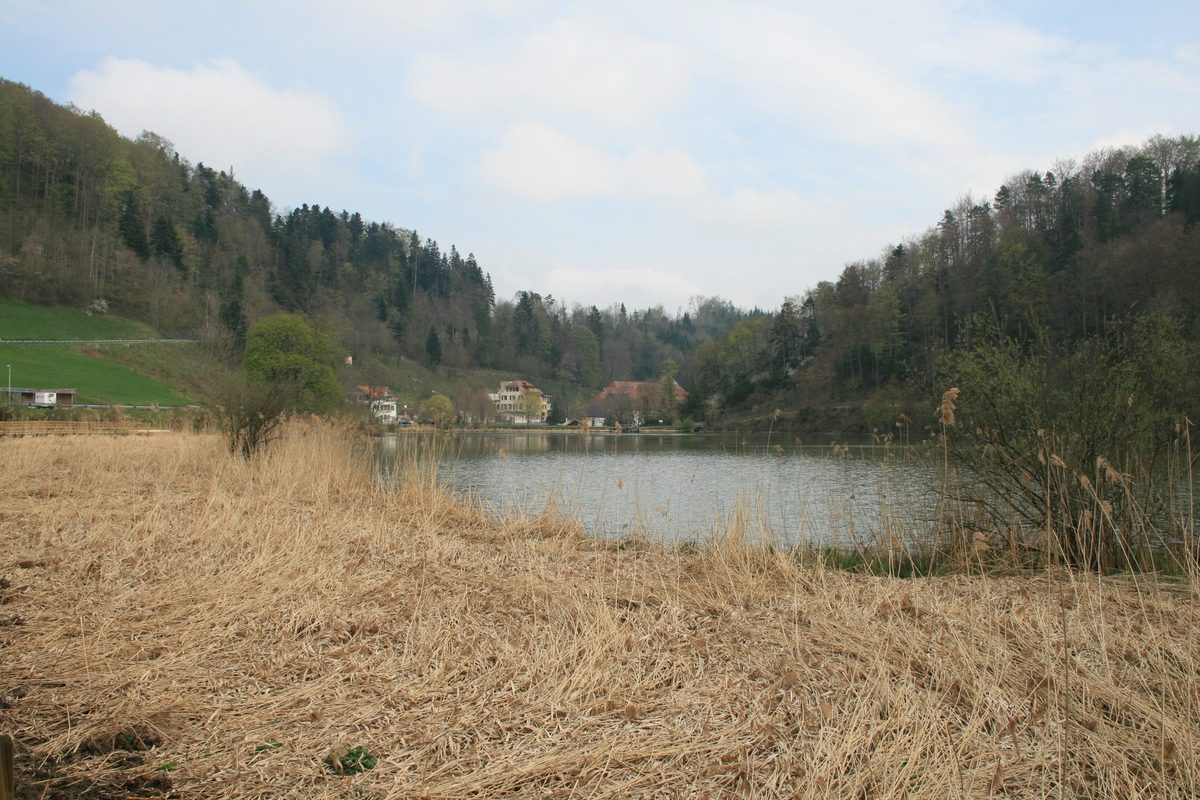
Lucelle is a hamlet divided by the French-Swiss border: the Swiss part belongs to the municipality of Pleigne, the French part to the municipality of Lucelle in the Haut-Rhin. The place grew out of the Cistercian abbey founded in 1123-1124 by the counts of Montfaucon on land of the Church of Basel, as a daughter house of Bellevaux in the Morimond line. The abbey and most of its buildings stood on what is now the French side of the border. The abbey was the main owner of the lands, forests and tithes of Pleigne, whose territory includes several of its former farms. On the Swiss side lies the Lucelle pond, a cantonal nature reserve.[1][2][3]
History of Lucelle
1123-1124. The Cistercian abbey is founded by the counts of Montfaucon, on a site now in France.[1][3]
1136. First mention as « Lucela ».[1]
around 1200. The abbey has about 200 monks, in a strongly bilingual community.[1]
1526. The abbey buys the lordship of Löwenbourg, in today's municipality of Pleigne.[1][3]
1638. The Thirty Years' War ruins the convent and scatters the community.[1][3]
1657. The community returns.[1][3]
1700-1730. A large new abbey is built.[1][3]
1789-1792. The abbey's property is declared national property and sold. The community is dispersed in 1792 and the conventual buildings and the great church are demolished.[1][3]
1801. The site is bought by ironmasters from Franche-Comté, who turn it into an industrial site.[3]
1824. The Société des usines de Lucelle et Bellefontaine passes to Basel industrialists.[3]
mid-19th century. The site has two blast furnaces, two refineries and two sawmills, and about 320 inhabitants, three quarters of whom work for the works.[3]
1883. End of all industrial activity (or in 1882).[1][3]
1960. The Saint-Bernard chapel is built, on the French side.[3]
1968. The Notre-Dame chapel is built.[3]
1981. The Fondation du Lac de Lucelle is created.[4]
Historic sites in Lucelle
Etang de Lucelle. Pond listed in the municipality of Pleigne, a cantonal nature reserve popular for walks around its shores. Its dam and the Lucelle spillway can be seen along the international road. A Fondation du Lac de Lucelle was created in 1981.[4]
Site of the former abbey (in France). Across the border, in the French municipality of Lucelle, the abbey site became in the 20th century a place for tourism and holidays and a cultural centre. The chapels of Saint-Bernard (1960) and Notre-Dame (1968) stand there. The feast of Saint Bernard is celebrated there every year.[1][3]
Remains in Lucelle
Remains of the Cistercian abbey (in France). The conventual buildings and the great Romanesque-Gothic church were demolished after the Revolution. Other buildings housed foundries and forges until 1882. These remains lie on the French side of the border.[1][3]
Sources
- Dictionnaire historique de la Suisse, « Lucelle » (André Chèvre), version du 26.11.2009
- Dictionnaire historique de la Suisse, « Pleigne » (François Kohler), version du 21.07.2020
- Dictionnaire du Jura, « Lucelle » (Emma Chatelain)
- Commune de Pleigne, « Lac de Lucelle »
- Statistique Jura, tableau JU-T.01.01.03, population résidante permanente au 31 décembre 2025
- geo.admin.ch (swisstopo), recherche de lieux « Lucelle »
Other villages near Lucelle
Missing information, or do you have a source? Suggest a correction or addition. Every submission is checked before it's published.
Suggest a change