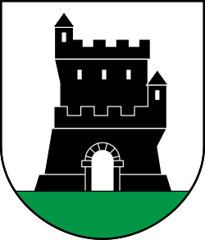
Bourrignon
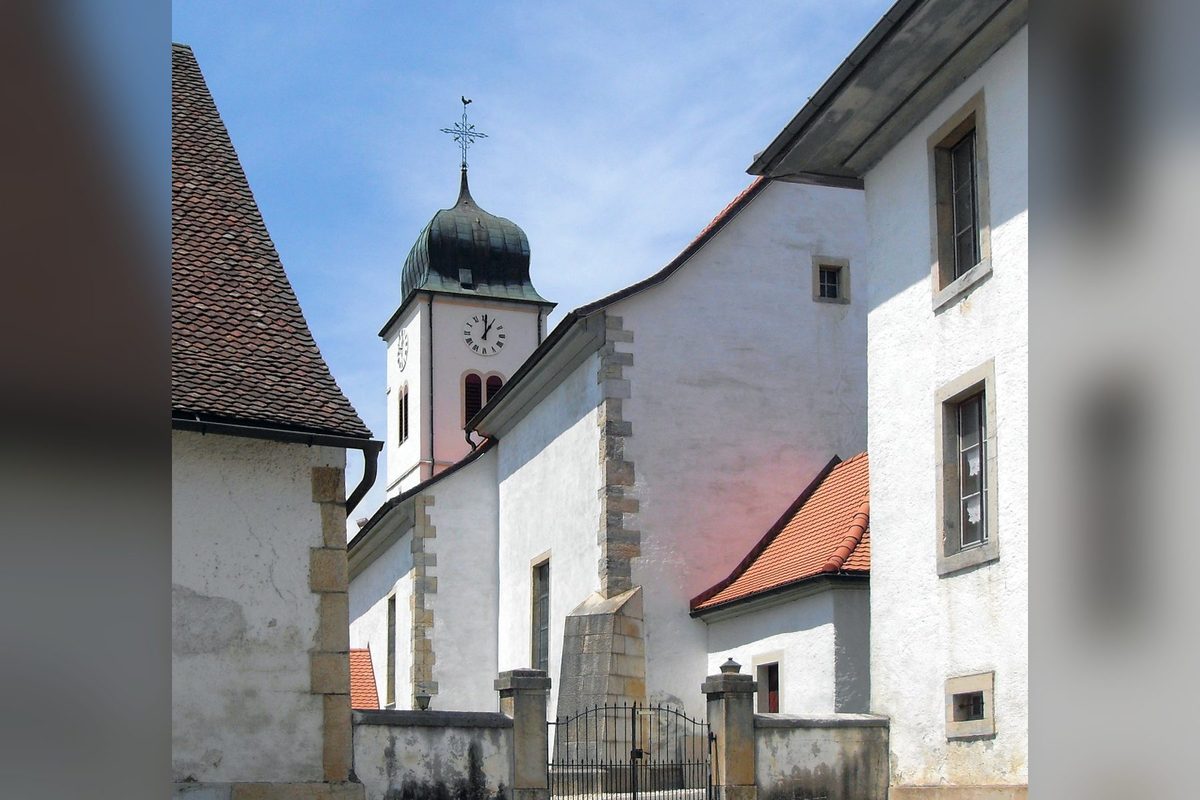
The restoration of its baroque church of Saint-Sébastien in 1974-1977 revealed a hoard of 17th-century coins.
Entry based on 9 sources · Our method · Reusable text (CC BY-SA)
Origin of the name Bourrignon
The village is mentioned in 1136 in the form « Borognuns », then in 1295 « Burgis ». Its old German name is « Bürkis ». The inhabitants reportedly bear the nickname « Borets » (ducks in patois).[4]
Founding of Bourrignon
The village lies on a terrace of the northern slope of the Rangiers chain, at a formerly important place of passage, the road linking the Delémont valley to Lucelle. It is mentioned from 1136 and its parish from 1181. Until 1792 it was one of the free villages of the lordship of Delémont, a bailiwick of the Prince-Bishopric of Basel.[4]
History of Bourrignon
1136. First mention in the form « Borognuns ».[4]
1181. The parish of Bourrignon is mentioned.
1295. Mention in the form « Burgis ».
16th century. A forge works the pig iron of the Charmoille blast furnace, in operation from 1516.
1747-1749. The church of Saint-Sébastien is rebuilt in baroque style with a porch tower.[4]
1753. The church's high altar is dated 1753.[3]
1777. Stations of the Cross, with paintings by François Ignace Tavanne.[3]
until 1792. Free village of the lordship of Delémont, a bailiwick of the Prince-Bishopric of Basel.
between 1792 and 1815. French period: Bourrignon belongs to the department of Mont-Terrible, then to Haut-Rhin.
1815-1978. Bourrignon belongs to the Bernese district of Delémont.
1854. Separation of the citizens' community and the municipality.
1874-1935. The parish is attached to that of Pleigne.
Around 1900. The Bourrignon mill stands 2.5 km north of the village on the Lucelle road. It lies in a gorge carrying the Bief de la Côte de Mai, which a kilometre further on forms the Lucelle pond and feeds the Lucelle, a tributary of the Birs near Laufen.[6]
1974-1977. Restoration of the church, which reveals a 17th-century coin hoard.
1979. Bourrignon becomes part of the new canton of Jura.
Population of Bourrignon
Sources and references: [4]
| 1818 | 226 |
| 1850 | 359 |
| 1870 | 382 |
| 1900 | 330 |
| 1950 | 312 |
| 1980 | 221 |
| 2000 | 286 |
| 2010 | 271 |
| 2025 | 259 |
Families of Bourrignon
Citizen families before 1800. Twelve citizen families before 1800, with no precise date: Bandelier, Buchwalder, Domon, Fleury, Frund, Guillaume, Koller, Monnin, Nusbaumer, Theurillat and Turberg, as well as the Klopfenstein, from Frutigen BE.[9]
From 1901 to 1962. In 1909 the Garessus family, from France, became the only one entered in the 20th century.[9]
Economy of Bourrignon, past and present
Fields and forests. Farming and forestry supported the village. Around 2000, just under a third of the 291 residents still worked in agriculture. A dairy society was founded in 1934. A cooperative for buying farm machinery was set up in 1959, a freezer cooperative in 1960.[4][8]
Iron and blue stone. A forge worked pig iron, and the first blast furnaces were built in 1516. A later forge stood upstream of the Lucelle pond. In October 1843 the commune assembly discussed ore mining by the Société des forges de Lucelle. The village also quarried a bluish limestone, laid in the floor of Lucelle church and in several buildings in the region.[4][8]
Historic sites in Bourrignon
Church of Saint-Sébastien. Baroque church with a porch tower, rebuilt in 1747-1749 and restored in 1974-1977. Its baptismal font dates from the 16th century, its high altar from 1753 and its Stations of the Cross from 1777, with paintings by François Ignace Tavanne.[3][4]
Les Ordons. Highest point of the municipality, at 999 m above sea level, where a regional radio and TV relay station stands.
Remains in Bourrignon
Coin hoard of the church. Hoard of 17th-century coins discovered during the restoration of the church of Saint-Sébastien in 1974-1977.
Protected heritage in Bourrignon
Cultural property of regional significance (B objects)[7]
- Eglise St-Sébastien
Sources
- Dictionnaire historique de la Suisse, « Bourrignon » (François Kohler), version remaniée du 15.06.2020
- Statistique Jura, tableau JU-T.01.01.03, population résidante permanente au 31 décembre 2025
- Orgues et vitraux, fiche « Bourrignon (orgue) » (revue en septembre 2020)
- Office fédéral de la culture, ISOS (inventaire fédéral des sites construits), Bourrignon, fiche n° 2345 (2007-2010)
- geo.admin.ch (swisstopo), recherche de lieux « Bourrignon »
- Geographisches Lexikon der Schweiz, Band I (Neuenburg, Attinger, 1902)
- Federal Office for Civil Protection (FOCP), Swiss Inventory of Cultural Property (PCP), list for the canton of Jura (as of 1.1.2026)
- Chronologie jurassienne (Denis Moine), « Bourrignon »
- Register of Swiss Surnames, 3rd edition (1989), search Commune "Bourrignon", Canton JU
Published by Sébastien Jörg ·
Other villages near Bourrignon
Missing information, or do you have a source? Suggest a correction or addition. Every submission is checked before it's published.
Suggest a change