Col des Rangiers
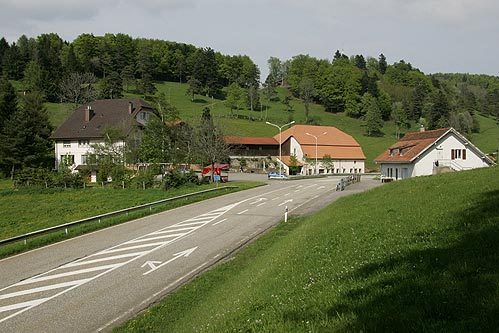
Origin of the name Col des Rangiers
A « Métairie des Rangiers » is mentioned in 1658. The etymology of « Rangiers » has not yet been explained.[3][6]
Founding of Col des Rangiers
How long the crossing has been in use is not known. The Col des Rangiers (856 m) links Delémont to Porrentruy, between the Delémont valley and the Ajoie. Its summit lay on the territory of the former municipality of Asuel, now in the municipality of La Baroche (merger of 2009). In the 17th century the prince-bishop of Basel granted a Métairie des Rangiers as a fief. Until the railways opened, the pass was one of the busiest in the Jura. Its strategic position, debated from the late 19th century, made it a place of manoeuvres and fortifications, then the site of the Sentinelle des Rangiers, a monument to the 1914-1918 mobilisation.[1][2][3][5][6]
History of Col des Rangiers
1516. Prince-bishop Christophe d'Utenheim grants a forge concession at Charmoille to smelt ore from the Rangiers and the Montavon.[6]
1658. On 9 February, prince-bishop Jean-Conrad de Roggenbach grants La Caquerelle, Le Creux and the Métairie des Rangiers as a fief.[3][6]
1877. The railways open; until then the Col des Rangiers was one of the busiest passes in the Jura.[1]
1884. Large military manoeuvres at the Rangiers, led by the 4th Infantry Brigade.[5]
1891. The bourgeoisie of Boécourt acquires the Rangiers farm.[3]
1911. On 21 October, the Jura deputation obtains guarantees from the Federal Military Department on the defence of the Rangiers in case of conflict.[5]
1924. On 31 August, the Sentinelle des Rangiers is unveiled, a statue by Charles L'Eplattenier commissioned by the Société jurassienne de développement for the tenth anniversary of the 1914 mobilisation.[2]
1926. On 16 May, the first Develier-Les Rangiers hill climb.[7]
1938. On 5 March, the Federal Council sets the boundaries of the fortified regions. In 1939, traffic is regulated in the outer zones of the Rangiers fortified region.[5]
1944. On 28 December, General Henri Guisan summons officers to the Rangiers for an army report.[4]
1956. On 6 April, a French military aircraft crashes near the pass; three dead.[6]
1964. On 3 February, the Rangiers restaurant is destroyed by fire. On 30 August, the commemoration of the 1939-1945 mobilisation turns into a riot. The speakers Virgile Moine and Paul Chaudet are heckled.[3][4]
1967. On 2 December, the new Hôtel des Rangiers is inaugurated.[3]
1984. In the night of 31 May to 1 June, the Sentinelle is toppled. The Groupe Bélier claims responsibility. It is put back in place on 27 June.[2][9]
1989. On 10 August, the Sentinelle is toppled again and beheaded.[2][9]
1990. In February, the statue, stored at Glovelier, is set on fire. The pedestal is removed on 20 July.[2][9]
2024. On 2 July, the remnant of the Sentinelle, a granite block of about 6 tonnes, is moved from Delémont to La Caquerelle to be put on display.[9]
Historic sites in Col des Rangiers
Hôtel des Rangiers. Former Rangiers farm acquired by Boécourt in 1891. The restaurant, destroyed by fire in 1964, was rebuilt and inaugurated in 1967.[3]
Saint-Ursanne-Les Rangiers hill climb. Motor hill climb held from 1926 starting at Develier, then from 1955 starting at Saint-Ursanne. In 1972 it joined the European Hill Climb Championship.[7]
Rangiers fortifications. Works of the Rangiers fortified region of 1939-1945, revealed to the public in 2002. The Chételat fort can be visited.[5]
Remains in Col des Rangiers
Remnant of the Sentinelle des Rangiers. A 4.5 m statue of a soldier carved by Charles L'Eplattenier and nicknamed « le Fritz », unveiled in 1924 at the junction of the roads from Les Rangiers to Delémont and to the Franches-Montagnes. Toppled in 1984 and 1989, then burned in 1990, only a granite block survives, on display at La Caquerelle since 2024. A fragment also stands in the Farinet vineyard at Saillon.[2][9]
Sources
- Dictionnaire historique de la Suisse, « Asuel » (Bernard Prongué), version du 10.06.2020
- Denis Moine, Chronologie jurassienne, « Rangiers : Sentinelle des Rangiers »
- Denis Moine, Chronologie jurassienne, « Rangiers : Auberge, hôtel »
- Denis Moine, Chronologie jurassienne, « Rangiers : Manifestations »
- Denis Moine, Chronologie jurassienne, « Rangiers : Fortifications »
- Denis Moine, Chronologie jurassienne, « Rangiers : Divers »
- Denis Moine, Chronologie jurassienne, « Rangiers : Course de côte »
- Christina Graf (ASSH), « La Sentinelle (Fritz) », Penser un monument
- République et Canton du Jura, communiqué « Déplacement du vestige de la Sentinelle des Rangiers » (3 juillet 2024)
- geo.admin.ch (swisstopo), recherche de lieux « Col des Rangiers »
- Statistique Jura, tableau JU-T.01.01.03, population résidante permanente au 31 décembre 2025
Other villages near Col des Rangiers
Missing information, or do you have a source? Suggest a correction or addition. Every submission is checked before it's published.
Suggest a change