Maracon
Vaud village of the Broye bordering four Fribourg municipalities, whose territory was split in the Middle Ages into two halves held by different lords.
Entry based on 11 sources · Our method · Reusable text (CC BY-SA)
Origin of the name Maracon
The village is first mentioned in 1236 in the form « Montmarascon ». Other readings give « Montimarascon » or « Montwarascon », and the exact spelling is uncertain. Then come « Morascon » in 1287, « Monracot » in 1290, « Montracot » in 1292 and « Marascon » around 1588. The name is said to mean « marsh mount », from Latin mons and mariscum, but this is uncertain.[2][3]
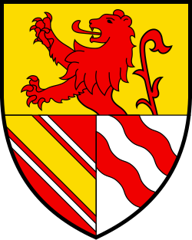
Coat of arms of Maracon
Per pale, gules a bend Or between two cotises argent, and argent two bends wavy gules, a chief Or with a lion issuant gules. The shield is divided vertically. On the left, on a red field, a yellow band edged by two thin white bands runs diagonally. On the right, two wavy red bands cross a white field. Across the top, a red lion rises from a yellow strip. These are the arms of the municipality formed by the merger with La Rogivue on 1 January 2003. The bend and cotises recall the Billens family, present from 1302. The wavy bands come from the arms of La Rogivue and stand for the local streams. The lion is the symbol of the lordships of Palézieux and Oron.[9][10]
Founding of Maracon
It is not known when and by whom Maracon was founded. At its first mention, in 1236, Montmarascon belonged to the lordship of Palézieux. In the Middle Ages the territory was divided into two halves: one depended on the lordship of Palézieux, the other belonged from 1287 to the lords of Pont, then to the lords of Oron and, in the early 16th century, to the Champion family. Links with the Billens family are recorded around 1302. The village's old coat of arms recalled these two houses: a lion's head for Palézieux and two silver cotises for the Billens. The municipality today consists of the village of Maracon, the village of La Rogivue and several hamlets, including Le Very, attached in 1872. It borders four Fribourg municipalities (Châtel-Saint-Denis, Remaufens, Saint-Martin and Semsales).[1][2][3]
History of Maracon
1236. First written mention, in the form « Montmarascon ». The place belongs to the lordship of Palézieux.[2][3]
1287. The name appears in the form « Morascon ».[3]
around 1302. Links with the Billens family are recorded.[2][3]
1547. The Champion family's share of the lordship passes to Bern.[1]
1557. Maracon is attached to the Bernese bailiwick of Oron, where it remains until 1798.[1]
around 1588. The name appears in the form « Marascon ». The place is part of the fief of Attalens.[2][3]
1609. Casting of a bell, since replaced.[4]
1798. Maracon joins the district of Oron.[1]
1822. Construction of the Reformed church, dedicated in December 1822 (or 1823). It replaces an old chapel of Saint-Georges, recorded in the 13th century.[1][4]
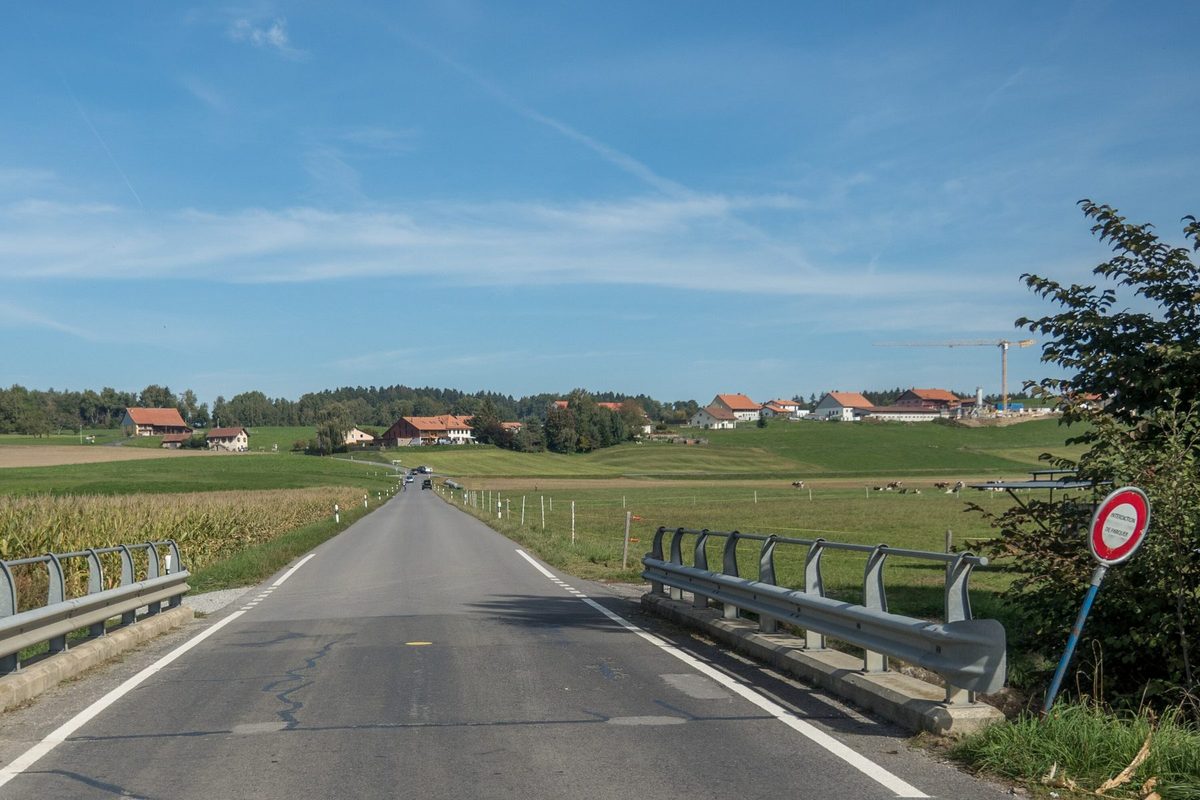
19 June 1949. The « Maracon crime »: two young women from Semsales are killed near the bridge over the Corjon. The case, never solved, strains relations with the neighbouring Fribourg villages.[3]
1 January 2003. Merger with the municipality of La Rogivue under the name Maracon.[1][2][3]
1 January 2008. The district of Oron is abolished. Maracon joins the new district of Lavaux-Oron (territorial division law).
Population of Maracon
Sources and references: [1][6]
| 1764 | 197 |
| 1850 | 350 |
| 1900 | 326 |
| 1950 | 230 |
| 2000 | 344 |
| 2025 | 565 |
Families of Maracon
Citizen families before 1800. Caillet, Chollet, Corboz, Dovat, Serex, Serez and Visinand, without a precise date.[11]
In the 19th century. The Félix, without a precise date.[11]
From 1901 to 1962. Ten registrations. The Held, from Germany, open the list in 1914, followed by the Ralini, from Italy, in 1933 and the Pesenti, also from Italy, in 1950. In 1954 the Dolgorouky come from the Soviet Union. Three families are admitted in 1957: the Christen of Affoltern im Emmental BE, the Eggen of Niederstocken BE and the Vuichard of Semsales FR. Next come the Bourret of Cernier FR (1958) and the Bader of Holderbank SO (1960). The last registered, in 1962, are the Vignandel, from Italy.[11]
Economy of Maracon, past and present
Milk, fields and forest. Maracon lives from farming, livestock and dairying, with eight farms in 2000. According to the FAO, five farms still work nearly 200 hectares. Forest covers 68 hectares, 54 of them owned by the municipality. The village has lost its shop, dairy, post office and bank, and most working residents are employed elsewhere.[1][10]
Peat, gravel and wood. Peat was cut between 1914 and 1923, then between 1943 and 1946. Extraction stopped for good in 1969. Part of the gravel beds under the village was also worked. A sawmill ran from 1866 to 1982. According to the FAO, an industrial joinery works in the heart of the village.[10][1]
Disasters and major events in Maracon
The castle fire of 1735. Already in ruins in 1660, the castle of Maracon was struck by fire in 1735.[1]
Historic sites in Maracon
Reformed church. Dedicated in December 1822 (or 1823), it replaced an old chapel of Saint-Georges, recorded in the 13th century. A bell of 1609 has been replaced. The belfry now holds three bells.[1][4]
La Rogivue. Village united with Maracon in 2003, known for its old name « Rubea aqua » (red water), said to come from the streams rising in the local peat soils. It has its own entry on this site.[1][2][3]
Protected heritage in Maracon
Cultural property of national significance (A objects in the PCP inventory)[8]
- Ferme de Praz-Derrey
Traditions and festivals in Maracon
The Abbaye du Cordon Blanc. Maracon has its own abbaye society, the Abbaye du Cordon Blanc, alongside the Amicale des anciens pompiers.[10]
Sources
- Dictionnaire historique de la Suisse, « Maracon » (Olivier Frédéric Dubuis, version du 01.09.2008)
- Commune de Maracon, « Histoire »
- Feuille des avis officiels du canton de Vaud, « Alphabet des communes vaudoises : Maracon »
- Gil. Colliard, « Maracon : commémoration du bicentenaire du temple », Le Courrier (Lavaux-Oron), 6 octobre 2022
- État de Vaud, communiqué du 12.07.2007, « Les préfètes et les préfets sont attribués aux nouveaux districts »
- Statistique Vaud, « Population résidante permanente au 31 décembre 2025 »
- geo.admin.ch, Répertoire des localités (swisstopo)
- Federal Office for Civil Protection (FOCP), Swiss Inventory of Cultural Property (PCP), list for the canton of Vaud (as of 1.1.2026)
- IPI, Swissreg, emblems database: coat of arms of Maracon (no. 101985)
- Feuille des avis officiels du canton de Vaud (Official Gazette of the Canton of Vaud), « Alphabet des communes vaudoises : Maracon »
- Register of Swiss Surnames, 3rd edition (1989), search Commune "Maracon", Canton VD
Published by Sébastien Jörg ·
Localities of the municipality with a page
Other villages near Maracon
Missing information, or do you have a source? Suggest a correction or addition. Every submission is checked before it's published.
Suggest a change