Massongex
Origin of the name Massongex
The form « Bernardus de Massunge » is attested in 1226. An older mention, « Massingiaco » in 1179, is also reported but not confirmed. The name reportedly combines a Latin family name (Maxuminius) with the suffix -acum of Celtic origin, though this is uncertain. The ancient name of the place, « Tarnaiae », may derive from that of the Celtic god Taranis; this is a hypothesis.
Founding of Massongex
Before the Roman conquest, Tarnaiae is said to have been the capital of the Nantuates, probably built of wood, with a sanctuary of Taranis. In Roman times Massongex became an important vicus. It was the only point where a bridge crossed the Rhône on the Great St Bernard road, at the junction of the roads to Italy, Avenches and Savoy, and public baths were built there. The buildings were abandoned in the second half of the 3rd century, perhaps after an Alamannic incursion, and Agaune (Saint-Maurice) took Massongex's place. The site became a mere garrison of the Burgundians and then of the Franks. Early medieval graves have been found in the ruins of the vicus. With Bex and Morcles, the village then belonged to the bishop of Sion, later to the Savoyard castellany of Saint-Maurice. Today the municipality comprises the village and eight hamlets, including Daviaz.[1][2]
History of Massongex
1st century. Heyday of the vicus of Tarnaiae: stone houses, public baths and a bridge over the Rhône. The mosaic of the two wrestlers is dated to the 30s AD.[2]
3rd century. From the second half of the century the buildings are abandoned, perhaps following an Alamannic incursion.[2]
515. The founding of the abbey by Sigismund helps make Agaune (Saint-Maurice) the centre of the region at the expense of Massongex.[2]
1226. Mention of « Bernardus de Massunge ».[1]
1250. First mention of the parish, which covers the whole present municipal territory.[1]
1296-1606. The de Montheolo family holds the office of vidame of Massongex, taken over by the de Quartéry family from 1606 to 1798.[2]
1475. After the Savoyard defeat at La Planta, Massongex depends on the governorship of Saint-Maurice.[1]
1790. Inhabitants fire on the house of the last vidame, Louis-Antoine de Quartéry.[2]
1798. After the Lower Valais revolution, Massongex becomes a municipality of the dizain of Saint-Maurice.[1]
1815. The municipality buys back its rights from the bishop of Sion and the abbey of Saint-Maurice.[1]
1820. Construction of the present church of Saint-Jean-Baptiste.[1]
1863-1894. First correction of the Rhône, which makes it possible to gain farmland.[2]
1872. Construction of a metal bridge over the Rhône, dismantled in 2000 and replaced by a footbridge in 2002.[2]
1882. Count Paul Riant settles at the château de la Vorpillière.[2]
1923. Construction of the Sacred Heart chapel at Daviaz.[1][2]
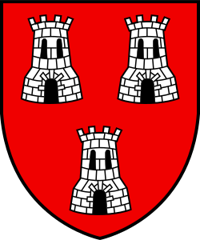
1934. Official use of the coat of arms with three towers, created in 1919 in reference to the three Roman roads.[2]
1970. Opening of the Maison de Massongex of Terre des hommes, which takes in sick children from countries of the South operated on in Geneva and Lausanne.[1]
1995. Construction of the multipurpose hall.[1]
Population of Massongex
Sources and references: [1][3]
| 1798 | 214 |
| 1850 | 503 |
| 1900 | 600 |
| 1950 | 659 |
| 2000 | 1'319 |
| 2025 | 2'148 |
Historic sites in Massongex
Church of Saint-Jean-Baptiste. The parish is mentioned from 1250. The church, rebuilt in 1606 and then replaced in 1820, was reportedly restored after a fire in 1843. It is said to preserve a 2nd-century inscription in the name of Sextus Varennus Priscus.
Daviaz and its chapel. Hamlet that long accounted for nearly half the population. Its Sacred Heart chapel dates from 1923.[1][2]
Saint-Martin locality. A chapel stood here until the 17th century.[1]
Château de la Vorpillière. Residence where Count Paul Riant (1836-1888) settled in 1882. He is buried at the abbey of Saint-Maurice, while his wife rests in Massongex.[2]
Maison de Massongex. House of the relief organisation Terre des hommes, opened in 1970.[1]
Remains in Massongex
Roman baths and wrestlers mosaic. The public baths of Tarnaiae lay beneath the present church square. A mosaic of about 1.48 m by 1.47 m, dated to the 30s AD, shows two wrestlers separated by a palm. It remains visible through a glass roof.[2]
Early medieval graves. Early medieval graves have been found in the ruins of the Roman vicus.[1]
Stones from Tarnaiae at Saint-Maurice. The ruins of the vicus served as a quarry: a milestone was reused as a lintel in the bell tower of the abbey of Saint-Maurice, where an altar dedicated to Jupiter Optimus Maximus is also kept.[2]
Sources
- Dictionnaire historique de la Suisse, « Massongex » (Albano Hugon, version du 27.08.2008, version allemande)
- Commune de Massongex, « Histoire »
- Office fédéral de la statistique (OFS), STATPOP, chiffres provisoires au 31.12.2025, via citypopulation.de
- geo.admin.ch, recherche de lieux (coordonnées)
Localities of the municipality with a page
Other villages near Massongex
Missing information, or do you have a source? Suggest a correction or addition. Every submission is checked before it's published.
Suggest a change