Mex
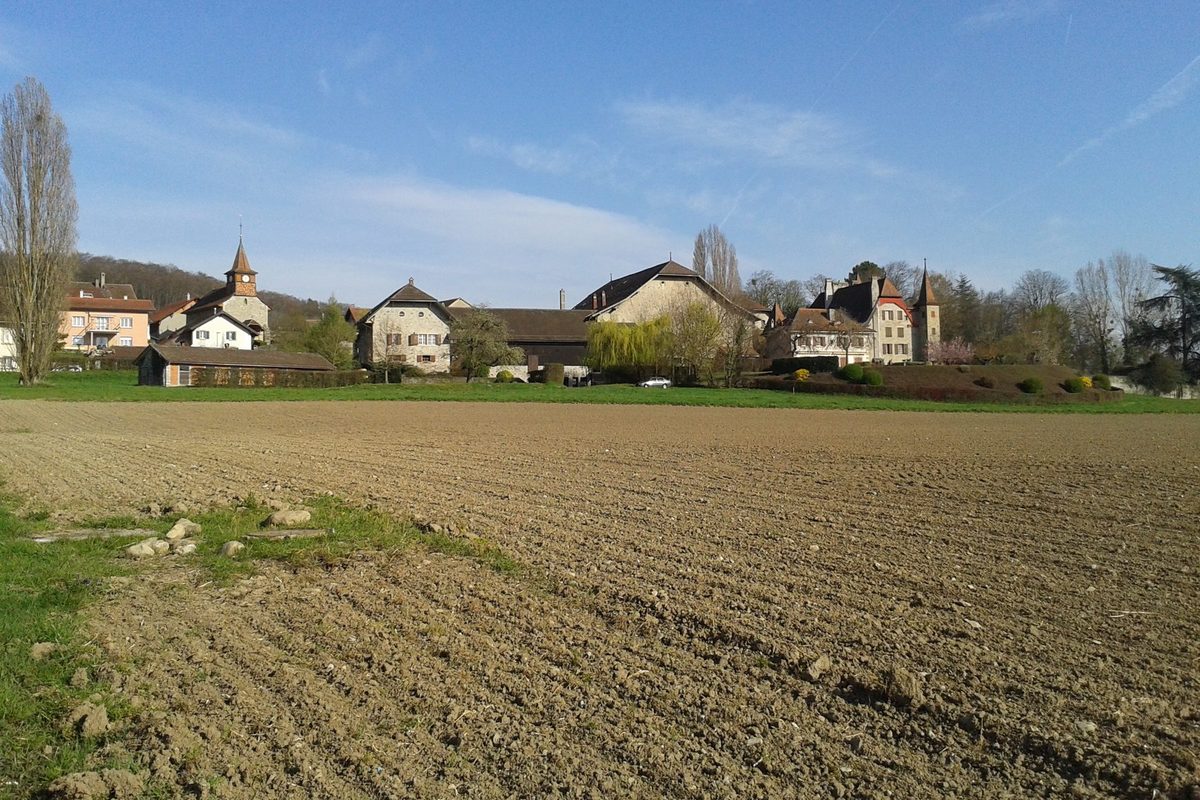
On the road from Lausanne to Jougne since the Middle Ages, Mex was the lordship of the Charrière family from 1585 to 1798, with two castles, before becoming a residential municipality.
Entry based on 10 sources · Our method · Reusable text (CC BY-SA)
Origin of the name Mex
The village appears in 1154 as «Mais». No one has yet explained the name «Mex».[1]
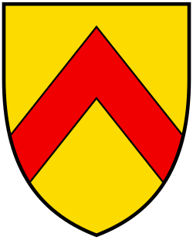
Coat of arms of Mex
Or, a chevron gules. On a yellow field stands a red chevron, shaped like an upside-down V. In the Middle Ages Mex belonged to a family of knights who appear from the 12th century and died out in the early 15th century. The Ropraz armorial of 1698 assigns these arms to the nobles of Mex, and the municipality took them up again in 1919.[8][9]
Founding of Mex
Nobody knows who founded Mex, or when. Tiles and pottery point to probable Roman settlements on its territory. The village and its lordship appear in written records in 1154. From the Middle Ages, Mex lay on the road linking Lausanne to Jougne.[1]
History of Mex
Roman period. Remains (tiles and pottery) point to probable Roman settlements.[1]
1154. First mention of the village and its lordship, in the form «Mais».[1]
1228. The church of Sainte-Marie-Madeleine appears as a parish church in the pouillé (list of parishes) of 1228.[1]
14th century. The lordship is divided into two fiefs. The fortified house, today's Château d'En-Bas, is held in fief and liege homage from the lord of Cossonay.[1]
1416. The village has 14 hearths.[1]
1475-1798. Mex belongs to the common bailiwick of Orbe-Echallens.[1]
late 15th century. The two fiefs are reunited into a single lordship.[1]
1570. The church only becomes Protestant at this date, when the heads of family vote by majority for the Reformation (the so-called «plus» vote).[1]
1580-1582. The church is rebuilt.[1]
1585-1798. The de Charrière family holds the lordship of Mex.[1]
1711-1845. Mex, first an annex of the parish of Penthaz, becomes an annex of the parish of Vufflens-la-Ville (then of Crissier from 1846 to 1851, and again of Vufflens-la-Ville from 1852).[1]
18th century. Salomon and Catherine de Charrière make their residence, the Château d'En-Haut, a centre of Lausanne's fashionable society.[1]
1798. Mex is assigned to the district of Cossonay.[1]
1974. An intermunicipal industrial zone is laid out with Vufflens-la-Ville and Villars-Sainte-Croix.[1]
1983. The municipal hall is built.[1]
1985. The school building is restored.[1]
1 January 2008. The new Vaud districts (law on territorial division) come into force: Mex moves from the district of Cossonay to the district of Gros-de-Vaud. The former farming municipality has become residential, with most of its inhabitants working in the Lausanne agglomeration.
Population of Mex
Sources and references: [1][6]
| 1416 | 14 hearths (households) |
| 1453 | 10 hearths (households) |
| 1764 | 18 hearths (households) |
| 1798 | 140 inhabitants |
| 1850 | 233 inhabitants |
| 1900 | 198 inhabitants |
| 1950 | 191 inhabitants |
| 1980 | 271 inhabitants |
| 2000 | 547 inhabitants |
| 2025 | 828 inhabitants |
Families of Mex
De Mex. In the Middle Ages the village belongs to a family of knights that appears from the 12th century. As vassals of the barons of Cossonay, they owe them liege homage for the fortified house. The nobles of Mex die out at the beginning of the 15th century.[9]
Citizen families before 1800. Braissant, Chêne, Morax, Thélin and Valet, without a precise date.[10]
From 1901 to 1962. No family is registered in the 19th century. In the 20th there are four registrations: the Martinelli, from Italy, in 1935, the Balmas, also from Italy, in 1936, then two families from Eggiwil BE, the Stauffer in 1956 and the Wermuth in 1957.[10]
Notable people of Mex
Louis Rivier. The painter decorates the Protestant church of Mex with stained glass and frescoes.[9]
Economy of Mex, past and present
From farming village to residential municipality. Long agricultural, Mex has become a residential municipality, and most of its inhabitants work in the Lausanne conurbation. In 1974 an intermunicipal industrial zone was laid out with Vufflens-la-Ville and Villars-Sainte-Croix. According to the FAO, the Château d'En-Haut remains at the heart of a farming business.[1][9]
Historic sites in Mex
Church (former church of Sainte-Marie-Madeleine). Parish church attested in 1228, which adopted the Reformation in 1570 and was rebuilt in 1580-1582.[1]
Château d'En-Bas. Former fortified house, held in fief and liege homage from the lord of Cossonay. The present building dates from the second half of the 16th century. Its south-east tower holds staircases « à l'italienne » of 1565, among the first in the canton. Jean-François de Charrière († 1696) added a latrine tower and the arcaded galleries of the south front. It is listed as a cultural property of national significance.[1][2][3]
Château d'En-Haut. Residence of the de Charrière family, lords of Mex from 1585 to 1798. In the 18th century Salomon and Catherine de Charrière made it a centre of Lausanne's fashionable society.[1]
Heritage site of national significance. The whole village of Mex is listed in the Federal Inventory of Swiss Heritage Sites (ISOS).[4]
Remains in Mex
Roman remains. Tiles and pottery found on the municipal territory point to probable settlements of the Roman period.[1]
Protected heritage in Mex
Cultural property of national significance (A objects in the PCP inventory)[7]
- Château d'En-Bas avec deux maisons de maître, communs, rural et fontaine
Legends of Mex
The «Foulx». According to tradition, the people of Mex are nicknamed the «Foulx», from a dialect word for the stunted fruit of the chestnut: they are said to have sold such fruit hidden in the husk.
Sources
- Dictionnaire historique de la Suisse, « Mex (VD) » (François Béboux, version remaniée du 12.01.2010)
- Inventaire fédéral des biens culturels (PBC), fiche 06233 « Château d'En-Bas », Mex, texte de la Société d'histoire de l'art en Suisse
- Office fédéral de la protection de la population, Inventaire PBC, liste du canton de Vaud (état au 1.1.2026)
- Tribunal fédéral, arrêt 1C_400/2023 et 1C_408/2023 du 24 mai 2024 (Mex VD, site ISOS), publié par l'Office fédéral de la culture
- État de Vaud, communiqué du 12.07.2007, « Les préfètes et les préfets sont attribués aux nouveaux districts »
- Statistique Vaud, « Population résidante permanente au 31 décembre 2025 »
- Federal Office for Civil Protection (FOCP), Swiss Inventory of Cultural Property (PCP), list for the canton of Vaud (as of 1.1.2026)
- IPI, Swissreg, emblems database: coat of arms of Mex (no. 101995)
- Feuille des avis officiels du canton de Vaud (Official Gazette of the Canton of Vaud), « Alphabet des communes vaudoises : Mex (Vaud) »
- Register of Swiss Surnames, 3rd edition (1989), search Commune "Mex", Canton VD
Published by Sébastien Jörg ·
Other villages near Mex
Missing information, or do you have a source? Suggest a correction or addition. Every submission is checked before it's published.
Suggest a change