Villars-Sainte-Croix
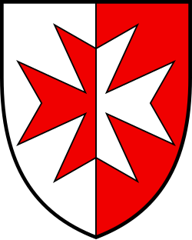
The Maltese cross in its coat of arms recalls the village hospice, mentioned from 1272 and attached in 1458 to the commandery of La Chaux of the Order of Saint John of Jerusalem.
Entry based on 9 sources · Our method · Reusable text (CC BY-SA)
Origin of the name Villars-Sainte-Croix
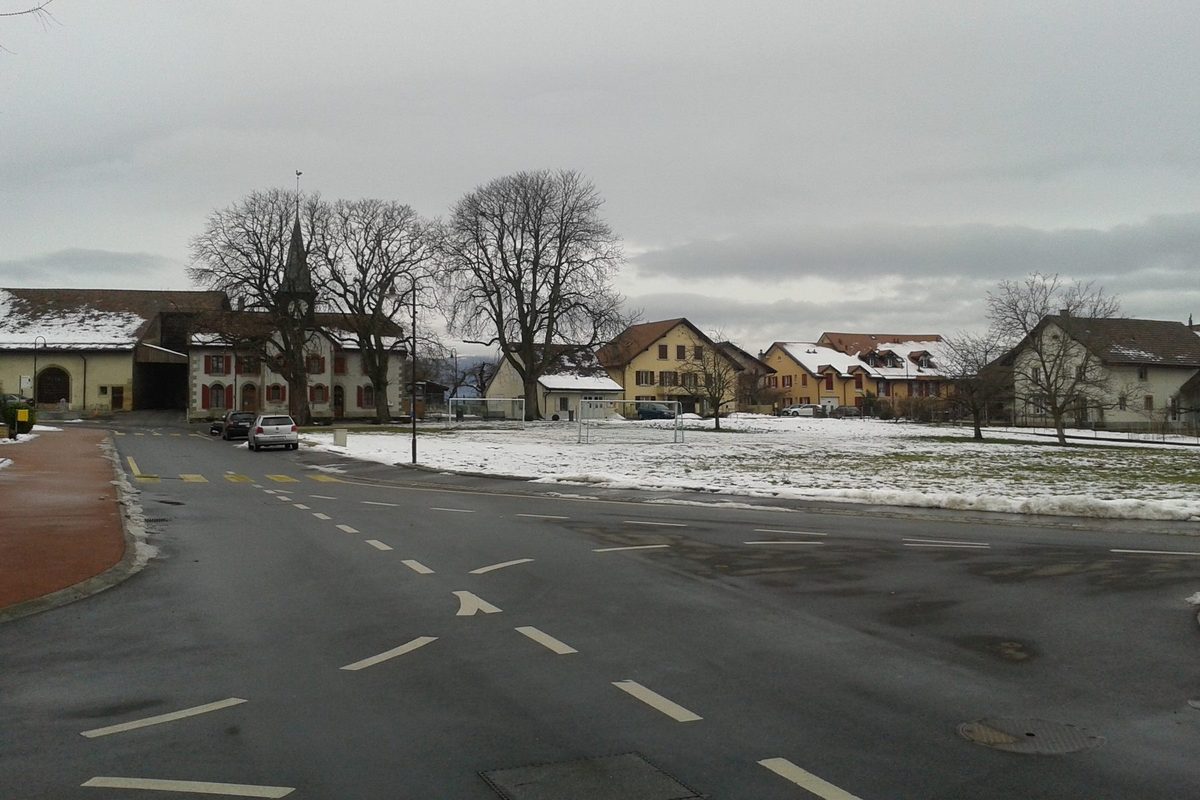
The village appears in 1227 in the form « inter sanctam Crucem », then in 1543 as « Villaret ». The original name, « Sainte-Croix », comes from the Latin « sanctam crucem » (the holy cross). The element « Villars », from the Romance « villare » (estate, hamlet), is said to have been added to distinguish the village from other places of the same name. « Villaret » reportedly denotes a Roman-era estate, probably a farm with outbuildings, but this is only a hypothesis. The inhabitants are reportedly nicknamed the « Cancoires », cockchafers in Vaud patois.[1][2][6]
Coat of arms of Villars-Sainte-Croix
Per pale argent and gules, a Maltese cross counterchanged. The shield is white on the left and red on the right, with a Maltese cross that is red on the white half and white on the red half. The red and white recall the bishop of Lausanne, on whom the cathedral chapter depended. The chapter shared the village with the lords of Cossonay. The cross refers to the Knights of St John of Jerusalem, linked to the commandery of La Chaux, near Cossonay.[8][2]
Founding of Villars-Sainte-Croix
The village developed around a church and a hospice, later attached to the commandery of La Chaux of the Order of Saint John of Jerusalem, hence the Maltese cross in the coat of arms. From the year 1000 it was shared between the lords of Cossonay and the chapter of Lausanne Cathedral. In the Middle Ages the abbey of Lac de Joux, the chapter of Lausanne and the castellany of Cossonay held property here. Farming and wine-growing until the 20th century, the village was profoundly transformed by the A1 motorway. No founder is known, but the area has been occupied since the La Tène period.[1][2]
History of Villars-Sainte-Croix
La Tène. First traces of settlement in the area.[1]
1227. First written mention: « inter sanctam Crucem ».[1]
1230. Vines are already cultivated.[1]
1272. First mention of a hospice.[1]
1458. The hospice belongs to the commandery of La Chaux (Order of Saint John of Jerusalem).[1]
1536. Bernese conquest: the village belongs to the bailiwick of Lausanne until 1798 and to the parish of Crissier, reformed the same year.[1]
1543. The village appears in the form « Villaret ».[1]
1546. The hospital and the church fall into ruin.[1]
1798. Attached to the district of Morges, until 31 December 2007.[1]
1962. Villars-Sainte-Croix leaves the parish of Crissier for that of Bussigny-près-Lausanne.[1]
1964. Opening of the A1 motorway, which encourages the creation of an industrial zone and residential areas.[1]
1975. A chapel is built.[1]
early 1980s. Construction of a municipal complex with a school and a multipurpose hall.[1]
2008. The new Vaud districts come into force: the municipality belongs to the Ouest lausannois district.[1][7]
Population of Villars-Sainte-Croix
Sources and references: [1][4]
| 1764 | 112 |
| 1798 | 116 |
| 1850 | 160 |
| 1900 | 142 |
| 1950 | 129 |
| 2000 | 602 |
| 2025 | 943 |
Families of Villars-Sainte-Croix
Citizen families before 1800. Cuérel, Moraz and Piccard, with no precise date. The Cuérel and the Moraz are the two oldest families in the village.[9][2]
In the 19th century. A single family: the Novel, from France, in 1895.[9]
From 1901 to 1962. Nine entries, almost all from abroad. The Robin (from France) opened the series in 1916. They were followed by the Cerutti (from Italy) in 1922, the Michel (from Germany) in 1923, the Cerottini (from Italy) in 1924, the Gerth (from Germany) in 1926, the Metzger (from Germany) in 1933, the Zaco (from Italy) in 1936 and the Roasotto (from Italy) in 1953. The last family entered, in 1956, was the Otto of Stein AG.[9]
Economy of Villars-Sainte-Croix, past and present
Four industrial zones. The municipality has four industrial zones: La Croix-du-Péage, La Pierreire, Mont-de-Faux and Fara. Nearly 150 craft, industrial and commercial businesses provide some 650 jobs there.[2]
One hectare of vines and two farms. About one hectare is still planted with vines, Chasselas, Pinot Noir and Servagnin, for white, rosé and red wines. Two farmers still work the land, one with cattle, the other with horses.[2]
Historic sites in Villars-Sainte-Croix
Chemin de l'Hôpital. This street name preserves the memory of the hospice of the Order of Saint John of Jerusalem, mentioned from 1272 and fallen into ruin in 1546 along with the church. It may rather have been a leper house.[1][2]
Chapel. Chapel built in 1975, after the village joined the parish of Bussigny-près-Lausanne in 1962.[1]
Croix-du-Péage. Industrial zone that grew out of the proximity of the A1 motorway. Its name recalls a toll levied on anyone passing this spot.[1][2]
Sources
- Dictionnaire historique de la Suisse, « Villars-Sainte-Croix »
- Commune de Villars-Sainte-Croix, « Présentation de la commune »
- Flags of the World, « Villars-Sainte-Croix (Vaud, Switzerland) »
- Statistique Vaud, « Population résidante permanente au 31 décembre 2025 »
- geo.admin.ch (swisstopo), recherche de lieux
- Commune de Villars-Sainte-Croix, journal d'informations communal n° 6, novembre 2024
- État de Vaud, communiqué du 12.07.2007, « Organisation des préfectures et adaptation au nouveau découpage territorial »
- IPI, Swissreg, emblems database: coat of arms of Villars-Sainte-Croix (no. 101874)
- Register of Swiss Surnames, 3rd edition (1989), search Commune "Villars-Sainte-Croix", Canton VD
Published by Sébastien Jörg ·
Other villages near Villars-Sainte-Croix
Missing information, or do you have a source? Suggest a correction or addition. Every submission is checked before it's published.
Suggest a change