Bussigny
In 1855-1856 this village on the Venoge became the railway junction between Lausanne, Morges and Yverdon, and later a town.
Entry based on 6 sources · Our method · Reusable text (CC BY-SA)
Origin of the name Bussigny
The place is mentioned in 1358 in the form « Bussignye ». The suffix « -iacum », common in French-speaking Switzerland, denotes an old Gallo-Roman estate. The personal name it may contain has not been identified. The commune was called « Bussigny-sur-Morges » before taking the name « Bussigny-près-Lausanne » in 1959. Today it uses the short name « Bussigny », date uncertain.[1]
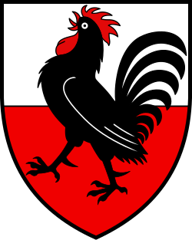
Coat of arms of Bussigny
Per fess argent and gules, a cock sable overall, one leg raised and crowing, beaked, combed and wattled gules. The shield is white above and red below. A black cock, one leg raised and beak open, stands over both colours, with red beak, comb and wattles. The white and red recall that the place belonged to the lordship of Lausanne and that its men served under the banner of Saint-Laurent. The cock comes from the arms of the de Polier family, who held a noble fief at Saint-Germain, the old centre of the village. The commune adopted these arms in 1926.[4][5][1]
Founding of Bussigny
A bronze torc from the La Tène period shows an early presence. The commune originally brought together two villages along the Venoge, Bussigny and Saint-Germain. In the Middle Ages the lordship broke up into many small fiefs under the authority of the bishop of Lausanne. Once a railway junction, the village attracted industry and grew strongly in the 20th century.[1]
History of Bussigny
La Tène period. A bronze torc is found in the commune.[1]
1228. The church of Saint-Germain is a parish church.[1]
1358. First mention, in the form « Bussignye ».[1]
1403. The village has 22 hearths (households).[1]
1536. Bernese conquest; after the Reformation the church of Saint-Germain becomes a chapel of the parish of Crissier.
1675-1676. The temple is rebuilt.[1]
1764. The village has 324 inhabitants.[1]
1855. Opening of the Morges-Bussigny-Yverdon line.[1]
1856. Opening of the Lausanne-Bussigny line.[1]
1859-1970. Operation of the Barraud brickworks.[1]
Around 1900. On the left slope of the Venoge valley, the village has 69 houses and 524 inhabitants, the whole commune 125 houses with the hamlet of Saint-Germain. People live from farming, a few vines and the woods. The glacial clay underground supplies a large brick, tile and pipe works. Saint-Germain, older than Bussigny, belonged with it to the lords of Cossonay, then of Montricher and to the bishop of Lausanne. Isabelle de Montolieu, author of the « Châteaux suisses », lived here.[3]
1900. The commune has 1'010 inhabitants.[1]
1940. Founding of the firm Scheuchzer SA.[1]
1947. Founding of the paint firm Jallut SA.[1]
1959. The commune takes the name Bussigny-près-Lausanne.[1]
1970. The commune has 4'509 inhabitants.[1]
2000. The commune has 7'498 inhabitants.[1]
Population of Bussigny
Sources and references: [1][2]
| 1403 | 22 hearths (households) |
| 1764 | 324 |
| 1860 | 555 |
| 1900 | 1'010 |
| 1950 | 1'568 |
| 1960 | 2'381 |
| 1970 | 4'509 |
| 1990 | 6'806 |
| 2000 | 7'498 |
| 2025 | 12'138 |
Families of Bussigny
Burgher families before 1800. Record for the commune of Bussigny-près-Lausanne. Fifteen families with no precise date: Barraud, Blondel, Dumont, Genand, Gorgerat, Gruffel, Neyret, Piccard, Pittet, Rolaz, Rossier and Vernaz, along with the Vuerchoz, Wuarchoz and Wuerchoz, three spellings of the same name.[6]
In the 19th century. A single family: the Visinand, with no precise date.[6]
From 1901 to 1962. Thirty-nine entries. The first came from Italy: Baroni and Charbonnier in 1913, Rivoira in 1917, then Cardis in 1950, Péra in 1953 and Invernizzi in 1954. In 1956 the commune registered twenty families, fourteen of them Bernese: Aeberhard of Jegenstorf, Aellen and Hauswirth of Saanen, Schopfer of Lauenen, Gysler and Lüthi of Langnau im Emmental, Hiltbrand of Burgistein, Häberli of Münchenbuchsee, Rothen of Rüschegg, Spahni of Köniz, Stauffer of Schwendibach, Stoll of Wahlern, Stoller of Frutigen and Trachsel of Jaberg. The other six were the Aebli of Ennenda GL, the Fischer of Wilihof LU, the Jäggi of Seewen SO, the Savary of Sâles (Gruyère) FR, the Senn of Göschenen UR and the Zahner of Lippoldswilen TG. In 1957 came the Baltisberger and the Matti of Saanen BE, the Dürrig of Schelten BE, the Klay of Walkringen BE, the Ferrari of Monteggio TI, the Keller of Zurzach AG, the Oberson of Rueyres FR and the Zulauf of Schinznach Dorf AG. Then the Krieg of Radelfingen BE in 1958 and the Pettolaz of Charmey FR in 1960. The last entries, in 1961, were the Bader of Holderbank SO, the Bommer of Wängi TG and the Zogg of Grabs SG.[6]
Notable people of Bussigny
Abraham Dünz. The architect rebuilt the Bussigny church in 1675-1676, on the site of the old church of Saint-Germain.[1]
Economy of Bussigny, past and present
The railway. Bussigny's first growth came from the station. In 1855 the canton's first railway line linked the village to Yverdon, and Lausanne followed in 1856. The station is a hub where several modes of transport meet.[1][5]
Bricks, paints and depots. The Barraud brickworks opened near the station in 1859 and ran until 1970. Scheuchzer SA was founded in 1940, then the paint maker Jallut SA in 1947. The Lausanne-Geneva motorway then drew Gétaz-Romang SA in 1964, the Usego, Placette and Veillon depots, and in 1991 Edipresse's printing centre.[1]
Historic sites in Bussigny
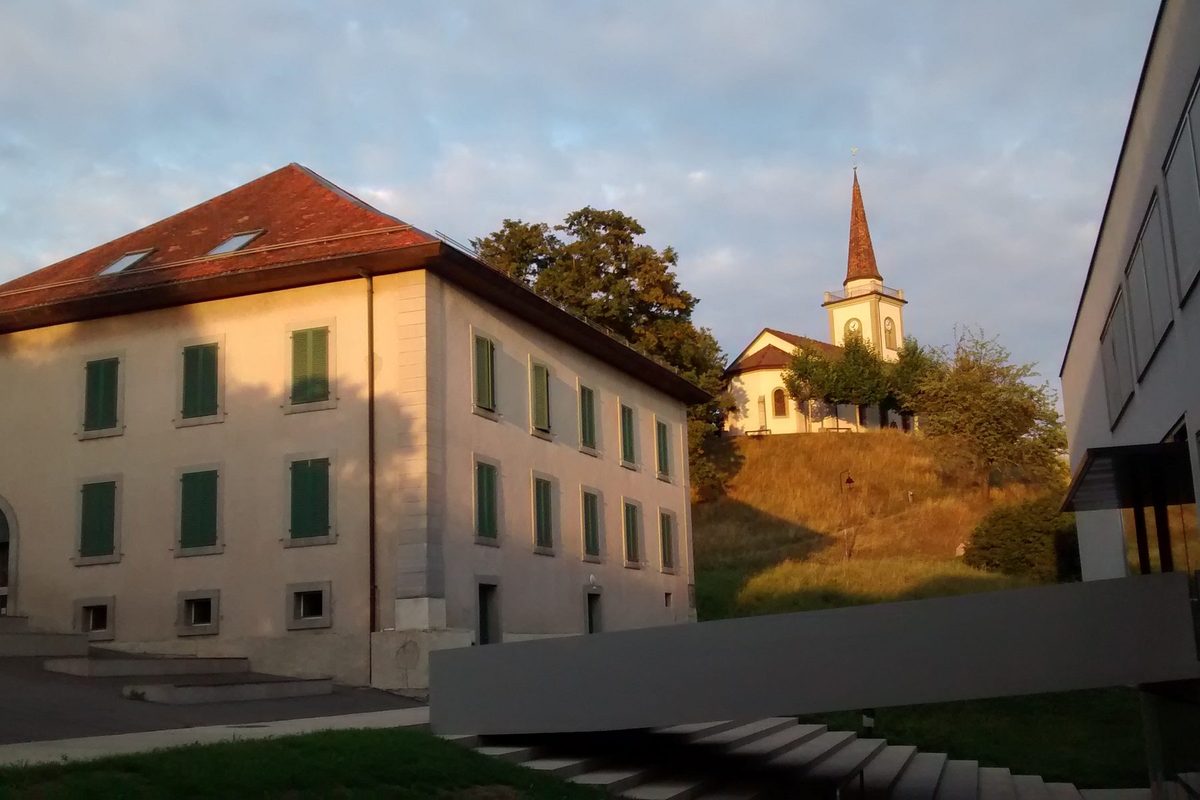
Bussigny temple. Rebuilt in 1675-1676.[1]
Former church of Saint-Germain. Parish church from 1228, it became a chapel of the parish of Crissier after the Reformation.[1]
Bussigny station. Junction of the lines to Morges, Yverdon and Lausanne since 1855-1856, the origin of the commune's development.[1]
Remains in Bussigny
La Tène torc. Bronze neck ring from the Celtic La Tène period, the oldest known object found in the commune.[1]
Traditions and festivals in Bussigny
The Abbaye. The commune describes its Abbaye society as more than a hundred years old. Its festival takes place every two years.[5]
Carnival and the Fête du Coq. The carnival and the Fête du Coq (rooster festival) are on the calendar of communal events. The rooster is also the emblem on Bussigny's coat of arms.[5][4]
Sources
- Dictionnaire historique de la Suisse, « Bussigny-près-Lausanne »
- Statistique Vaud, « Population résidante permanente au 31 décembre 2025 »
- Geographisches Lexikon der Schweiz, Band I (Neuenburg, Attinger, 1902)
- IPI, Swissreg, emblems database: coat of arms of Bussigny (no. 101646)
- Official Gazette of the Canton of Vaud (FAO), "Alphabet des communes vaudoises: Bussigny"
- Register of Swiss Surnames, 3rd edition (1989), search Commune "Bussigny-près-Lausanne", Canton VD
Published by Sébastien Jörg ·
Other villages near Bussigny
Missing information, or do you have a source? Suggest a correction or addition. Every submission is checked before it's published.
Suggest a change