Missy
A possession of the Priory of Payerne from 1148, Missy is a street village in the Broye plain whose farmers all also work land in the canton of Fribourg.
Entry based on 6 sources · Our method · Reusable text (CC BY-SA)
Origin of the name Missy
First mentioned in 1148 in the form «Missiacum» (in a vidimus, a certified copy of a deed), then «de Missiaco» in 1183. The former German name is «Missach». The meaning of «Missy» remains unknown.[1]
Coat of arms of Missy
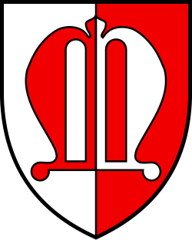
Per pale argent and gules, a letter M counterchanged. The shield is white on the left and red on the right. A large M crosses it, red on the white half and white on the red half.[4]
Founding of Missy
It is not known when, why or by whom the village was founded. An early medieval burial ground attests early occupation of the site. In the Middle Ages Missy belonged to the Priory of Payerne (attested in 1148 and 1183). The lord of Grandcour also held rights there (justice, right of lodging). The village is a street village.[1]
History of Missy
early Middle Ages. A burial ground is laid out in the area.[1]
1148. First mention, «Missiacum», among the possessions of the Priory of Payerne.[1]
1183. Further attestation, «de Missiaco», as a possession of the Priory of Payerne.[1]
1263. Peter of Savoy buys the mill and threshing mill of Chaffard.[1]
14th-15th centuries. Disputes with Payerne and Corcelles over the use of pastures.[1]
1536. Missy, until then part of the parish of Dompierre-en-Vully, now depends on Ressudens.[1]
1536-1798. Missy belongs to the governorship of Payerne. The commune is run by a council of Twelve and has a court of justice.[1]
18th century. Horse breeding.[1]
1803. Missy belongs to the district of Payerne, until 2007.[1]
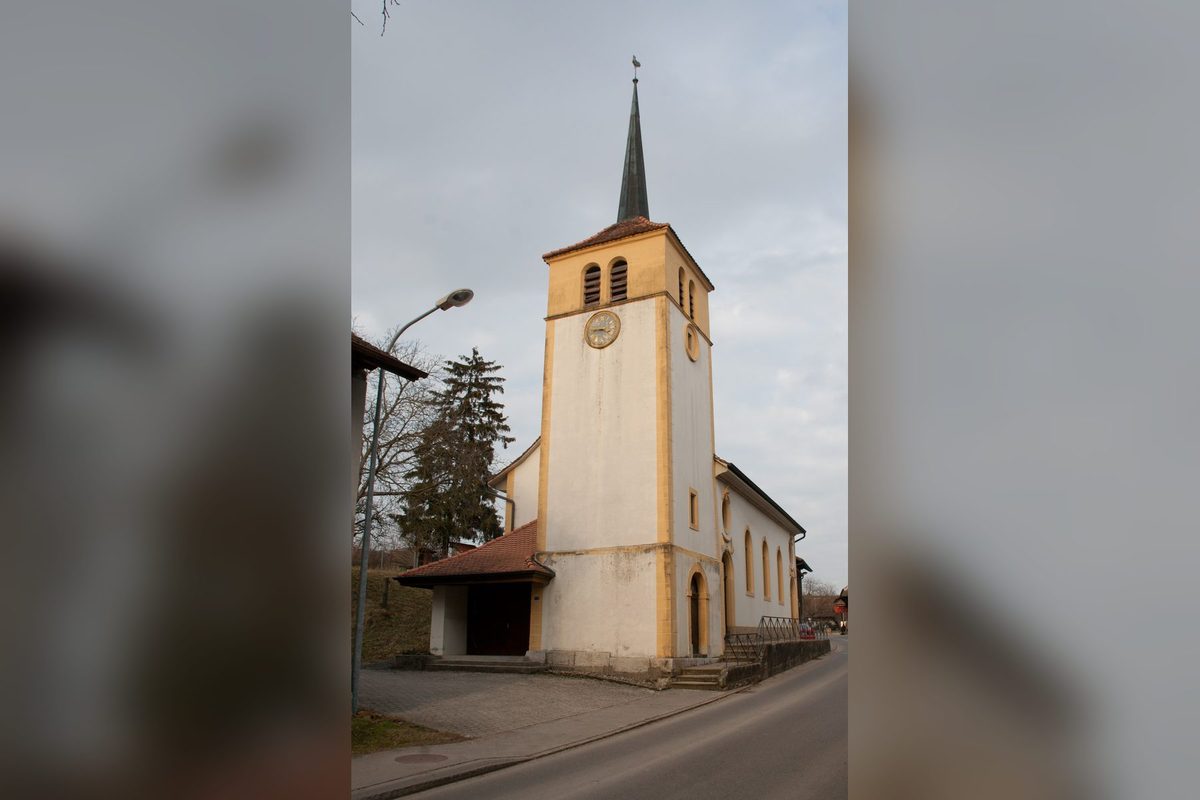
1810. The chapel is replaced by a new Protestant church (temple).[1]
1831. Founding of a cheese dairy society.[1]
1847. A Free Church congregation is formed, lasting until 1965.[1]
1878. The Free Church builds its chapel.[1]
1879-1922. The Free Church runs a private school.[1]
around 1900. A few large farming estates are formed.[1]
1920-1930. Land consolidation.[1]
2008. Missy becomes part of the new district of Broye-Vully.
early 21st century. Payerne still owns land in Missy. All the village's farmers work land in the canton of Fribourg.[1]
Population of Missy
Sources and references: [1][2]
| 1764 | 220 |
| 1850 | 282 |
| 1900 | 359 |
| 1950 | 318 |
| 2000 | 275 |
| 2025 | 379 |
Families of Missy
Citizen families before 1800. Blanc, Delacour, Morel, Quillet, Roulet and Thévoz, with no precise date.[6]
From 1901 to 1962. Four entries, three of them families from Italy: the Violi in 1936, the Villa in 1946 and the Bizzozero in 1954. The last to be registered were the Stöckli family of Rüschegg BE, in 1957.[6]
Notable people of Missy
Édouard Meyer. Seed merchant, historian and photographer. In the 1930s he recorded the houses of Missy and wrote a history of the municipality.[5]
Economy of Missy, past and present
The fields of the Broye. Since the 19th century, farming has been central to Missy's economy. Cereals, maize, sugar beet and potatoes are grown. The farmers share 60 hectares of municipal land in equal parts, although the number of farms has fallen.[5]
Livestock and tobacco. The former dairy recalls the village's livestock farming, organised in a breeders' association with cows entered in the herd-book. In 1943 this breeders' association bought the Sonlomont alpine pasture, between Château-d'Œx and Lac de l'Hongrin. The pentagonal tobacco drying sheds bear witness to the rise of this crop in the Broye.[5]
Joinery and workshops. Missy is home to a joinery specialising in making and fitting windows, as well as a tyre garage and a forestry equipment company.[5]
Historic sites in Missy
Protestant church (temple) of 1810. It replaces the village's old chapel. Missy, first part of the parish of Dompierre-en-Vully, has depended on Ressudens since 1536.[1]
Free Church chapel. Built in 1878 for the Free Church congregation, active in Missy from 1847 to 1965, which also ran a private school from 1879 to 1922.[1]
Remains in Missy
Early medieval burial ground. An early medieval burial ground is attested in the municipality. No details of it are known.[1]
Castle of Agnens. This vanished castle probably stood north of the present cemetery. Nothing is known of its history.[1]
Mill and threshing mill of Chaffard. Peter of Savoy bought them in 1263. What became of them afterwards is not known.[1]
Traditions and festivals in Missy
The men's choir. The men's choir of Missy was founded in 1887. Its evening performances are among the village's events.[5]
Abbaye and youth society. Missy has its abbaye society and its youth society. The Youth Festival is among the municipal events, along with 1 August and the welcome for new citizens.[5]
Sources
- Dictionnaire historique de la Suisse, « Missy »
- Statistique Vaud, « Population résidante permanente au 31 décembre 2025 »
- État de Vaud, communiqué du 12.07.2007, « Organisation des préfectures et adaptation au nouveau découpage territorial »
- IPI, Swissreg, emblems database: coat of arms of Missy (no. 101924)
- Official Gazette of the Canton of Vaud (FAO), "Alphabet des communes vaudoises: Missy"
- Register of Swiss Surnames, 3rd edition (1989), search Commune "Missy", Canton VD
Published by Sébastien Jörg ·
Other villages near Missy
Missing information, or do you have a source? Suggest a correction or addition. Every submission is checked before it's published.
Suggest a change