Molondin
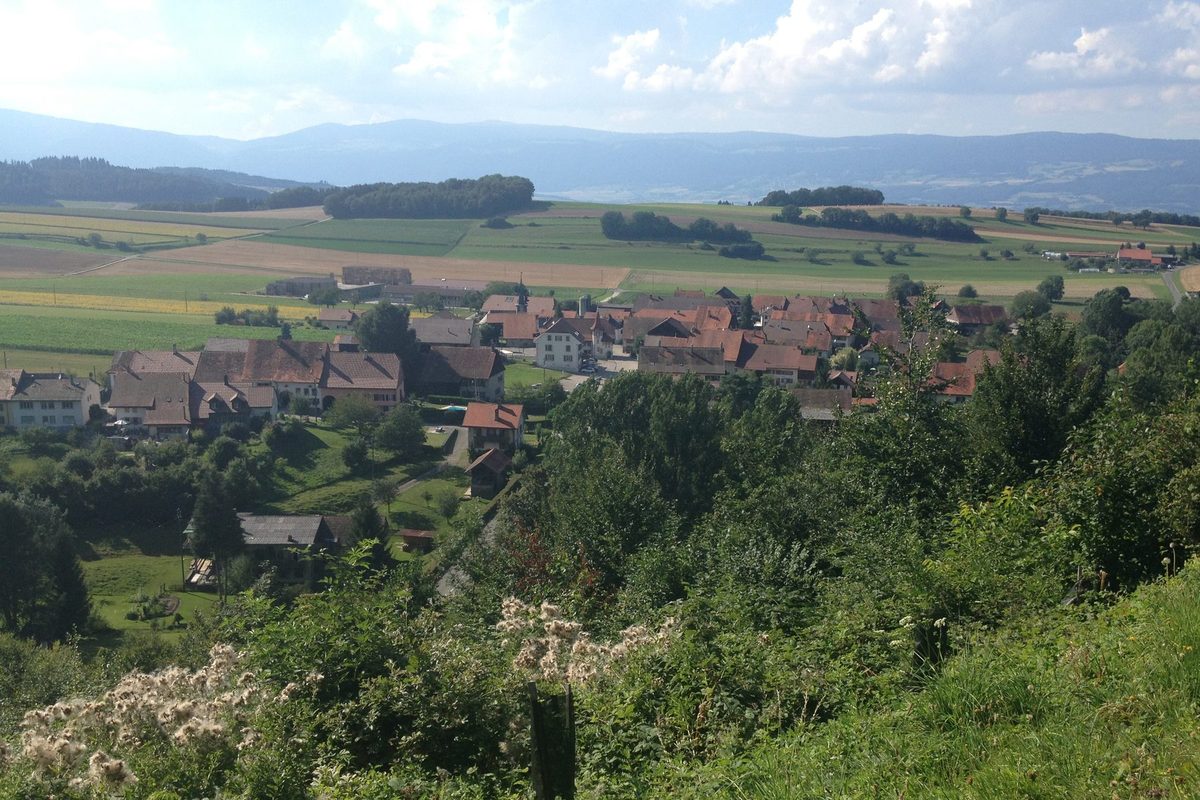
Farming village on a plateau overlooking the ravine of the Ruisseau des Vaux, heir to the lordship of Saint-Martin-du-Chêne, whose medieval tower still stands.
Entry based on 13 sources · Our method · Reusable text (CC BY-SA)
Origin of the name Molondin
The name is attested in 1380 in the forms «Mollondens» and «Mollendens». The etymology of «Molondin» has yet to be found. The inhabitants, the Molondinois, are nicknamed «lè Coumcllio» (the pot hooks, in Vaud patois).[1][3]
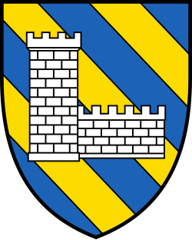
Coat of arms of Molondin
Azure, three bends Or, overall a tower argent with a wall of the same to sinister, both embattled and masoned. On a blue field crossed by three slanting yellow bands stands a white embattled tower, extended to the right by a white wall, also embattled. Adopted in 1921, these arms take the colours of the former lords of Saint-Martin and the outline of their old castle.[10][11]
Founding of Molondin
Who founded Molondin remains unknown. The territory of Molondin was the seat of the lordship of Saint-Martin-du-Chêne, which existed from the early 12th century until around 1550. A fortified castle and a small walled town were built there in the 13th century and disappeared in the 16th century. Around 1380, Molondin was detached from Saint-Martin and divided into several fiefs, most of which went to Hugues d'Estavayer. In the 17th century his descendants brought the whole lordship of Molondin together through successive purchases, and kept it until the end of the 18th century.[1][2][3][5]
History of Molondin
early 12th century. Beginning of the lordship of Saint-Martin-du-Chêne, attested from this time.[2][5]
13th century. Construction of the castle and small town of Saint-Martin-du-Chêne, whose large square tower is built around 1240. The lordship is then at its height.[2][7]
1303. The lordship of Saint-Martin-du-Chêne is divided, giving rise to two main fiefs.[5]
14th century. A chapel of Saint-Antoine is built in Molondin.[1]
1380. First written mention, «Mollondens», «Mollendens». Around this date Molondin is detached from Saint-Martin and divided into fiefs, most going to Hugues d'Estavayer.[1]
1536. During the Bernese conquest of the Pays de Vaud, in February, the Bernese spare the castle of Saint-Martin-du-Chêne (or destroy it in 1536; this is uncertain); Molondin belongs to the bailiwick of Yverdon until 1798.[1][5][7]
16th century. The castle and small town of Saint-Martin-du-Chêne disappear. The town is abandoned before 1550.[5]
17th century. Through successive purchases, the descendants of Hugues d'Estavayer bring together the whole lordship of Molondin, which they hold until the end of the 18th century.[1]
1667. Molondin, which belonged to the parish of Saint-Martin, passes to that of Le Pâquier. The chapel of Saint-Martin is replaced by the church of Chêne-Pâquier.[1][5][7]
1718-1719. The chapel of Saint-Antoine is rebuilt.[1]
1798. The municipality becomes part of the district of Yverdon.[1]
1955. A Protestant church replaces the chapel of Saint-Antoine.[1]
1961. Restoration of the Saint-Martin tower (or in 1965).[2][5]
2000. The village has thirteen farms (cereals, potatoes, livestock); agritourism is developing.[1]
2008. With the new districts coming into force on 1 January, the municipality joins the district of Jura-Nord vaudois.
Population of Molondin
Sources and references: [1][4]
| 1803 | 200 |
| 1850 | 327 |
| 1900 | 330 |
| 1950 | 250 |
| 2000 | 181 |
| 2025 | 260 |
Families of Molondin
d'Estavayer. Philippe II d'Estavayer founded the Estavayer-Molondin line, which later split into two branches, Montet and Lully. Several members bore the title of lord of Molondin. Jacques became a maréchal de camp in the French army, while François-Louis-Blaise and François-Henri were governors of Neuchâtel. The family died out in 1851 with Françoise Vallier-d'Estavayer, of the Molondin branch.[13]
Citizen families before 1800. Crisinel, Héritier, Lambelin, Peytregnet, Peytrignet, Tacheron and Vallon, with no precise date.[12]
From 1901 to 1962. Four entries. The Petrovic family, from Yugoslavia, was admitted in 1953. They were followed in 1956 by the Bachofner of Oberbalm BE and the Maurer of Bassersdorf ZH, then in 1957 by the Bigler of Muri bei Bern BE.[12]
Economy of Molondin, past and present
Farms and craftsmen. Molondin remains a farming area, with crops, livestock and short supply chains. Family farms, craftsmen and entrepreneurs work side by side, among them chocolate makers, brewers, joiners and carpenters.[11]
The Agropôle. In the village centre, the Agropôle brings together several food companies committed to the FoodTech transition.[11]
Historic sites in Molondin
Saint-Martin tower (castle of Saint-Martin-du-Chêne). The only major remnant of the castle of the lordship of Saint-Martin-du-Chêne, this 17-metre square tower, the former keep, overlooks the Vallon des Vaux. It was built around 1240 and adjoins the former castle entrance. Restored in 1961 (or 1965), it is listed together with the adjoining ruins as a Swiss heritage site of national significance.[2][5][6][7]
Protestant church of Molondin. Built in 1955 in place of the chapel of Saint-Antoine, founded in the 14th century and rebuilt in 1718-1719.[1]
Village of Molondin. The whole village is reportedly listed in the Federal Inventory of Swiss Heritage Sites (ISOS).
Remains in Molondin
Wall and vanished town of Saint-Martin-du-Chêne. Besides the tower, a section of the enclosure wall survives from the castle and small town built in the 13th century. The town was abandoned before 1550. Its chapel remained in use until 1667, when it was replaced by the church of Chêne-Pâquier.[1][5][7]
Protected heritage in Molondin
Cultural property of national significance (A objects in the PCP inventory)[9]
- Saint-Martin-du-Chêne, ruines du château et ville abandonnée - Moyen Age
Traditions and festivals in Molondin
The Wasimolo cross-country race. Every first weekend of November, the Wasimolo society holds a popular race in Molondin.[11]
The Friends of the Tower. The Association des Amis de la Tour was founded in 2015 around the Saint-Martin tower. On the evening of 1 August the municipality marks the national day with a speech, the anthem and a bonfire.[11]
Sources
- Dictionnaire historique de la Suisse, « Molondin »
- Commune de Molondin, « La Tour St-Martin »
- Commune de Molondin, « Notre village »
- Statistique Vaud, « Population résidante permanente au 31 décembre 2025 »
- Dictionnaire historique de la Suisse, Pierre-Yves Favez, « Saint-Martin-du-Chêne », version du 08.02.2011
- Office fédéral de la protection de la population, Inventaire PBC, liste du canton de Vaud (état au 1.1.2026)
- Inventaire PBC, fiche 06236 « Saint-Martin-du-Chêne, ruines du château et ville abandonnée » (texte de la Société d'histoire de l'art en Suisse)
- État de Vaud, communiqué du 12.07.2007, « Organisation des préfectures et adaptation au nouveau découpage territorial »
- Federal Office for Civil Protection (FOCP), Swiss Inventory of Cultural Property (PCP), list for the canton of Vaud (as of 1.1.2026)
- IPI, Swissreg, emblems database: coat of arms of Molondin (no. 102095)
- Official Gazette of the Canton of Vaud (FAO), "Alphabet des communes vaudoises: Molondin"
- Register of Swiss Surnames, 3rd edition (1989), search Commune "Molondin", Canton VD
- Historical Dictionary of Switzerland (HDS), Stefan Jäggi, "Estavayer, d'", version of 04.05.2017
Published by Sébastien Jörg ·
Other villages near Molondin
Missing information, or do you have a source? Suggest a correction or addition. Every submission is checked before it's published.
Suggest a change