Mont-la-Ville
Mountain municipality on the south-east slope of the Jura along the Mollendruz road, whose Freymond rock shelter holds human traces dating back to the end of the Palaeolithic.
Entry based on 9 sources · Our method · Reusable text (CC BY-SA)
Origin of the name Mont-la-Ville
First written mention in 1140 as «in Monte Villa». The meaning of «Mont-la-Ville» remains unknown.[1]
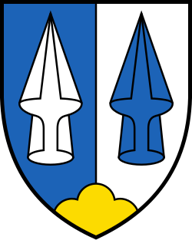
Coat of arms of Mont-la-Ville
Per pale azure and argent, two ploughshares counterchanged, overall in base a mount of three peaks Or. The shield is blue on the left and white on the right. Two ploughshares face each other, white on blue and blue on white. At the bottom, a yellow mount with three peaks covers both halves. The municipality adopted these arms in 1927. The ploughshares stand for the villagers' work in the fields, and the mount alludes to the village's name.[6][7]
Founding of Mont-la-Ville
The area has been frequented since the end of the Palaeolithic: the Freymond shelter, at the Mollendruz, was occupied temporarily from the end of the Palaeolithic to the Mesolithic (10'000-5500 BC), then permanently in the Neolithic. It is not known who founded Mont-la-Ville, or when. It is mentioned in 1140 and in the Middle Ages belonged to the land of Les Clées.[1]
History of Mont-la-Ville
10'000-5500 BC. The Freymond shelter, a large rock shelter at the Mollendruz, is occupied temporarily from the end of the Palaeolithic to the Mesolithic.[1]
Neolithic. Permanent occupation of the shelter.[1]
1140. First mention as «in Monte Villa».[1]
Middle Ages. Mont-la-Ville belongs to the land of Les Clées.[1]
1416. Mont-la-Ville and Cuarnens together have 96 hearths.[1]
1536-1798. Under Bernese rule the village belongs to the castellany of Les Clées.[1]
1764. The village has 254 inhabitants.[1]
1798. Mont-la-Ville is assigned to the district of Cossonay.[1]
1825. The present church is built.[1]
1838. The chapel of Saint-Michel becomes a parish seat. The parish is abolished in 1845 and restored in 1857.[1]
1851. The school is built.[1]
1900. The municipality reaches 447 inhabitants.[1]
1962. A water reservoir is built.[1]
1970s. A Nordic sports centre opens at the Mollendruz.[1]
1983. A municipal tax is introduced.[1]
1 January 2008. The new Vaud districts come into force: the district of Cossonay disappears and the municipality becomes part of the district of Morges.
Population of Mont-la-Ville
Sources and references: [1][2]
| 1416 | 96 hearths (households), with Cuarnens |
| 1764 | 254 |
| 1798 | 309 |
| 1900 | 447 |
| 1950 | 351 |
| 2000 | 328 |
| 2025 | 504 |
Families of Mont-la-Ville
Citizen families before 1800. Bélaz, Cardinaux, Charotton, Charrotton, Genevay, Martinet, Nicole and Rochat, with no precise date. The Courvoisier family, from Le Locle NE, was admitted in 1678.[8]
In the 19th century. A single family, the Guetty, with no precise date.[8]
From 1901 to 1962. Eight entries. The Bégoune family, from the Soviet Union, opened the series in 1931. Italy gave the Pistoletti (1936) and the Pini (1959), France the Duraffourg (1941), the Duret (1948) and the Biollay (1961), the last family registered. To these were added the Ruchty of Homberg BE (1956) and the Cameroni of Porza TI (1958).[8]
Notable people of Mont-la-Ville
César Roux (Mont-la-Ville 1857 - Lausanne 1934). The son of a schoolteacher and the third of eleven children, he became a surgeon in Lausanne, where he headed the surgical department of the cantonal hospital, and a professor at the University of Lausanne in 1893. He received the Legion of Honour for his help to wounded French soldiers during the war of 1914-1918.[9][7]
Economy of Mont-la-Ville, past and present
The alpine pastures. Farming still dominates in Mont-la-Ville. The municipality owns four alpine pastures, Vernand, Pré de Joux, Pré Magnin and Sasselet, which it leases to farmers from the village. Seven other pastures on its territory, including the Mollendruz, belong to other municipalities or to private owners.[1][7]
The forest. Until 1983 the municipality lived from its forests rather than from taxes. Forest covers 53% of the territory. Its 512 hectares of communal forest now cost it far more than they bring in.[1][7]
Skiing at the Mollendruz. A Nordic sports centre opened at the Mollendruz in the 1970s. Several dozen kilometres of cross-country ski, snowshoe and walking trails cross the territory.[1][7]
Disasters and major events in Mont-la-Ville
The fire of July 1723. In July 1723 a fire ravaged Mont-la-Ville. The bailiff ordered a collection for the victims.[7]
Historic sites in Mont-la-Ville
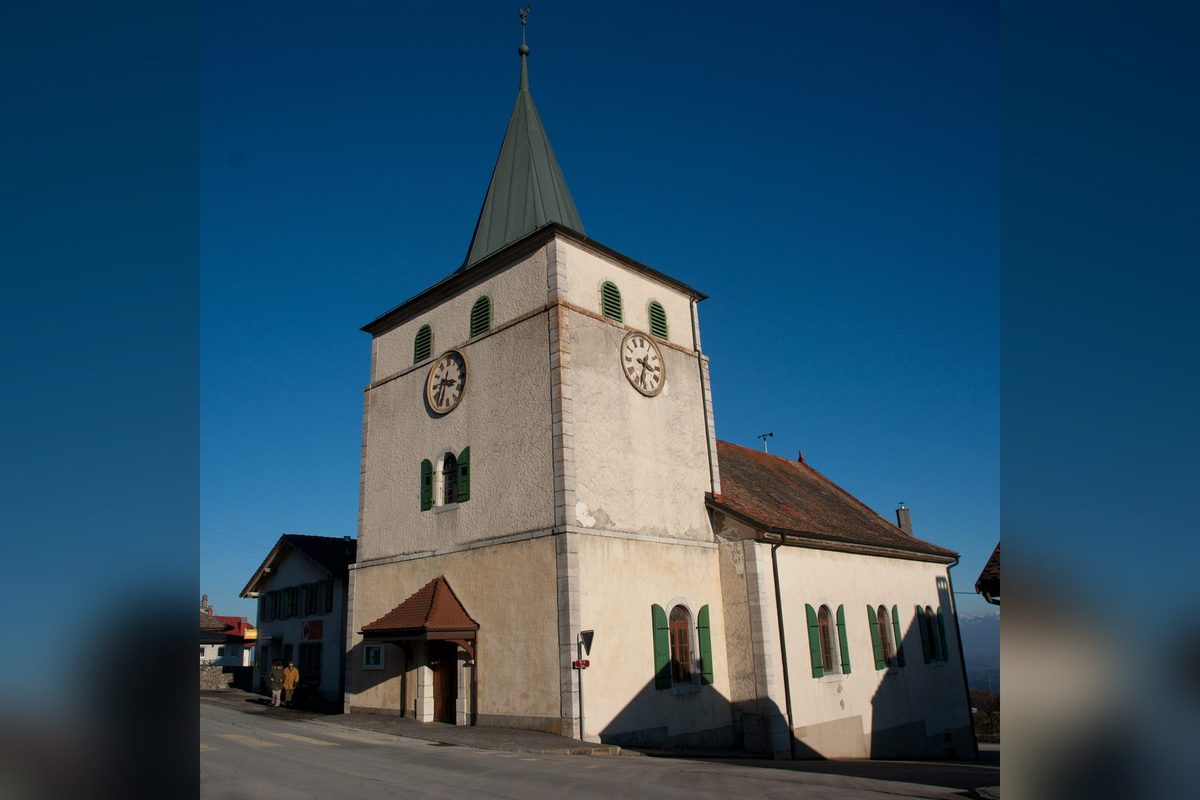
Church (temple) of Mont-la-Ville. Built in 1825, it succeeded the chapel of Saint-Michel. It holds a bell from 1500 and stained-glass windows by Pierre Chiara and Charles Clément, reportedly from 1950.[1]
School of 1851. Built in 1851 and attributed to the architects Krieg and Rossier. It reportedly served as a model for the school of Marchissy.[1]
Mollendruz road and pass. The municipality stretches along the Mollendruz road. A Nordic sports centre opened there in the 1970s.[1]
Hamlet of Chaume. Besides the village, the municipality includes the hamlet of Chaume and scattered farms. Farming dominates, with five alpine pastures.[1]
Remains in Mont-la-Ville
Freymond shelter (Mollendruz rock shelter). Large rock shelter occupied temporarily from the end of the Palaeolithic to the Mesolithic (10'000-5500 BC), then permanently in the Neolithic. It holds the oldest known human traces in the municipality and is listed as a cultural property of national importance (Mollendruz rock shelter, Palaeolithic to Neolithic occupations).[1][3]
Protected heritage in Mont-la-Ville
Cultural property of national significance (A objects in the PCP inventory)[5]
- Abri-sous-roche du Mollendruz, occupations paléolithiques - néolithiques
Traditions and festivals in Mont-la-Ville
The village societies. Mont-la-Ville has its abbaye society, the Écho du Jura, its music society, La Persévérante, and its youth society. The men's choir brings together singers from Mont-la-Ville and Montricher.[7]
Sources
- Dictionnaire historique de la Suisse, « Mont-la-Ville »
- Statistique Vaud, « Population résidante permanente au 31 décembre 2025 »
- Office fédéral de la protection de la population, Inventaire PBC, liste du canton de Vaud (état au 1.1.2026)
- État de Vaud, communiqué du 12.07.2007, « Organisation des préfectures et adaptation au nouveau découpage territorial »
- Federal Office for Civil Protection (FOCP), Swiss Inventory of Cultural Property (PCP), list for the canton of Vaud (as of 1.1.2026)
- IPI, Swissreg, emblems database: coat of arms of Mont-la-Ville (no. 101928)
- Official Gazette of the Canton of Vaud (FAO), "Alphabet des communes vaudoises: Mont-la-Ville"
- Register of Swiss Surnames, 3rd edition (1989), search Commune "Mont-la-Ville", Canton VD
- Lausanne Cantonal and University Library, Patrinum, record "Roux, César"
Published by Sébastien Jörg ·
Other villages near Mont-la-Ville
Missing information, or do you have a source? Suggest a correction or addition. Every submission is checked before it's published.
Suggest a change