
Münster
Origin of the name Münster
First recorded in 1221 as « Musterium », then « Comes » in 1272 and « Conches » in 1276. Until the 15th century the village itself was also called Goms (Conches), a name that later passed to the whole valley. The etymology remains unexplained.[1][2]
Founding of Münster
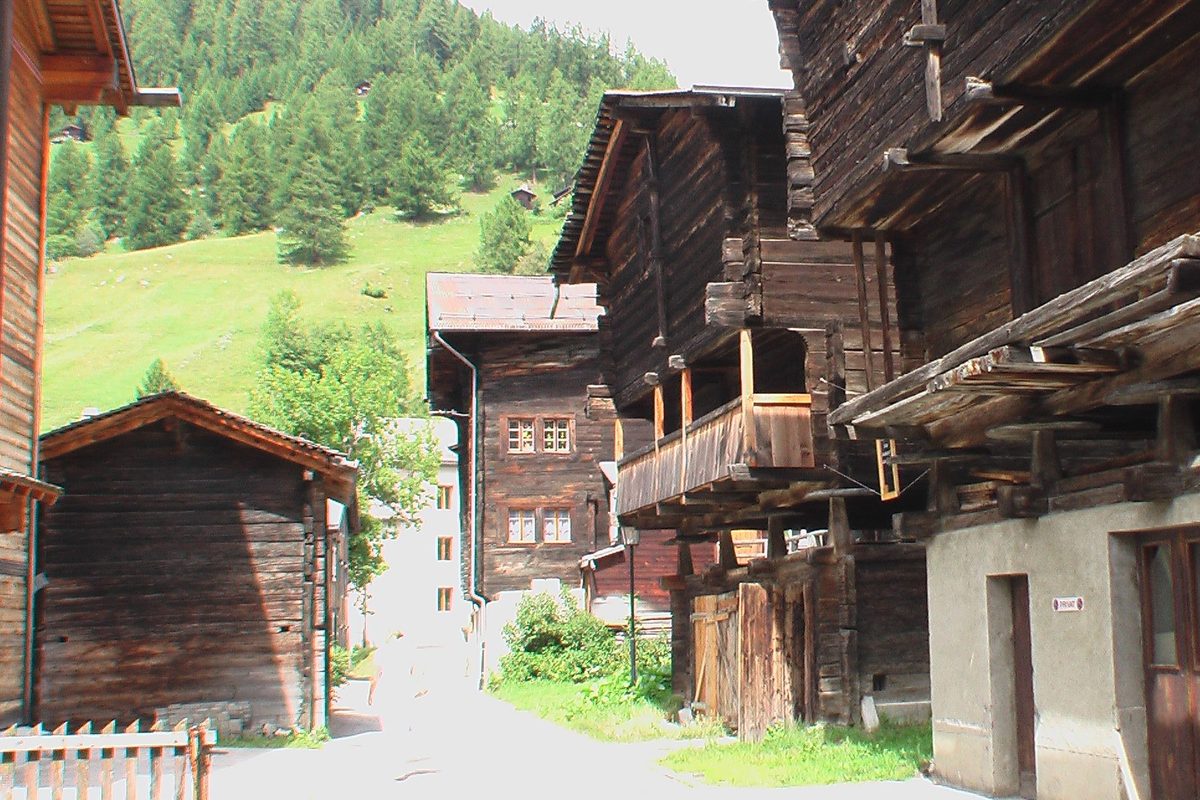
Münster is a clustered village at the mouth of the Minstigertal in the Goms valley, of which it was the main town. In the Middle Ages its farming population belonged mainly to the episcopal table of Sion, alongside a few free holdings and dues owed to outside nobles, and Münster formed a mistralry of the vidomnate of Goms. The village owed its standing to the large parish of which it was the seat, probably founded in the 11th or 12th century and reaching down the valley as far as Selkingen. The community regulated the use of its forests and alps itself and adopted peasant regulations (« Zünfte »). In the 16th and 17th centuries the Riedmatten family, which had come from the Visp valley, dominated the local elite until the end of the Ancien Régime. Cattle trade with Lombardy over the Grimsel, the Nufenen and the Gries pass, together with foreign military service, brought prosperity in the 17th and 18th centuries. In the 19th century the Simplon and Gotthard roads competed, then the Gotthard railway ended goods traffic through the valley. At the start of the 21st century Münster lived mainly from tourism and services. From 2004 to 2016 Münster formed with Geschinen the municipality of Münster-Geschinen, which then joined the municipality of Goms.[1][2]
History of Münster
1221. First recorded as « Musterium ».[1][2]
1247. First mention of the parish, probably founded in the 11th or 12th century.[1][2]
1379. Use of the forests regulated with Geschinen.[1]
1391. Agreement with neighbouring communities on the use of the Aegina alp.[1]
1468. First peasant regulation (alps, common land, forests).[1]
1540. Second regulation (paths, water channels, rural police).[1]
1549. Third regulation (acquisition, use and loss of citizenship rights).[1]
1560-1601. The statutes are supplemented and revised in 1560, 1579, 1587 and 1601.[1]
16th-17th centuries. The Riedmatten family dominates the elite and almost continuously supplies the prince-bishop of Sion.[1][2]
17th century. The daughter churches begin to break away from the large parish of Münster.[1]
1882. The opening of the Gotthard railway ends goods traffic in the Goms valley.[1]
1915. Connection to the Brig-Oberwald railway line.[1][2]
1939-1945. Construction of the military airfield during the Second World War.[1][2]
1959. First summer gliding camps on the airfield.[1][2]
1987. After violent storms a debris flow buries the village along the Minstigerbach.[2]
1993. The airfield is used for civil purposes only.[1][2]
2004. On 1 October Münster merges with Geschinen to form the municipality of Münster-Geschinen.[1][4]
2017. Münster-Geschinen merges with Blitzingen, Grafschaft, Niederwald and Reckingen-Gluringen into the municipality of Goms.[1]
Population of Münster
Sources and references: [1]
| 1802 | 381 |
| 1850 | 411 |
| 1900 | 417 |
| 1950 | 470 |
| 2000 | 455 |
Historic sites in Münster
Parish church of St Mary. Church of the former large parish of the upper Goms. Its bell tower, originally free-standing, dates from the 12th century.[1]
St Peter's church. In the village centre, built in the 17th century over an earlier building.[1]
Münster airfield. Military airfield built during the Second World War, used for summer gliding camps since 1959 and for civil aviation only since 1993.[1][2]
Sources
- Dictionnaire historique de la Suisse, « Münster (VS) » (Robert Walpen, trad. Florence Piguet, version du 08.02.2017)
- Historisches Lexikon der Schweiz, « Münster (VS) » (Robert Walpen, version du 08.02.2017, version allemande)
- Dictionnaire historique de la Suisse, « Münster-Geschinen » (version du 13.01.2017)
- Office fédéral de la statistique, Répertoire officiel des communes, mutation n° 2301 (01.10.2004)
- geo.admin.ch, recherche de lieux (coordonnées)
Other villages near Münster
Missing information, or do you have a source? Suggest a correction or addition. Every submission is checked before it's published.
Suggest a change