Noville
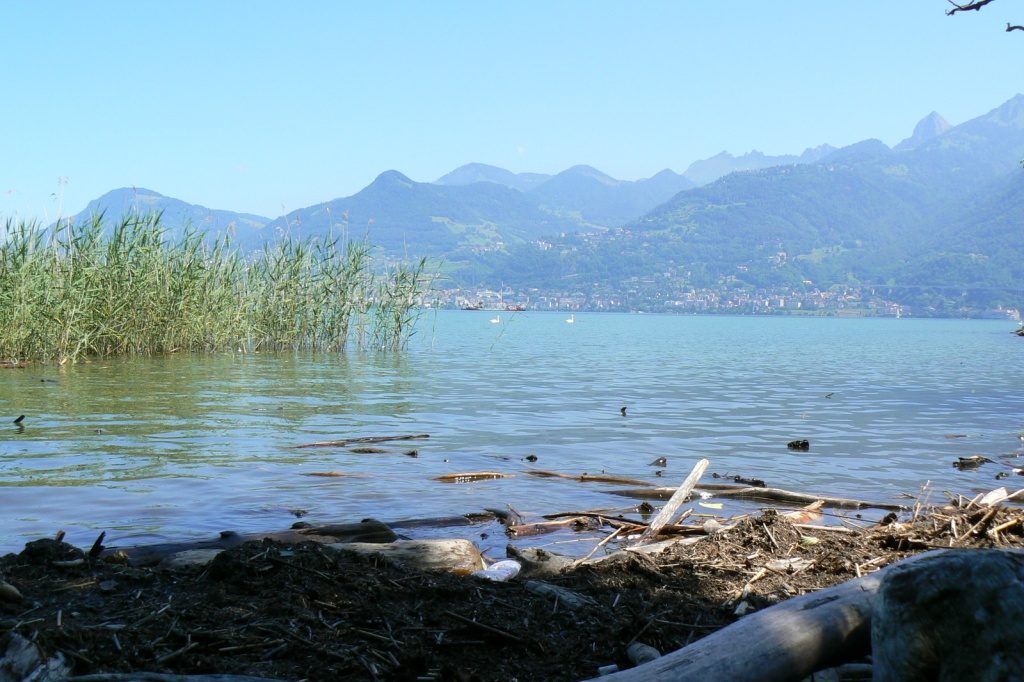
Built on slight rises in the plain, Noville and the hamlet of Crebelley long had to cope with the floods of Lake Geneva and the shifting course of the Rhône.
Entry based on 12 sources · Our method · Reusable text (CC BY-SA)
Origin of the name Noville
Noville is mentioned as « Nova villa » in 903, then « Nouila » in 1162/1173. In old documents it is sometimes hard to tell apart from Villeneuve, which was also called « Villa Nova ». The precise etymology has not yet been explained.[1]
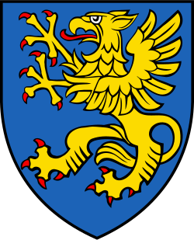
Coat of arms of Noville
Azure a griffin or, armed and langued gules. On a blue field stands a yellow griffin with red claws and tongue. Adopted in 1919, the arms take up the figure of an old seal bought by the municipality in 1783. This seal, used from 1784 to 1816, has been lost since 1832.[8][9]
Founding of Noville
An early medieval cemetery, discovered at Crebelley, shows early occupation, and the village appears in the records at the start of the 10th century. In the Middle Ages the abbey of Saint-Maurice and various lords held rights over its lands, which belonged in temporal matters to the castellany of Chillon and in spiritual matters to the diocese of Sion. Lying on slight rises in the plain, the village and the hamlet of Crebelley long had to cope with the floods of the lake and the shifting course of the Rhône. Who founded Noville, or when, remains unknown.[1][3]
History of Noville
Early Middle Ages. A cemetery is established at Crebelley.[1]
903. First mention of the village as « Nova villa ».[1]
1162/1173. Mentioned as « Nouila ».[1]
1177. The parish church dedicated to Saint Maurice, dependent on the Great Saint Bernard, is attested.[1][3]
13th century. From this period at the latest, Noville, Villeneuve, Rennaz and Crebelley jointly use certain woods and pastures.[1]
1309. A confraternity of the Holy Spirit is attested.[1]
1476. Start of Bernese rule: until 1798 Noville is part of the governorship and mandement of Aigle, as a castellany with Rennaz and Roche.[1][2]
1798. Noville joins the district of Aigle.[1]
1809. Division of the jointly held property with Villeneuve.[1]
1834. Rennaz separates from Noville and becomes a municipality.[2]
1840-1850. Construction of the Grand Canal. Together with the embankment of the Rhône, it allows the arable land to be extended (tobacco, market gardening).[1][3]
1840. First division of the jointly held property with Rennaz, followed by others in 1877, 1905 and 1992.[1][2]
1871. Construction of the municipal hall and school, a neoclassical building on the Place du Crêt, perhaps by the architect François Jaquerod.[3]
1947. Founding of the dairy cooperative.[1]
1980s. Start of residential development.[1][3]
2000. The village has twenty-five farms. More than three fifths of the working population are commuters.[1]
2008. The dairy cooperative is dissolved.[1]
Population of Noville
Sources and references: [1][6]
| 1798 | 207 |
| 1850 | 376 |
| 1900 | 415 |
| 1950 | 467 |
| 1980 | 427 |
| 2000 | 647 |
| 2025 | 1'214 |
Families of Noville
Citizen families before 1800. Bonnavaux, Cathélaz, Chatelan, Chausson, Culand, Dufour, Dulon, Favre, Gailloud, Humberset, Merle, Trollux and Veillard are listed with no precise date. So are the de Palézieux dit Falconnet family, from Vevey VD, and four families from France: de Rameru, Derameru, Dumusc and Dumusque. The dated entries run from 1571, with the Jaquemin family, to 1781. Montreux-Châtelard VD supplied the Monod (1597), Rambert (1612), Coulin (1630) and Dufaux (1781) families. Also admitted were the Borloz of Ormont-Dessous VD (1644), the Perret of Vevey VD (1667), the Favrod of Château-d'Oex VD (1704), the Collomb of Prahins VD (1744) and the Pernet of Ormont-Dessus VD (1770).[10]
In the 19th century. The Schenk family was admitted in 1807, the Falquier family of Veytaux VD in 1834 and the Schalk family, from Germany, in 1847.[10]
From 1901 to 1962. Thirteen entries, including seven families from Italy: Cossetto (1916), Delgrande (1936), Zappeli (1941), Rossi (1948), Giovannoni (1953), Sculati (1956) and Seren-Rosso (1957). The Bédat family was admitted in 1927, the de Mertzenfeld family, from France, in 1932, the Sieveking family, from Germany, in 1940, the Hagen family in 1950 and the Müller family of Boltigen BE in 1956. The last to be registered, in 1962, were the Regad family, from France.[10]
Notable people of Noville
Frédéric Chausson (1831-1876). Born in Noville, Frédéric Chausson studied law in Lausanne and practised as a notary in Aigle from 1856 to 1876. Clerk of the civil court of the Aigle district, he also served as chief judge of the military tribunal. He sat in the National Council as a Radical from 1875 to 1876.[11]
Jean-Marc Bory (1934-2001). Born in Noville, the actor Jean-Marc Bory left for Paris in 1954 to study with Maurice Escande. He played the male lead in Louis Malle's The Lovers (1958) opposite Jeanne Moreau and appeared in some thirty films, including Francis Reusser's Derborence. In 1981 he portrayed Pierre-Nicolas Chenaux for Swiss French-language television.[12]
Economy of Noville, past and present
From marsh to fields. For more than five centuries the plain of Noville remained an uncultivated marsh. Floods from the lake and the meanders of the Rhône often submerged it, until the river was embanked in the 19th century. Dug between 1840 and 1850, the Grand Canal won land for tobacco and market gardening. Land improvements drained the area further from 1918 to 1922.[1][9]
Market gardeners and growers. In 2000 Noville had 25 farms. Livestock farmers can now be counted on the fingers of one hand, replaced by market gardeners and crop growers.[1][9]
The harbour and the campsite. The municipality has three harbour facilities, including a large boatyard on the Vieux-Rhône. On the lakeshore, the Les Grangettes campsite covers 6 hectares and hosts more than 600 residents in high season.[9]
Historic sites in Noville
Church of Saint-Maurice. Parish church dedicated to Saint Maurice, attested in 1177. It was under the canons of the Great Saint Bernard. The bell tower probably predates 1300, while the nave and choir date from the second half of the 15th or early 16th century. Cultural property of regional importance.[1][3][5]
Municipal hall and school of 1871. Neoclassical building erected in 1871 on the Place du Crêt to house the municipality and the school. It is reportedly the work of the architect François Jaquerod.[3]
Les Grangettes nature reserve. A wetland formed on the Rhône delta, where it flows into Lake Geneva, in the municipalities of Noville and Villeneuve. A mire landscape of national importance, it is a reserve of national and international importance for waterbirds and migratory birds (Ramsar Convention).[4]
Grand Canal. Dug from 1840 to 1850 to drain the plain, it allowed crops to be extended, together with the embankment of the Rhône.[1][3]
Remains in Noville
Crebelley cemetery. An early medieval cemetery was discovered in the hamlet of Crebelley. It is the oldest known evidence of settlement in the municipality.[1]
Protected heritage in Noville
Cultural property of regional significance (B objects)[7]
- Cure
- Eglise réformée Saint-Maurice
- Ferme de L'Essert
- Grange (ancien rural de la cure)
Traditions and festivals in Noville
Lovats and Moustiques. The people of Noville are nicknamed the Lovats. Those of the hamlet of Crebelley go by Moustiques, the mosquitoes.[9]
Sources
- Dictionnaire historique de la Suisse, « Noville » (Liliane Desponds, version du 18.12.2014, version allemande consultée)
- Dictionnaire historique de la Suisse, « Rennaz » (Liliane Desponds, version du 25.08.2010)
- Office fédéral de la culture, ISOS, Noville (n° 4260)
- Office fédéral de l'environnement, Inventaire des sites marécageux, objet 289 « Les Grangettes »
- Office fédéral de la protection de la population, Inventaire PBC, liste du canton de Vaud (état au 1.1.2026)
- Statistique Vaud, « Population résidante permanente au 31 décembre 2025 »
- Federal Office for Civil Protection (FOCP), Swiss Inventory of Cultural Property (PCP), list for the canton of Vaud (as of 1.1.2026)
- IPI, Swissreg, emblems database: coat of arms of Noville (no. 102018)
- Official Gazette of the Canton of Vaud (FAO), "Alphabet des communes vaudoises: Noville"
- Register of Swiss Surnames, 3rd edition (1989), search Commune "Noville", Canton VD
- Dictionnaire historique de la Suisse, « Chausson, Frédéric », version du 11.11.1999
- Dictionnaire historique de la Suisse, « Bory, Jean-Marc », version du 13.10.2004
Published by Sébastien Jörg ·
Other villages near Noville
Missing information, or do you have a source? Suggest a correction or addition. Every submission is checked before it's published.
Suggest a change