Villeneuve
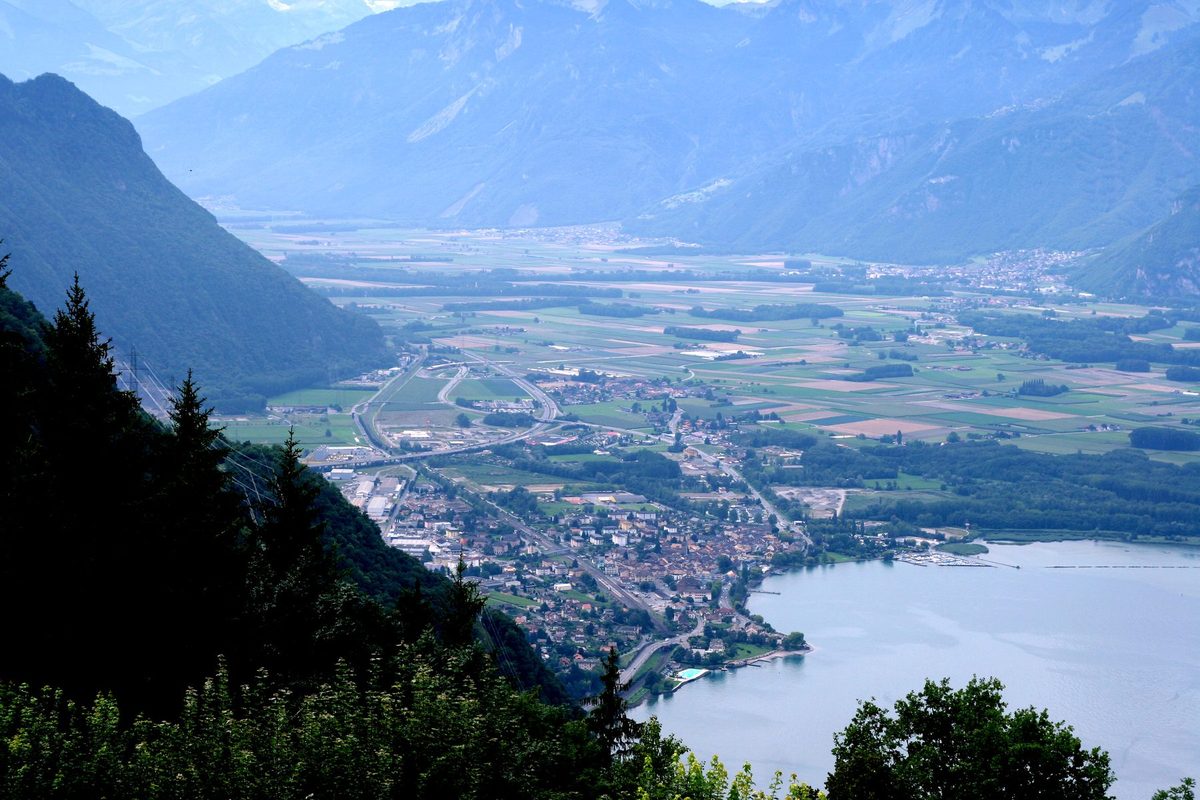
Around 1214 Thomas I of Savoy granted franchises to the «new town of Chillon», the first Savoyard foundation in the region, at the eastern end of Lake Geneva on the Great St Bernard route.
Entry based on 7 sources · Our method · Reusable text (CC BY-SA)
Origin of the name Villeneuve
The place appears around 280 as «Penne Locos», a Roman small town. In 1005 we find «in villa Compendiaco». The present name, «Villanova» (1217), then «in Villa nova Chillionis» (1254), simply means «new town (of Chillon)», referring to its foundation by Savoy.[1]
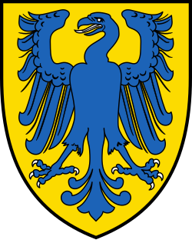
Coat of arms of Villeneuve
Or, an eagle azure. A blue eagle stands out against a yellow field. The FAO's "Alphabet des communes" presents these arms as the oldest in the canton of Vaud and dates them to 1214, when Count Thomas of Savoy founded the Villeneuve de Chillon. The oldest known seals bearing them, however, only date from the 17th century.[4][5]
Founding of Villeneuve
The site was inhabited in Roman times (small town of Penne Locos, settlements at La Muraz and Le Clos du Moulin, necropolis at Valleyres). The present town is the «new town of Chillon», the first foundation of the House of Savoy in the region: around 1214 Count Thomas I of Savoy granted it a charter of franchises. It replaced the borough and toll of Chillon, which had become cramped next to the castle. Around 1236 Aymon of Savoy founded the Notre-Dame hospital there for the poor, pilgrims and the sick.[1]
History of Villeneuve
around 280. Roman small town of «Penne Locos».[1]
Roman period. Settlements at La Muraz and Le Clos du Moulin; necropolis at Valleyres.[1]
1005. The place appears as «in villa Compendiaco».[1]
around 1214. Count Thomas I of Savoy grants a charter of franchises to the «new town of Chillon».[1]
1217. First mention of the name «Villanova».[1]
around 1236. Aymon of Savoy founds the Notre-Dame hospital for the poor, pilgrims and the sick.[1]
around 1395. The town has 170 hearths (households).[1]
1476. Bernese conquest and creation of the government of Aigle. Villeneuve loses its territory on the left bank of the Eau-Froide but stays in the Savoyard bailiwick of Chablais until 1536, then belongs to the Bernese bailiwick of Chillon (Vevey) until 1798.[1]
1803. The town has 862 inhabitants.[1]
1857. The railway links Villeneuve to Bex.[1]
1861. The railway links Villeneuve to Lausanne.[1]
1900. The town has 1'751 inhabitants.[1]
2000. The town has 4'180 inhabitants.[1]
Population of Villeneuve
Sources and references: [1][2]
| around 1395 | 170 hearths (households) |
| 1407 | 113 hearths (households) |
| 1803 | 862 |
| 1850 | 1'161 |
| 1900 | 1'751 |
| 1950 | 1'989 |
| 1970 | 3'705 |
| 2000 | 4'180 |
| 2025 | 6'073 |
Families of Villeneuve
Citizen families before 1800. Twenty-three families with no precise date: Amiguet, Bertholet, Bontems, Burnod, Chablaix, Chenaud, Chenaux, Deleysin, Dulon, Gailloud, Glapey, Glappey, Joly, Lenoir, Masson, Navioz, Nicolet, Perret (of Le Châtelard VD), Pilet, Pilliod, Puenzieux, Rosset and Saladay. The Jaquemin, from Noville VD, became citizens in 1621, the de Loës in 1631 and the Martin, from Rossinière VD, in 1718.[6]
In the 19th century. The Briaux alias Dupertuis, from Ormont-Dessous VD, with no precise date. Then the Fischer (from Germany) in 1885 and the Berger (from France) in 1890.[6]
From 1901 to 1962. Thirty-four entries. Up to 1953 they came mostly from Italy and France: the Poletti (from Italy, in 1918, 1923 and 1939), the Pinget (from France) in 1928, the Rollandin (from Italy, in 1930 and 1931), the Delgrande and the Preti (from Italy) in 1936, the Girardoz (from France) and the Waldmann (from Germany) in 1941, the Comte (from France) in 1945, the Tammann (from Germany) in 1947, the Ansaldo (from Italy) in 1949, the Campana (from Italy) in 1952, then in 1953 the Buffoni and the Maschio (from Italy), the Horn (from France) and the Hlavaceck (from Czechoslovakia). In 1956 seven Swiss families were received: Ammeter of Isenfluh BE, Bridy of Savièse VS, Jaquier of Prez-vers-Siviriez FR, Riesen of Burgistein BE, Trachsel of St. Stephan BE, Voumard of Tramelan-Dessous BE and Wenger of Gurzelen BE. They were followed by the Bertolami (from Italy) and the Clerc of Port-Valais VS in 1958, the Gex of Fully VS and the Lehmann of Worb BE in 1959, and the Stojilikovic (from Yugoslavia) in 1960. The year 1961 saw six entries: Bandini (from Italy), Fäs of Unterkulm AG, Hugli of Hasliberg BE, Jeanloz of Roches BE, Maier of Renan BE and Pieren of Adelboden BE. The last to be entered, in 1962, were the Gippa, from Italy.[6]
Notable people of Villeneuve
Romain Rolland (Clamecy 1866 - Vézelay 1944). From 1922 to 1938 the French writer lived in Villeneuve, at the Villa Olga, an internationalist meeting place for all who shared an ideal of non-violence. In December 1931 he talked there with Mahatma Gandhi.[7][5]
Bastian Baker. The Swiss singer grew up in Villeneuve.[5]
Economy of Villeneuve, past and present
The port and the toll. In the Middle Ages the port is a compulsory transshipment point for goods travelling between Lombardy and the Champagne fairs. The town replaces the borough and toll of Chillon, and the counts of Savoy have their ships built here. The volume of goods falls from the second quarter of the 14th century. Until around the end of the 19th century, barges still carry stone from the Chablais quarries and wine to Lausanne.[1][5]
Quarries, lime and factories. Gypsum is worked at Valleyres from the 14th century, stone from the Arvel quarries from the 15th. Two lime and cement works open in the third quarter of the 19th century. The 20th century brings, among others, a chocolate factory in 1927, a soap works in 1931 and the Ateliers de constructions mécaniques de Vevey in 1947, taken over by Bombardier Transport in 1998. Carrières d'Arvel SA, founded in 1905, is still operating at the start of the 21st century.[1]
Vines and plain. Under Bernese rule, Villeneuve lives from alpine farming and wine. The Eau-Froide plain is drained between 1915 and 1920, which makes market gardening possible. According to the FAO, the vineyard covers more than 61.5 hectares. The Viticole Villeneuve, founded in 1907, brings together 35 owners on 11 hectares.[1][5]
Boats, tourism and motorway. A regular boat service runs from 1828. Tourism begins around 1840 with the Hôtel Byron and a few establishments on the lakeshore. From 1903 a tramway links Villeneuve with Chillon. The A9 motorway, built between 1966 and 1970, has an exit at Villeneuve. In 2005, 60% of the municipality's workforce are commuters.[1]
Disasters and major events in Villeneuve
The fire of 1476. During the Burgundian Wars the town is partly burned. It then loses its influence over the upper end of the lake.[5]
Historic sites in Villeneuve
Savoyard new town. The plan of the town founded around 1214 along the Great St Bernard road still shapes the historic centre.[1]
Notre-Dame hospital. Founded around 1236 by Aymon of Savoy to shelter the poor, pilgrims and the sick on the Alpine road.[1]
Remains in Villeneuve
Roman remains. Roman settlements at La Muraz and Le Clos du Moulin and the necropolis at Valleyres show the small town of Penne Locos.[1]
Protected heritage in Villeneuve
Cultural property of regional significance (B objects)[3]
- Archives communales
- Ecluse de la Joux-Verte (cf. également Corbeyrier)
- Eglise réformée Saint-Paul
- Hôtel de Ville (ancienne chapelle de l'Hôpital)
- Remparts
- Scex du Châtelard, site paléolithique
Traditions and festivals in Villeneuve
The sculpture biennial. Every two years the Villeneuve Culture association shows sculptures on the quays and in the old town.[5]
Sources
- Dictionnaire historique de la Suisse, « Villeneuve (VD) »
- Statistique Vaud, « Population résidante permanente au 31 décembre 2025 »
- Federal Office for Civil Protection (FOCP), Swiss Inventory of Cultural Property (PCP), list for the canton of Vaud (as of 1.1.2026)
- IPI, Swissreg, emblems database: coat of arms of Villeneuve (no. 101322)
- Official Gazette of the Canton of Vaud (FAO), "Alphabet des communes vaudoises: Villeneuve"
- Register of Swiss Surnames, 3rd edition (1989), search Commune "Villeneuve", Canton VD
- Historical Dictionary of Switzerland, "Rolland, Romain", version of 11.11.2010
Published by Sébastien Jörg ·
Other villages near Villeneuve
Missing information, or do you have a source? Suggest a correction or addition. Every submission is checked before it's published.
Suggest a change