Onnens
Around 4700-4500 BC a child aged about three was buried at Praz Berthoud, in Onnens: it is considered the oldest known burial in the canton of Vaud.
Entry based on 13 sources · Our method · Reusable text (CC BY-SA)
Origin of the name Onnens
The village appears as «Unens» in 1228, followed by «curatus de Onnens» in 1361 and «Onnens» in 1453. The name is said to be formed from a Germanic male personal name such as «Huno» or «Unno» and the suffix «-ingos», very common in the cantons of Vaud and Fribourg, meaning «at the home of the people of».[1][6]
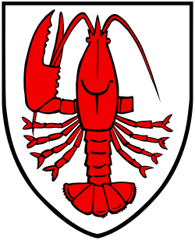
Coat of arms of Onnens
Argent a crayfish gules missing its sinister claw. On a white field, a red crayfish has lost the claw on the right as seen by the viewer. According to tradition, the arms of Onnens and Montagny recall the sharing of a property between the two communities, probably in the early 18th century: Montagny kept the claw that Onnens lacks. The arms appear on a church bell dated 1779.[12][4]
Founding of Onnens
The territory of Onnens has been occupied almost without interruption since about 8000 BC, a date still uncertain: excavations carried out before the construction of the A5 motorway uncovered remains from the Mesolithic to the modern period, including a Neolithic child burial, a Late Bronze Age village and an open Iron Age village on the hill of Le Motti. It is not known who founded the medieval village of Onnens. Its name probably points to a settlement linked to a group with a Germanic name. In the Middle Ages, Onnens formed a mayorie, a court made up of the mayor, a clerk and twelve jurors, dependent on the lordship of Montagny. With it, it was incorporated into the common bailiwick of Grandson (1484-1798), then into the district of Grandson. A parish from 1228, its church of Saint-Martin depended on the charterhouse of La Lance. The inhabitants are nicknamed the Droolers («lè Béviâo» or «lè Baveur», the drinkers in Vaud patois).[1][2][4][6]
History of Onnens
around 8000 BC. Beginning of an almost uninterrupted occupation of the territory, probably at the place called Praz Berthoud, near a permanent spring.
4700-4500 BC. Burial of a child aged about three at Praz Berthoud, considered the oldest known burial in the canton of Vaud.[2]
Neolithic. Neolithic stations; erection of menhirs and of a dolmen at Praz Berthoud.
1280-800 BC. Late Bronze Age village: post-built buildings in rows (1280-1200 BC), then large rectangular hearths (1050-800 BC).[3]
Iron Age. Open village on the hill of Le Motti, a major site of the Swiss Plateau for this period, and two burial mounds.[9]
Roman period. Traces of occupation, including a brooch.
1228. First mention, «Unens»; Onnens is already a parish.[1][6]
1361. Mention of a «curatus de Onnens».
Middle Ages. Onnens forms a mayorie dependent on the lordship of Montagny. The church of Saint-Martin depends on the charterhouse of La Lance.[1][6]
1484. Together with Montagny, Onnens joins the common bailiwick of Grandson, administered by Bern and Fribourg until 1798.[1][6]
16th century. With the Reformation, Onnens forms a parish with Bonvillars.[1]
1722. Partial rebuilding of the church nave. The church keeps its Gothic choir.[7]
1779. Date of a bell of the temple bearing the municipal coat of arms with the crayfish.
1798. Onnens joins the district of Grandson, to which it belongs until 2007. From 1798 to 1803 it belongs to the canton of Léman.
1846. Onnens is attached to the parish of Concise.[1][6]
1973. Construction of a warehouse.[1]
1990. A cigarette production line of the Fabriques de tabac réunies (Philip Morris) is set up.[1][6]
1995-2004. Archaeological excavations along the route of the A5 motorway: eight of the sixteen sites on the Yverdon-Neuchâtel section are in Onnens.[2][3]
2005. Opening of the A5 motorway.[1]
2008. Onnens belongs to the new district of Jura-Nord vaudois.
2019. After Philip Morris leaves, the Swiss logistics centre of Decathlon settles in Onnens.[10]
Population of Onnens
Sources and references: [1][5][6]
| 1803 | 258 |
| 1850 | 328 |
| 1900 | 341 |
| 1950 | 275 |
| 1970 | 223 |
| 2000 | 397 |
| 2025 | 527 |
Families of Onnens
Citizen families before 1800. Apothélos, Apothéloz, Filleux, Fillieux and Mayor.[13]
In the 19th century. Dagon, Perdrisat and Perdrizat, with no precise date.[13]
From 1901 to 1962. Four entries: the Boiti family, from France, in 1952, the Ponsot family, also from France, in 1955, the Hurlimann family of Walchwil ZG in 1957 and the Schwab family of Fribourg FR in 1961.[13]
Economy of Onnens, past and present
Vines, fields and forest. Onnens remains a farming and wine-growing village, with some forestry. In 2005 the primary sector provided 15% of jobs. One winegrowing family sells its own wine, while others deliver their grapes to the Cave de Bonvillars.[1][4]
Tobacco, logistics and solar panels. The Fabriques de tabac réunies, part of the Philip Morris group, built a warehouse in 1973 and installed a cigarette production line in 1990. Since 2016 the site of the former warehouses has held 49'000 m² of solar panels, producing the equivalent of what 2'000 households use. The industrial zone also attracts large logistics firms.[1][4]
Water for northern Vaud. The wells of Onnens supply about 6'000 m³ of water a day, enough for a large part of northern Vaud.[4]
Historic sites in Onnens
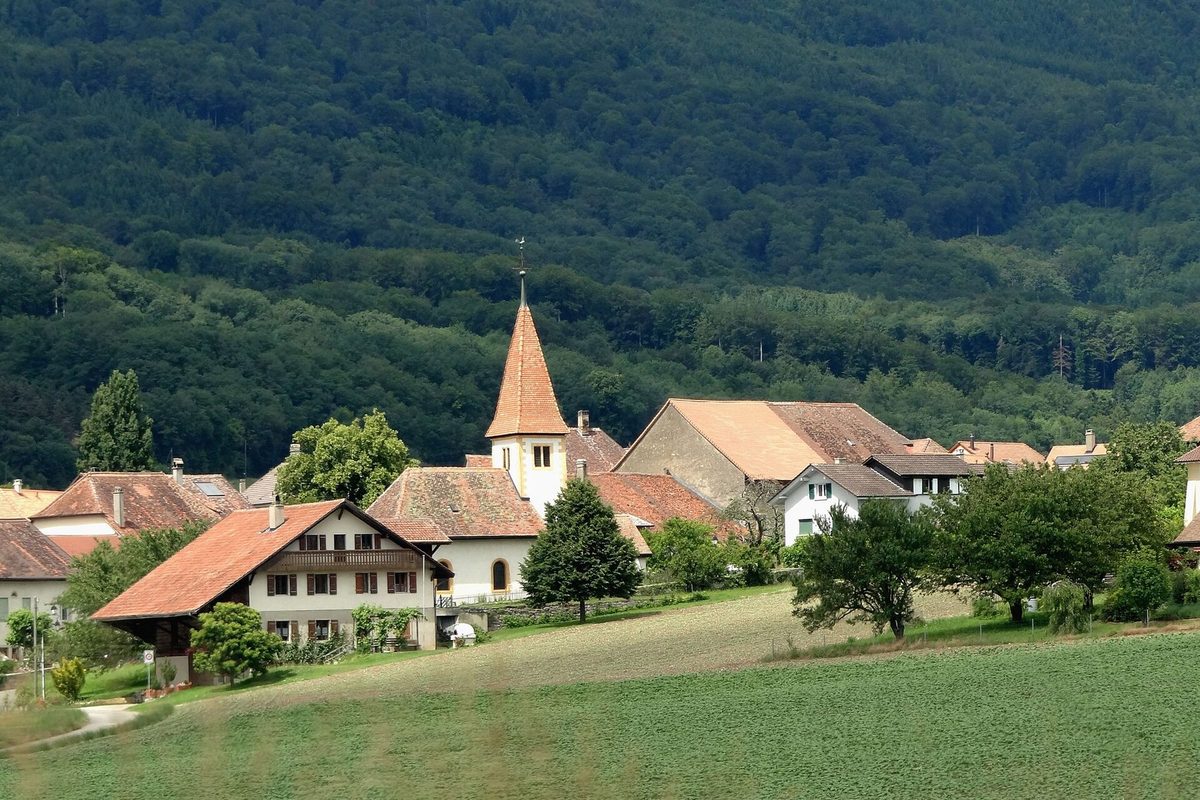
Church of Saint-Martin. Reformed church listed as a cultural property of national importance. Mentioned as a parish from 1228 and dependent in the Middle Ages on the charterhouse of La Lance, it preserves a Gothic choir decorated with wall paintings (Entombment, Last Judgement) dated to the 15th or 14th century; the dating is uncertain. It has stained-glass windows by the Polish painter Józef Mehoffer.[1][6][7][8]
Village listed in the ISOS. The whole village, with its 18th- and 19th-century farmhouses, is listed in the Federal Inventory of Swiss Heritage Sites of national importance.[6]
La Chassagne. Dry, steppe-like slope, listed in the Federal Inventory of Dry Grasslands and Pastures of national importance.[1]
Remains in Onnens
Dolmen of Praz Berthoud. Megalithic monument presented as the first attested megalith in the canton of Vaud and open to the public. It is also described as a destroyed dolmen, which is uncertain.
Menhirs. The municipal territory reportedly has several menhirs, including the Menhir de la Vernette.
Praz Berthoud site. Place occupied in more than fifteen different periods: flints over 10'000 years old, a Bronze Age pin, two Iron Age burial mounds, a Roman brooch, a medieval water pipe and the grave of a child dated 4700-4500 BC.[2]
Hill of Le Motti. Open Iron Age village (around 700-600 BC), excavated from 1997 to 2004: about fifteen buildings, their walls sometimes coated with painted plaster, and about 60'000 pottery sherds.[9]
Late Bronze Age village. Discovered beneath the motorway route, it had at least six post-built buildings and yielded traces of bronze working, pottery, textile work, grain milling and livestock farming.[3]
Protected heritage in Onnens
Cultural property of national significance (A objects in the PCP inventory)[11]
- Église réformée Saint-Martin
Cultural property of regional significance (B objects)[11]
- L'Ile, station palafittique néolithique - Age du Bronze
- La gare, station lacustre néolithique - Age du Bronze
Legends of Onnens
The one-clawed crayfish. The coat of arms of Onnens shows a red crayfish missing its left claw. According to tradition, in an old division of property with Montagny, it was Montagny that received the missing claw.[4]
Sources
- Dictionnaire historique de la Suisse, « Onnens (VD) »
- Commune d'Onnens, « Fouilles archéologiques »
- État de Vaud, « Sous l'autoroute, un village de l'âge du Bronze final à Onnens » (2014)
- Feuille des avis officiels du canton de Vaud, « Alphabet des communes vaudoises : Onnens »
- Statistique Vaud, « Population résidante permanente au 31 décembre 2025 »
- Inventaire fédéral des sites construits d'importance nationale à protéger en Suisse (ISOS), fiche 4385 « Onnens »
- Inventaire fédéral des biens culturels (PBC), fiche 06364 « Église réformée Saint-Martin », texte de la Société d'histoire de l'art en Suisse
- Office fédéral de la protection de la population, Inventaire PBC, liste du canton de Vaud (état au 1.1.2026)
- État de Vaud, « Parution de deux nouveaux Cahiers d'archéologie romande », communiqué du 23 janvier 2019
- Allnews, « Procimmo loue une surface de 18'000 m2 à Decathlon », 16 janvier 2019
- Federal Office for Civil Protection (FOCP), Swiss Inventory of Cultural Property (PCP), list for the canton of Vaud (as of 1.1.2026)
- IPI, Swissreg, emblems database: coat of arms of Onnens (no. 101288)
- Register of Swiss Surnames, 3rd edition (1989), search Commune "Onnens", Canton VD
Published by Sébastien Jörg ·
Other villages near Onnens
Missing information, or do you have a source? Suggest a correction or addition. Every submission is checked before it's published.
Suggest a change