Provence
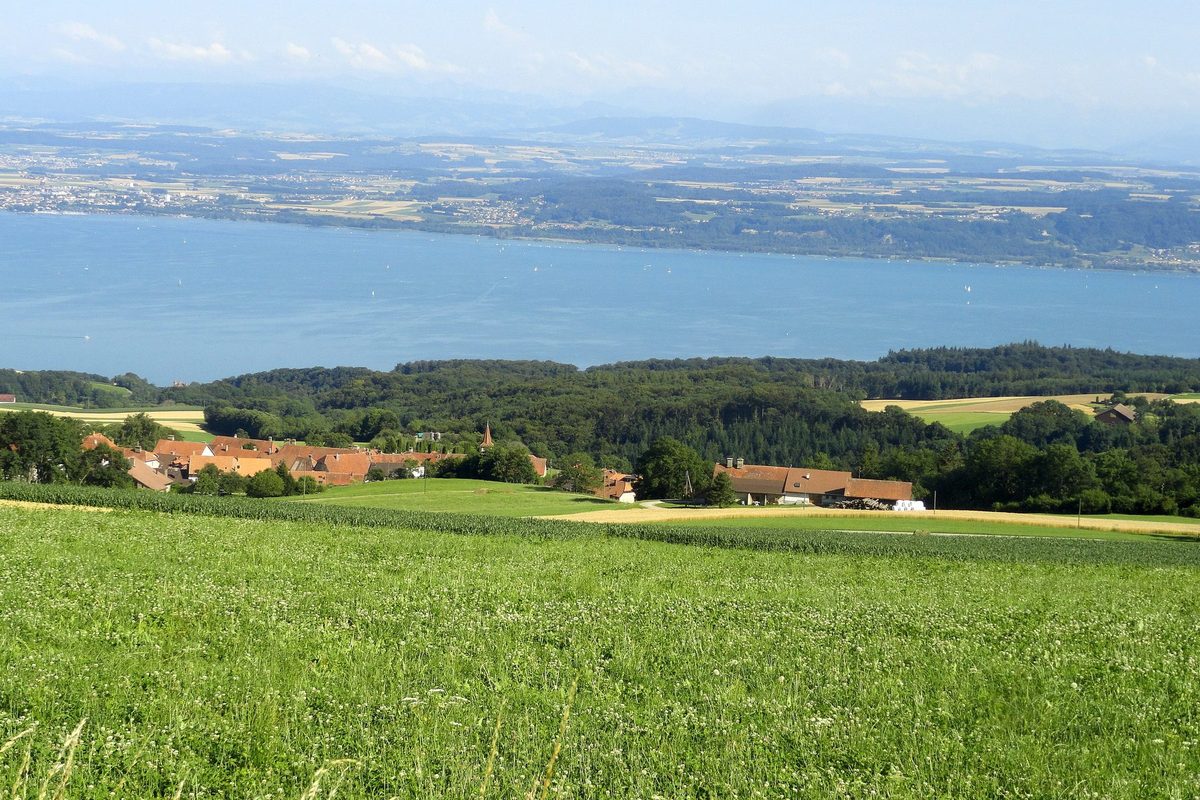
At the foot of Mont Aubert, Provence's territory stretches to the Creux-du-Van. Roger Schutz, the future Brother Roger and founder of Taizé, was born here in 1915 and spent his childhood here.
Entry based on 11 sources · Our method · Reusable text (CC BY-SA)
Origin of the name Provence
Apparently first mentioned in 1340 in the form «Provency», then «Provincia» in 1359 and «Provenica» in 1403. The name probably derives from the Latin «proventus» (harvest, yield).[4]
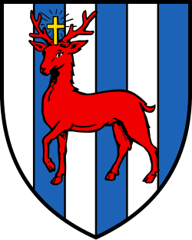
Coat of arms of Provence
Paly argent and azure, a stag gules overall, its head facing, surmounted by a radiant Latin cross Or. The shield is striped vertically in white and blue. A red stag, head facing forward, lies over the stripes. Between its antlers rises a yellow Latin cross surrounded by rays. In 1927 the municipality chooses to recall its medieval link to the barony of Grandson by taking over the white and blue striped field of those lords. The stag's radiant cross is the attribute of Saint Hubert.[9][10]
Founding of Provence
Nobody knows who founded Provence. Traces of iron smelting, reportedly dated to the 4th-6th centuries, point to early occupation. In the Middle Ages the locality belonged partly to the county of Neuchâtel before being incorporated into the lordship of Grandson. In 1340 two thirds of the village reportedly belonged to the lordship of Grandson and one third to the counts of Neuchâtel. The municipality, bordering the Val-de-Travers, comprises the village, the hamlet of Les Prises, the Montagne Devant and the territory of the Nouvelle Censière. Long attached to the Neuchâtel parish of Saint-Aubin, it became a Vaud parish only in 1848.[4]
History of Provence
4th-6th centuries. Traces of iron smelting reportedly attest early occupation of the territory.
1180. A religious building is reportedly mentioned at Provence.
1340. First mention, in the form «Provency». The locality then belongs partly to the county of Neuchâtel and partly to the lordship of Grandson.[4]
before 1400. The whole village reportedly passes to the lords of Grandson.
1453. Mention of the chapel of Saint-Georges.
1476. After the Burgundian Wars, the Grandson area becomes a bailiwick shared by Bern and Fribourg.
1484-1798. Provence forms a métralie with Mutrux (dates uncertain).
1540. A fire destroys 64 houses in the village.[4][5]
1605. Georges Driol, owner of the house that later became the parsonage, is sentenced to death.[5]
1631. A new disaster makes a complete rebuilding of the church necessary.[4][5]
1706. Construction of the present parsonage. The date of the present church (1687-1701 or 1706) is uncertain.[4]
1798. Provence is assigned to the district of Grandson, to which it belongs until the end of 2007.
1847. Half of the village is destroyed by fire.[5]
1848. Until then attached to the Neuchâtel parish of Saint-Aubin, Provence becomes a Vaud parish together with Mutrux.[4]
19th century. Lace-making and watchmaking employ part of the population.[4]
1883. A cheese dairy opens, followed by a dairy in 1904.[4]
1905. Major renovation of the church.[4]
1915. Birth in Provence of Roger Schutz, the future Brother Roger, founder of the Taizé community, who spends his childhood in the village, where his father is pastor.[5][7]
1966. The Les Rochat military firing range is set up.
1970. Closure of the intercantonal school of the Nouvelle Censière.
2008. On 1 January 2008, with the reform of the Vaud districts, the district of Grandson is dissolved and Provence joins the district of Jura-Nord vaudois.
Population of Provence
Sources and references: [3][4]
| 1803 | 811 |
| 1850 | 956 |
| 1900 | 815 |
| 1950 | 447 |
| 1980 | 300 |
| 2000 | 368 |
| 2025 | 421 |
Families of Provence
Citizen families before 1800. Twenty-five families. Allisson, Bastardot, Bastardoz, Bolens, Colomb, Colomb-dit-Delay, Delay, Favre, Franel, Frête, Gacond, Gaille, Gattolliat, Girard, Jeanmonod, Mariller, Perrin, Raymondaz, Reymondaz, Rougemont, Roulin and Vuillermet are citizens with no precise date, as are the de Buren, from Bern, and the de Montmollin, from Neuchâtel. The Vouga, from Cortaillod NE, are admitted in 1793.[11]
From 1901 to 1962. No registration in the 19th century. Then twenty-two families, mostly Italian: Magistris (1917), Vietti (1923), Greppi (1929), Morandi and Uberti (1940), Righi (1953 and 1957), Capraro and Granato (1954), Vout (1958 and 1960), Giubin (1960) and Licata (1962), the last on the list. From Germany come the Güthlin (1930), Zill (1947), Timeus (1956) and Hitzschke (1957), from Austria the Neuwirth (1953) and from Yugoslavia the Mercier (1940). The Liechti of Landiswil BE and the Guillaume of Les Verrières NE join in 1957. The Hénault (1916), Nanchen (1938) and Verdon (1947) have no place of origin listed.[11]
Notable people of Provence
Roger Schutz, Brother Roger. He grows up in the parsonage at Provence. As Brother Roger, he founds the Taizé community.[10]
Economy of Provence, past and present
Livestock. Farming long remained Provence's main resource. The municipality is geared to livestock, with 26 farms in 2000, and the primary sector provides half of all jobs in 2005. In 2026 the alpine pastures are fully used, the territory holds about 3'500 head of cattle and nearly half of working residents remain tied to the land and livestock.[1][4][10]
Lace and watchmaking. In the 19th century, bobbin lace and watchmaking employ many villagers. The decline of this industry then leads to heavy emigration.[1][4]
The cheese dairy. A cheese dairy society exists from 1883, the Nouvelle Censière dairy society from 1904. Built in 1984 and enlarged in 2008, the cheese dairy processes more than 2.7 million litres of milk a year. Joiners, an earthworks firm and a garage round out the village's activity.[1][4][10]
Disasters and major events in Provence
The fires of 1540, 1631 and 1847. Three great fires mark the village's history. In 1540 fire ravages 64 houses. In 1631 ten houses are wiped out, along with the church, rebuilt in 1687, whose façade is completed only in 1701. In 1847 the flames destroy half the village, including the central block with the school and the municipal hall. These two buildings are restored a year later, and most houses in the village core are rebuilt.[4][10]
Historic sites in Provence
Church and parsonage. Preceded by the chapel of Saint-Georges, mentioned from 1453, and by a church rebuilt after the disaster of 1631, the present church (1687-1701 or 1706, date uncertain) and the parsonage of 1706 dominate the village. The church was renovated in 1905. Roger Schutz, the future Brother Roger of Taizé, spent his childhood in Provence, where his father was pastor.[4][5]
Village of Provence. The entire village is listed in the Federal Inventory of Swiss Heritage Sites of national importance (ISOS).[4]
La Redalle alpine chalet. Located in the municipality's vast mountain territory, this alpine chalet is listed as a cultural property of national significance.[6]
La Nouvelle Censière. Part of the municipality near the Neuchâtel border, where an intercantonal school operated until 1970.
Remains in Provence
Traces of early iron-working. Remains of iron production dated to the 4th-6th centuries are said to attest early occupation of the territory.
Protected heritage in Provence
Cultural property of national significance (A objects in the PCP inventory)[8]
- Chalet d'alpage La Redalle et boiton
Traditions and festivals in Provence
The Jeunesse Les Vagabonds. The village youth society is called Les Vagabonds. In 2019 it organises the Rencontres of the Vaud federation of rural youth societies (FVJC).[10]
Celebrations shared with Mutrux. Provence hosts the 1 August celebration every other year, taking turns with neighbouring Mutrux. The brass band La Jurassienne brings together the musicians of both villages.[10]
24 January. Every year on 24 January, the village celebrates Vaud independence.[10]
Sources
- Dictionnaire historique de la Suisse, « Provence »
- Feuille des avis officiels du canton de Vaud, « Alphabet des communes vaudoises : Provence »
- Statistique Vaud, « Population résidante permanente au 31 décembre 2025 »
- Office fédéral de la culture, ISOS (Inventaire fédéral des sites construits d'importance nationale à protéger en Suisse), « Provence », n° 4375, 2e version, août 2011
- Commune de Provence, « Histoire et armoiries »
- Office fédéral de la protection de la population, Inventaire des biens culturels (PBC), données géographiques, commune de Provence (objet 10350, chalet d'alpage La Redalle et boiton, catégorie A)
- François Boulet, « Taizé, les protestants français et Marc Boegner (1940-1970) », Revue d'histoire du protestantisme, 5/4, 2020
- Federal Office for Civil Protection (FOCP), Swiss Inventory of Cultural Property (PCP), list for the canton of Vaud (as of 1.1.2026)
- IPI, Swissreg, emblems database: coat of arms of Provence (no. 101551)
- Official Gazette of the Canton of Vaud (FAO), "Alphabet des communes vaudoises: Provence", issue of 20 October 2026
- Register of Swiss Surnames, 3rd edition (1989), search Commune "Provence", Canton VD
Published by Sébastien Jörg ·
Other villages near Provence
Missing information, or do you have a source? Suggest a correction or addition. Every submission is checked before it's published.
Suggest a change