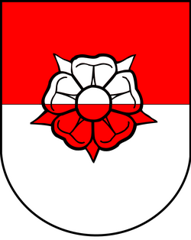
Fresens
During the republican unrest of 1831, Fresens was the first commune of the Béroche to put up a liberty tree.
Entry based on 6 sources · Our method · Reusable text (CC BY-SA)
Origin of the name Fresens
The village is mentioned in 1265 in the phrase « Hiremanz dit de Fressen », designating an inhabitant called « of Fressen »: the place therefore already existed. The name is said to be formed from a personal name of Burgundian or Gallo-Roman origin, Frigis, with the suffix -ens, very common in French-speaking Switzerland.[1]
Founding of Fresens
The area was inhabited from the Neolithic, as the Trou des Âmes dolmen shows. In Roman times the Vy d'Etra passed through it: a Roman wall and paving of this road survive near the Pont Porret, and traces of a Roman building have been found at La Salette. A Merovingian cemetery was discovered at Le Tombet. In the Middle Ages Fresens belonged to the allodial estate of Gorgier, which passed to the lords of Estavayer in the 13th century. The castellany of Gorgier became a fief of the house of Neuchâtel in 1344. The village belongs to the parish of Saint-Aubin. Seigneurial accounts from around 1360, kept in the Neuchâtel State Archives, list the inhabitants' dues (wheat, capons, beeswax, walnut oil) and the lord's rights (fines, transfer dues, rents payable at Saint-Maurice). No founder or act of foundation is known for Fresens, which grew up gradually.[1][2][3]
History of Fresens
Late Neolithic (end of the 4th, beginning of the 3rd millennium BC). The oldest attested occupation in the territory of Fresens: a dolmen with a pierced slab, known today as the Trou des Âmes, is erected beside what would later become a road, in the upper part of the village.[2]
Roman era. The Vy d'Etra crosses the area: a Roman wall and paving of this road survive near the Pont Porret, and traces of a Roman building have been found at La Salette. A large Roman villa dominated the southern part of the village. Its materials were probably reused in later houses.[1][3]
Merovingian period. A cemetery is laid out at the place called Le Tombet.[1]
1265. First known written mention: a certain « Hiremanz dit de Fressen » is named, which implies that the place already existed.[1]
1344. The castellany of Gorgier, to which Fresens belongs, becomes a fief of the house of Neuchâtel.[1]
1356. The conflict between Louis de Neuchâtel and Arthaud d'Estavayer over possession of the seigneury of Gorgier-Vaumarcus, which includes Fresens, results in the occupation of this seigneury and marks the beginning of richer documentation about the village.[3]
1359-1378. At dates that are not well known, the seigneury of Gorgier, to which Fresens belongs, passes from the d'Estavayer family to the House of Neuchâtel (Louis Ier de Neuchâtel, then his daughter Isabelle de Neuchâtel), before returning to the d'Estavayer family, probably in 1378.
around 1360. Seigneurial accounts kept at the Archives de l'État de Neuchâtel detail the obligations of the inhabitants of Fresens toward their lord: wheat for the communal oven (7 coupes annually), 16 capons, beeswax and walnut oil, as well as fines, lods (transfer dues) and rents (land taxes) payable at Saint-Maurice.[3]
1433. The seigneury of Gorgier, including Fresens, reportedly passes to Jean de Neuchâtel-Vaumarcus.
1806. The principality of Neuchâtel, on which Fresens depends, is ceded by the King of Prussia to Emperor Napoleon I, who turns it into a principality for his marshal Alexandre Berthier.[5]
1815. Following the Congress of Vienna, the principality of Neuchâtel joins the Swiss Confederation as the 21st canton, while remaining a possession of the King of Prussia. This mixed status, unique in Switzerland, reportedly also applies to Fresens.
1831. Fresens is the first commune of the Béroche to put up a liberty tree, during the republican unrest of 1831.[1]
1856-1857. The Neuchâtel affair, a royalist counter-revolutionary attempt followed by an international diplomatic settlement, ends the status of Prussian principality. Neuchâtel from then on becomes a full-fledged Swiss canton, like the others, though the details are unclear.
19th century. The village remains agricultural; some inhabitants find work in textile crafts, above all bobbin lace-making.[1]
1914. A small joinery opens; it switches to industrial production in 1971.[1]
1 January 2018. Fresens merges with Bevaix, Gorgier, Saint-Aubin-Sauges, Vaumarcus and Montalchez to form the new municipality of La Grande Béroche, of which it becomes a locality. The village has kept its rural character.[1][4]
Population of Fresens
Sources and references: [1]
| 1632 | 181 (38 houses) |
| 1750 | 169 |
| 1850 | 193 |
| 1880 | 234 |
| 1900 | 175 |
| 1950 | 147 |
| 2000 | 218 |
| 2010 | 215 |
| 2017 | 252 |
Families of Fresens
Citizen families before 1800. Banderet, Gaccon, Gacon, Gacon dit Carême, Gaudard, Jacot, Millet, Porret and Richardet, with no precise date.[6]
In the 19th century. Bippus and Sudmann, with no precise date. The Zwahlen family, from Wahlern BE, was registered in 1889.[6]
From 1901 to 1962. Five registrations. The Scuri came from Pregassona TI in 1905. Provence VD supplied the Gattolliat family in 1906 and the Jeanmonod family in 1920. The Martin family followed in 1936. The last family registered, in 1961, was the Cursaz family, from France.[6]
Economy of Fresens, past and present
The fields. Fresens has always lived from farming. The village kept its rural character into the 21st century.[1]
Lace and joinery. In the 19th century a few inhabitants worked in textiles, mainly bobbin lace. A small joinery, opened in 1914, moved to industrial production in 1971.[1]
Historic sites in Fresens
The Trou des Âmes dolmen. In the upper part of the village, beside the road, stands a stone slab pierced by an oval opening about 40 by 26 cm, a remnant of a pierced-slab dolmen of the type known as Schwörstadt, dating from the Late Neolithic. It was identified during the Second World War, during a survey of megalithic monuments in the region, and belongs to a family of similar dolmens, including those of Onnens (VD), Courgenay (JU), and the one from Auvernier displayed at the Laténium, in Hauterive (NE).[2]
The la Pompe fountain. Old village fountain topped with a wooden shingle roof. It is said to be a characteristic heritage feature of Fresens.
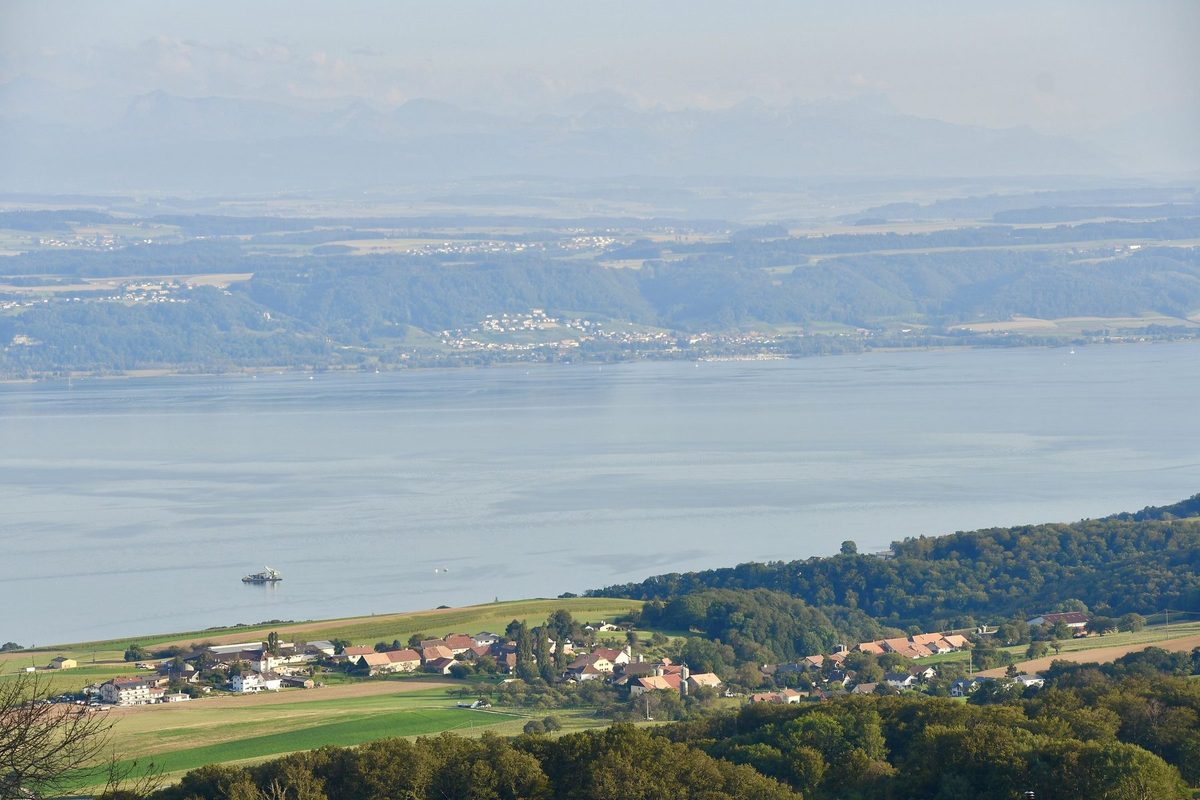
The Fresens terrace and its viewpoint. The village is built on a terrace overlooking the lac de Neuchâtel, at about 620 metres above sea level (figure uncertain), with a view over the lake and the Alps. The highest point of the municipal territory, on the slope above the village, is said to reach 690 metres.
Remains in Fresens
The Trou des Âmes dolmen (Late Neolithic). The only surviving megalithic remnant in Fresens: a stone slab pierced by an oval opening, part of a pierced-slab dolmen dating from the end of the 4th or beginning of the 3rd millennium BCE. The slab today measures about 1.3 by 1.3 metres. It was formerly larger, and its opening was once located at the centre. Other, smaller slabs serve as fencing further down the slope.[2]
Roman remains. A Roman wall and paving of the Vy d'Etra survive near the Pont Porret, and traces of a Roman building have been found at La Salette. A large Roman villa also dominated the southern part of the village. Its materials were probably reused in the houses of the rue des Fontaines.[1][3]
Merovingian cemetery of Le Tombet. A cemetery of the Merovingian period has been uncovered at the place called Le Tombet.[1]
Sources
- Dictionnaire historique de la Suisse, « Fresens » (Olivier Girardbille)
- Archeoplus, Fresens (NE), le dolmen du Trou des Âmes
- Association des Sociétés d'histoire de La Grande Béroche, Fresens vers 1360
- Gemeinde-Commune-Comune.ch, fiche commune Fresens (statut administratif, fusion, gentilé)
- Dictionnaire historique de la Suisse, « Neuchâtel (canton) » (Lionel Bartolini, version du 30.05.2017)
- Register of Swiss Surnames, 3rd edition (1989), search Commune "Fresens", Canton NE
Published by Sébastien Jörg ·
Other villages near Fresens
Missing information, or do you have a source? Suggest a correction or addition. Every submission is checked before it's published.
Suggest a change