
Rances
Village on a plateau overlooking the Mujon valley, at the foot of the Suchet, rich in prehistoric archaeological sites and once the seat of a Bernese court of justice.
Entry based on 6 sources · Our method · Reusable text (CC BY-SA)
Origin of the name Rances
The village is mentioned in 972/973 in the form «Rancias», when a certain Romanus gave the bishop of Lausanne fields he owned there. The form «Rances» appears in 1228. The name reportedly derives from the Roman family name «Rancius» or «Rantius», though this is not confirmed. The inhabitants are called Ransignolets.[1][2]
Coat of arms of Rances
Argent, a vine vert fructed with four bunches of grapes gules, twined around a column or. On a white field, a green vine bearing four red bunches of grapes winds around a yellow column. The authorities chose in the early 20th century the arms of the de Gallera family, which had held the métralie (local judicial office) of Rances since 1286.[5][2]
Founding of Rances
Rances has no known founder. The area was settled long before the Middle Ages, as shown by Neolithic and Bronze Age settlements, Iron Age burial mounds, La Tène graves and an early medieval cemetery. Mentioned in the 10th century, Rances became the main locality of the lordship (castellany) of Les Clées. Under Bernese rule the village was the seat of a court of justice.[1]
History of Rances
Neolithic. Occupation of the site: Neolithic pottery and possibly Neolithic cup-marked stones at Vy-des-Buissons. Bell Beaker pottery at Sur-la-Cheneau and Champ-Vully.[1]
Middle Bronze Age. A settlement with hundreds of post holes extends over Champ-Vully.[1]
Late Hallstatt. Burial mounds at Champs des Bois, Bois du Vuavre and Le Montet. At Champs des Bois a central grave contains the remains of a chariot, a bronze basin, a belt plate and an iron dagger.[1]
Early La Tène. Burials at Champs des Bois, Pra Técoz and Vy-des-Buissons.[1]
Early Middle Ages. A cemetery extends over Champ-Vully.[1]
972/973. First written mention, «Rancias».[1][2]
1228. The church of Saint-Sulpice is a parish church. First appearance of the form «Rances».[1][2]
1286. The de Gallera family acquires the mayoralty (métralie) of Rances.[1]
1371. The inhabitants are exempted from all tolls in the barony of Vaud, a privilege reaffirmed in 1517 and 1698.[2]
1536. Under Bernese rule Rances belongs to the bailiwick of Yverdon until 1798 and becomes the seat of a court of justice. The village adopts the Reformation.[1]
1539. Jacques de Gallera sells the mayoralty to Bern.[1]
1541. The parsonage is built (or in 1540, date uncertain), described as the first built in the canton.[1][2]
1548. A fire devastates the village. Only the church, the parsonage and 19 houses are spared.[1][2]
1798. The municipality becomes part of the district of Orbe.[1]
1820. The choir of the church collapses and is rebuilt the same year slightly askew.[2]
1889. A dairy opens.[1]
1896. Restoration of the church of Saint-Sulpice.[1]
1989. The opening of the A9 motorway speeds up residential development.[1]
2000. Rances and Valeyres-sous-Rances join the parish of Baulmes-Rances.[1]
2008. With the new districts coming into force on 1 January, the municipality joins the district of Jura-Nord vaudois.
Population of Rances
Sources and references: [1][3]
| 1684 | 80 hearths (households) |
| 1764 | 385 |
| 1850 | 518 |
| 1900 | 493 |
| 1950 | 412 |
| 1970 | 314 |
| 2000 | 419 |
| 2025 | 513 |
Families of Rances
Recordon. Coming from Sainte-Croix VD, the Recordon became burghers of Rances in 1679. Among the village's burgher families they hold a special place. The family produced Frédéric-François-Louis, co-founder of the asylum for the blind, after whom an avenue in Lausanne is named, and Benjamin, the architect in charge of building the Federal Supreme Court.[2][6]
Burgher families before 1800. Bavet, Caillachon, Cand, Contesse, Cottens, May, Mayland, Pinard, Pisler, Randin, Ravey, Simonin, Tréhan, Villanchet and Vuitel appear with no precise date. The Recordon, from Sainte-Croix VD, were received in 1679.[6]
From 1901 to 1962. Four entries: the Mouchian in 1931, the Cordero, from Italy, in 1953 and 1957, the Crausaz in 1956 and the Spitteler from Bennwil BL in 1957.[6]
Economy of Rances, past and present
Vines, fields and alpine pastures. The territory of Rances rises from vineyards through fields and forests to alpine pastures. In 1663 and 1672, Bern took measures to limit new vine planting in today's Côtes de l'Orbe area. Surviving cellar inventories nevertheless show that the Bernese appreciated the wine of Rances. In 2005 the primary sector still provided 45% of jobs. Mont Suchet (1'588 m) and the summer pasture of La Mathoulaz are the municipality's tourist spots.[1][2]
The marshes. The marshes supplied fodder and served as grazing for small livestock, especially sheep. They were first drained in the 1880s and 1890s. Only the Marais de Rances remains, now strictly protected.[2]
Crafts, fair and credit. Bern authorised an annual fair at Rances, recorded before 1700 and last held in the 1930s. The Caisse de crédit mutuel opened in 1907. In the 1920s the village had two wheelwrights, three shoemakers, a cooper, a saddler, three blacksmiths, two carpenters, a joiner, a pork butcher, two masons, two cheesemakers, a baker, a grocer and three innkeepers.[2]
Disasters and major events in Rances
The Bernese troops in 1536. On 22 February 1536, Bernese troops on their way to besiege Yverdon camped at Rances and received the village's submission.[2]
The fire of 1548. Local tradition blames a Mrs Caillachon, who was chatting with neighbours at the village fountain. The chronicler Pierrefleur of Orbe, a contemporary, names instead a certain Claude of the Caillachon family, who lost three children in the fire.[2]
Historic sites in Rances
Church of Saint-Sulpice. A parish church since 1228, it retains 15th-century elements and was restored in 1896. Its parish included L'Abergement, Sergey and Valeyres-sous-Rances, as well as Montcherand until 1662 and from 1846 to 1849.[1]
Parsonage of Rances. Built in 1540 or 1541 (date uncertain), shortly after the Reformation, it is described as the first parsonage built in the canton. It escaped the fire of 1548.[1][2]
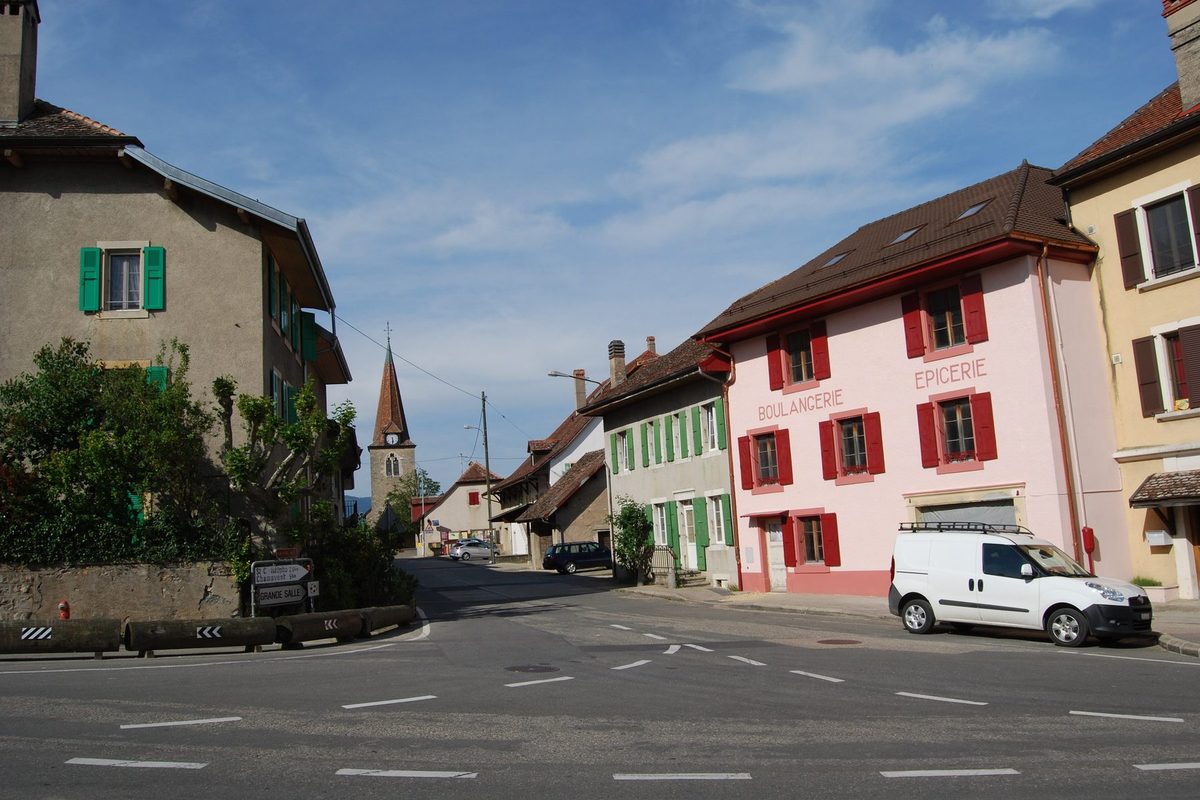
Village of Rances. The whole village is listed in the Federal Inventory of Swiss Heritage Sites (ISOS).[2]
The Suchet. The municipal territory rises to the Suchet, where the municipality owns four alpine pastures.[2]
Remains in Rances
Hallstatt burial mounds. From the 19th century, Frédéric Troyon and other researchers excavated burial mounds at Champs des Bois, Bois du Vuavre and Le Montet. Champs des Bois, the first site in the canton to be explored scientifically, yielded a Late Hallstatt central grave with the remains of a chariot, a bronze basin, a belt plate and an iron dagger, as well as an early La Tène burial.[1]
Champ-Vully settlement. The 1974-1981 excavations uncovered a Middle Bronze Age settlement (hundreds of post holes, pottery, stone tools), Bell Beaker pottery and an early medieval cemetery.[1]
Vy-des-Buissons, Pra Técoz and Sur-la-Cheneau. Possibly Neolithic cup-marked stones, Neolithic pottery, a storage pit and early La Tène graves at Vy-des-Buissons. Three early La Tène burials discovered in 1861 at Pra Técoz. A protohistoric ditch with Bell Beaker and La Tène pottery at Sur-la-Cheneau. Roman remains are scarce.[1]
Protected heritage in Rances
Cultural property of regional significance (B objects)[4]
- Bon Château, groupe de mégalithes à cupules néolithiques
- Champ Vully, habitat de l'Age du Bronze / nécropole du Haut Moyen Age
- Vy des Buissons, nécropole de l'Époque de La Tène
Legends of Rances
The Pierre à Bonchâteau. The Pierre à Bonchâteau lies along the road from Baulmes to Sergey-L'Abergement. According to tradition, a treasure lies buried beneath this huge rock, which on certain evenings, at the twelfth stroke of midnight, is said to turn on itself. It was also called the Pierre des sorciers (sorcerers' stone).[2]
Traditions and festivals in Rances
The Abbaye des Laboureurs. Before the Abbaye des Laboureurs, Rances had two abbayes (shooting societies), founded in 1568 and 1648. In 1802 the Abbaye des Laboureurs held a shooting contest without the permission of the Petit Conseil. The sub-prefect of Orbe then denounced its founders, who had to supply, through the municipal council, the list of marksmen and a copy of the new rules. The festival hall (cantine), first owned by the abbaye, was built in 1902.[2]
Sources
- Dictionnaire historique de la Suisse, « Rances »
- Commune de Rances, « Histoire »
- Statistique Vaud, « Population résidante permanente au 31 décembre 2025 »
- Federal Office for Civil Protection (FOCP), Swiss Inventory of Cultural Property (PCP), list for the canton of Vaud (as of 1.1.2026)
- IPI, Swissreg, emblems database: coat of arms of Rances (no. 101294)
- Register of Swiss Surnames, 3rd edition (1989), search Commune "Rances", Canton VD
Published by Sébastien Jörg ·
Other villages near Rances
Missing information, or do you have a source? Suggest a correction or addition. Every submission is checked before it's published.
Suggest a change