Mathod
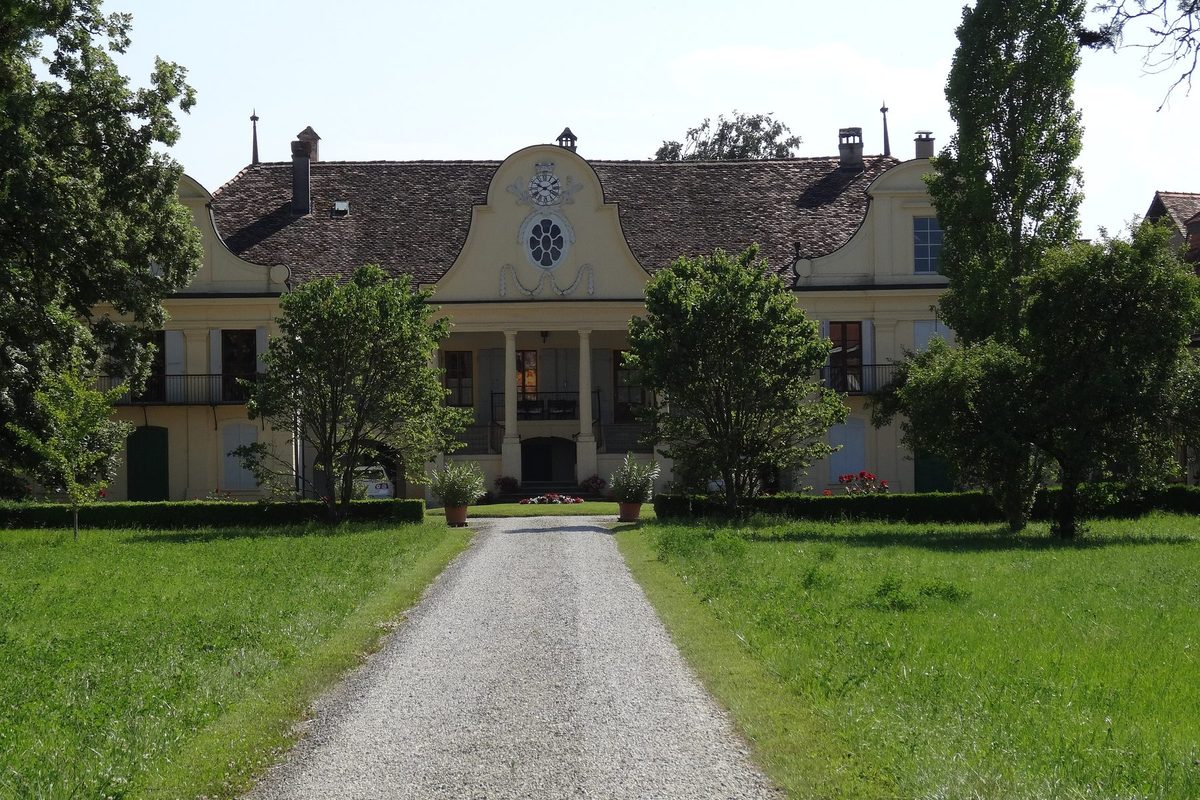
On the former Roman road from Orbe to Avenches, Mathod keeps a Bernese castle enlarged in the 18th century with a large covered Palladian-style staircase. The village is set to merge with Suscévaz in 2027.
Entry based on 13 sources · Our method · Reusable text (CC BY-SA)
Origin of the name Mathod
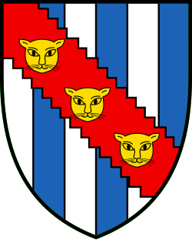
The village is mentioned in 1141 as «Mastod» (or «Masthod»), then as «Mastoud» in 1235 and «Mathod» in 1382. The etymology of «Mathod» has yet to be found. The municipal coat of arms plays on the name by showing three cat's heads, the «mathous».[1][2]
Coat of arms of Mathod
Paly argent and azure, over all a bend indented gules charged with three cat's heads affronty Or, set upright. The shield is striped vertically in white and blue. A red band with toothed edges crosses it diagonally, from the upper left corner to the lower right. It bears three yellow cat's heads, seen from the front and set upright. These are the arms of the lords of Champvent, with the three heads of "mathous" added.[11][2][12]
Founding of Mathod
Mathod grew up on the Roman road from Orbe to Avenches, at the fork towards Pontarlier, where Roman remains (tiles, lime) have been found. Who founded Mathod remains unknown. In the Middle Ages the locality first depended on the abbey of the Lac de Joux, which owned land there from 1141, then was attached to the lordship of Champvent and finally to that of la Mothe. Under Bernese rule Mathod formed a castellany with a castellan and six jurors.[1][2]
History of Mathod
Roman period. The site lies on the Roman road from Orbe to Avenches, at the fork towards Pontarlier. Roman tiles and lime have been found there.[1]
1141. First mention, as «Mastod»; the abbey of the Lac de Joux owns land there.[1][2]
12th century. The village has a church dedicated to Saint Martin.[2]
1235. Mentioned as «Mastoud».[2]
1285-1558. The Saint-Martin church, a daughter church of Saint-Christophe, becomes an independent parish at some point between 1285 and 1558, and is later joined to the parish of Champvent.[1]
1370. The Count of Neuchâtel exchanges his lands with the Count of Savoy. Most of the village then belongs to the lordship of la Mothe.[2]
1382. The name appears in its present form, «Mathod».[2]
1416. Mathod has 40 hearths.[1]
17th century. Construction of the main block of the castle.[1]
1691. Date of the pulpit of the church built after the Reformation.[2]
1747. The lords free the inhabitants from all corvée labour in return for a payment of 2'000 florins.[2]
18th century. The castle, lived in by the Bernese families Weiss, Thormann and Burmann, is enlarged with two wings and a large covered staircase of Palladian inspiration.[1][2]
1798. Mathod becomes part of the district of Yverdon.[1]
1936-1938. Construction of the new church, inaugurated in spring 1938.[2]
1 January 2008. The new Vaud districts (law on territorial division) come into force: Mathod moves from the district of Yverdon to the district of Jura-Nord vaudois.
early 21st century. The village, which has specialised in market gardening since the draining of the marshes, regains momentum thanks to its location between the exits of the A1 and A9 motorways.[1]
28 September 2025. Voters of Mathod (224 yes, 47 no) and Suscévaz (85 yes, 41 no) approve the merger agreement.[4]
1 January 2027. Planned entry into force of the merger with Suscévaz. The new municipality is to be called Mathod-Suscévaz.[3][4][5]
Population of Mathod
Sources and references: [1][9]
| 1416 | 40 hearths (households) |
| 1764 | 229 |
| 1803 | 350 |
| 1850 | 382 |
| 1900 | 358 |
| 1950 | 368 |
| 2000 | 459 |
| 2025 | 740 |
Families of Mathod
Citizen families before 1800. Amiguet, Burdet, Gagnaux, Girard, Marendaz and Page, without a precise date.[13]
From 1901 to 1962. No family is registered in the 19th century. In the 20th there are two registrations: the Baudin of Autavaux FR in 1957 and the Caliri, from Italy, in 1959.[13]
Notable people of Mathod
Paul Lavenex. Architect of the church of Mathod, built from 1936 to 1938.[12]
Economy of Mathod, past and present
From marsh to vegetables. Mathod was long a purely farming municipality. After the marshes of the Orbe plain were drained, the village specialised in market gardening. According to the FAO, the municipality has winegrowers, a market gardener, two restaurants and several small shops.[1][12]
Historic sites in Mathod
Mathod Castle. Bernese castle whose main block dates from the 17th century and which was enlarged in the 18th century with two wings and a large covered staircase of Palladian inspiration. It is also said to have been rebuilt in 1765-1778 for Gaspard Brumann. It housed the Bernese families Weiss, Thormann and Burmann, and later the painter Louis Rivier. The park still holds the choir of the old Saint-Martin church, deconsecrated around 1938, and an 18th-century riding hall. It is a cultural property of national significance.[1][6][7]
Mathod church. Church built in 1936-1938 at the entrance to the village and inaugurated in spring 1938, with a work by the painter Louis Rivier. It replaced the old Saint-Martin church, attested from the 12th century, enlarged in 1738 and deconsecrated in 1938.[1][2]
Remains in Mathod
Roman remains. Roman tiles and lime found on the municipal territory, which lay on the Orbe-Avenches road.[1]
Protected heritage in Mathod
Cultural property of national significance (A objects in the PCP inventory)[10]
- Château avec manège, habitation, dépendance, fontaine et chœur de l'ancienne église
Cultural property of regional significance (B objects)[10]
- Maison Marendaz et fontaine
Traditions and festivals in Mathod
The Mathous. The inhabitants are nicknamed the Mathous or the Mathoulons. The commune's arms bear three gold cat heads, called "mathous".[12][2]
The macaron. The macaron is the village speciality. It is sold at the shop in the former schoolhouse.[12]
Village societies. Local societies include the Abbaye des Laboureurs, the men's choir and the Jeunesse youth society, the last two shared by Mathod and Suscévaz. The Nord en Scène theatre company stages its plays here.[12]
Sources
- Dictionnaire historique de la Suisse, « Mathod » (Philippe Heubi, version du 09.10.2007)
- Commune de Mathod, « Histoire »
- Commune de Mathod, « Projet de fusion des communes de Mathod et Suscévaz »
- Conseil d'État du canton de Vaud, « Exposé des motifs et projet de décret sur la fusion des communes de Mathod et Suscévaz »
- La Télé, « Deux nouvelles fusions de communes en passe d'être ratifiées »
- Inventaire fédéral des biens culturels (PBC), fiche 06231 « Château », Mathod, texte de la Société d'histoire de l'art en Suisse
- Office fédéral de la protection de la population, Inventaire PBC, liste du canton de Vaud (état au 1.1.2026)
- État de Vaud, communiqué du 12.07.2007, « Les préfètes et les préfets sont attribués aux nouveaux districts »
- Statistique Vaud, « Population résidante permanente au 31 décembre 2025 »
- Federal Office for Civil Protection (FOCP), Swiss Inventory of Cultural Property (PCP), list for the canton of Vaud (as of 1.1.2026)
- IPI, Swissreg, emblems database: coat of arms of Mathod (no. 101304)
- Feuille des avis officiels du canton de Vaud (Official Gazette of the Canton of Vaud), « Alphabet des communes vaudoises : Mathod »
- Register of Swiss Surnames, 3rd edition (1989), search Commune "Mathod", Canton VD
Published by Sébastien Jörg ·
Other villages near Mathod
Missing information, or do you have a source? Suggest a correction or addition. Every submission is checked before it's published.
Suggest a change