Suscévaz
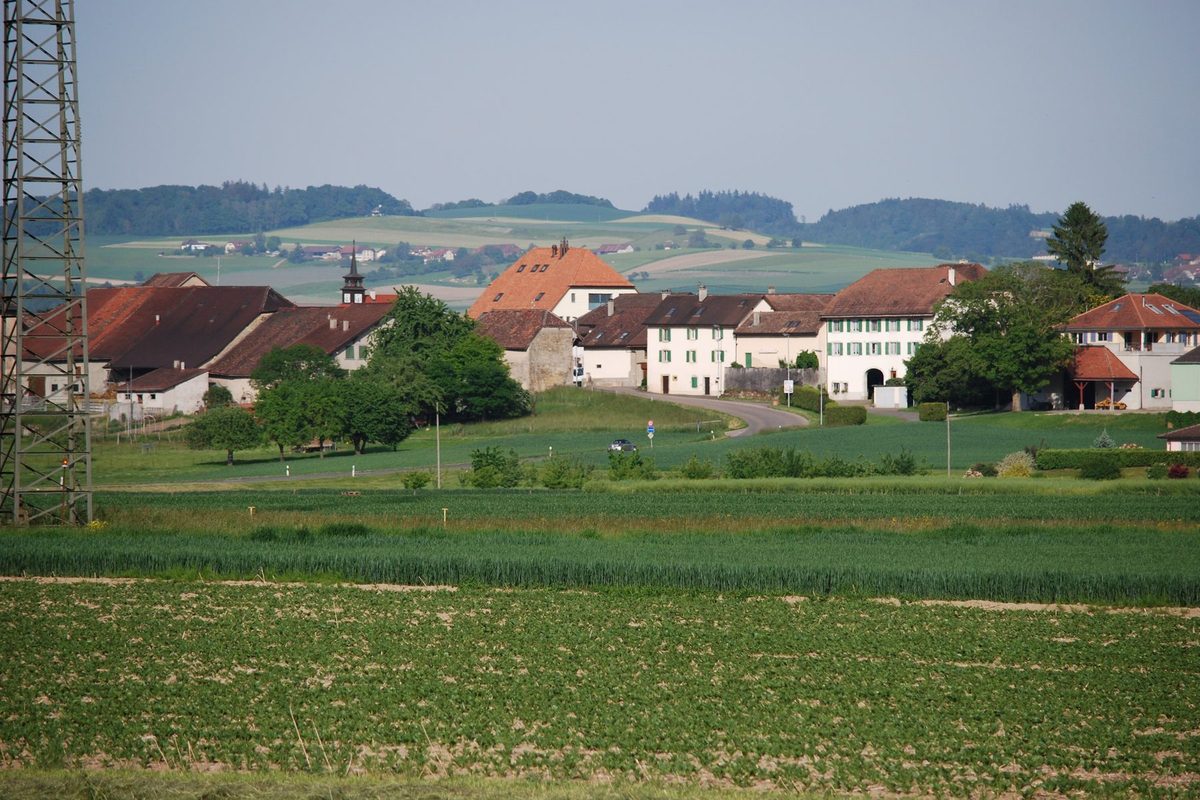
Its name, «Subsilva» in 1140, means «below the forest», after its place on the wooded slopes of Mont de Chamblon. A merger with Mathod is planned for 2027.
Entry based on 10 sources · Our method · Reusable text (CC BY-SA)
Origin of the name Suscévaz
The village is mentioned in 1140 as «Subsilva» («in Subsilva»). The name comes from Latin and means «below the forest», matching its position on the wooded southern slopes of Mont de Chamblon. It is reportedly pronounced «Suscève» (not confirmed).[2][3]
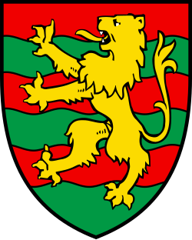
Coat of arms of Suscévaz
Barry wavy gules and vert, over all a lion or. Wavy horizontal stripes alternate red and green. A yellow lion stands over them. Adopted in 1927, the arms come from the flag presented in 1763 by the Decoppet family and kept by a shooting society.[8][3]
Founding of Suscévaz
Archaeological remains show Roman occupation of the site, which lay on a route linking Orbe and Yverdon. Who founded Suscévaz is not known. In the Middle Ages the place depended on the abbey of the Lac de Joux, which owned land there, then was attached to the lordship of Champvent when that lordship was divided. The municipality comprises the village, on a hill, and the hamlet of Grange Décoppet.[2][3]
History of Suscévaz
Roman period. The site, on a route linking Orbe and Yverdon, is occupied, as archaeological remains show.[2][3]
1140. First mention, as «Subsilva».[2][3]
1225. Following the division of the lordship of Champvent, the village is attached to it and remains so for centuries.[2][3]
1453. The chapel of Saint-Barthélemy is recorded. The village belongs to the parish of Champvent.
1536. Start of Bernese rule: Suscévaz belongs to the bailiwick of Yverdon until 1798.
17th century. The chapel of Saint-Barthélemy is taken out of use.
1624. Date of the bell owned by the municipality.[3]
1655. Founding of a first «abbaye» (shooting society). A second one is founded in 1745.[2][3]
1763. The Decoppet family presents a flag to one of the village shooting societies.[2][3]
1798. Suscévaz becomes part of the district of Yverdon.
1846-1848. The only period when the village is not part of the parish of Champvent: it is then joined to that of Yverdon.
1888. Founding of the dairy society, active until 2001.
1927. Adoption of the municipal coat of arms, based on the flag presented in 1763 by the Decoppet family.[2][3]
1945. Founding of the cattle-breeding society, active until 2006.
2005. The primary sector provides 77% of jobs. The municipality focuses on market gardening, sugar beet, livestock and some winegrowing.
2006. Suscévaz takes part in drawing up the Yverdon-les-Bains agglomeration, without joining it.
2008. Suscévaz becomes part of the new district of Jura-Nord vaudois.
28 September 2025. Voters in Suscévaz (85 yes, 41 no) and Mathod (224 yes, 47 no) approve the merger agreement.[2]
1 January 2027. Planned entry into force of the merger with Mathod. The new municipality is to be called Mathod-Suscévaz, with Suscévaz becoming one of its localities.[2][5]
Population of Suscévaz
Sources and references: [7]
| 1803 | 121 |
| 1850 | 180 |
| 1900 | 144 |
| 1950 | 178 |
| 1970 | 138 |
| 2000 | 178 |
| 2025 | 263 |
Families of Suscévaz
Burgher families before 1800. The de Coppet, Décoppet, Gillard and Gilliard, with no precise date.[10]
In the 19th century. The Turin, from Valeyres-sous-Rances VD, were received in 1807.[10]
From 1901 to 1962. Seven entries. The Musy, from France, opened the list in 1907, and another French family, the Dotte, followed in 1942. The Panighini, from Italy, were received in 1953 and the Hurni, from Sutz-Lattrigen BE, in 1958. The Gueland, the Morel-Maréchal and the Ruffieux were registered in the same period, with no precise date.[10]
Notable people of Suscévaz
Camille Decoppet (Suscévaz 1862 - Bern 1925). The son of an innkeeper and a citizen of Suscévaz, he studied law in Lausanne and became a lawyer. A National Councillor from 1899 to 1912 and a member of the cantonal government from 1900 to 1912, he was elected to the Federal Council on 17 July 1912. He headed the Military Department from 1914 to 1919 and was President of the Confederation in 1916.[9]
Economy of Suscévaz, past and present
Fields and vegetables. According to the FAO, eight farms, one of them a market garden, share the land. They grow field crops of the Orbe plain, including sugar beet, and produce many vegetables. Only one milk producer remains. The others have turned to fattening cattle, sheep or poultry.[3]
Suscévaz wine. Each year the vines yield a few bottles of red and rosé. This wine, labelled Suscévaz, is sold and drunk in the village.[3]
Two small firms. According to the FAO, the village has two small businesses, one of them a fodder haulier. A joinery, once sold, has become a garage. Many working residents have jobs outside the municipality, in Yverdon, Orbe, Lausanne, Geneva, Neuchâtel or the Broye.[3]
Historic sites in Suscévaz
The hilltop village. The village, at 445 metres above sea level, sits on a hill on the southern slopes of Mont de Chamblon, facing the Orbe plain. It has no church: it has almost always belonged to the parish of Champvent.[4]
Hamlet of Grange Décoppet. Hamlet of the municipality, separate from the main village. Together with it, it makes up the municipal territory.
Mont de Chamblon vineyard. Small vineyard on the southern slope of Mont de Chamblon, producing red and rosé wine bearing the municipality's name.[3]
Remains in Suscévaz
Roman remains. Archaeological remains confirm occupation of the site in Roman times, along the Orbe-Yverdon route.[2][3]
Legends of Suscévaz
The inhabitants' nicknames. By tradition, the inhabitants are nicknamed the «Susçons», reportedly «the lollipops» in Vaud patois (meaning uncertain), and «lè Pilanta-lâma», «the wool-planters».[3]
Traditions and festivals in Suscévaz
The shooting abbaye. Of the two shooting abbayes founded under Bernese rule, in 1655 and 1745, one still exists. It keeps the flag given in 1763 by the Decoppet family.[3]
The tasting of the communal wines. In April the municipality holds a tasting of its wines.[3]
Sources
- Dictionnaire historique de la Suisse (DHS), « Suscévaz »
- Conseil d'État du canton de Vaud, « Exposé des motifs et projets de décret et de loi sur la fusion des communes de Mathod et Suscévaz » (25_LEG_172), octobre 2025
- Feuille des avis officiels du canton de Vaud, « Alphabet des communes vaudoises : Suscévaz »
- Commune de Suscévaz, site officiel
- Commune de Mathod, « Projet de fusion des communes de Mathod et Suscévaz », 02.04.2025
- État de Vaud, communiqué du 12.07.2007, « Les préfètes et les préfets sont attribués aux nouveaux districts »
- Statistique Vaud, « Population résidante permanente au 31 décembre 2025 »
- IPI, Swissreg, emblems database: coat of arms of Suscévaz (no. 101391)
- Roger-Charles Logoz, "Decoppet, Camille", Historical Dictionary of Switzerland (HDS), version of 24.07.2015
- Register of Swiss Surnames, 3rd edition (1989), search Commune "Suscévaz", Canton VD
Published by Sébastien Jörg ·
Other villages near Suscévaz
Missing information, or do you have a source? Suggest a correction or addition. Every submission is checked before it's published.
Suggest a change