Saint-Blaise
In 1011 King Rudolph III of Burgundy gave the Arins estate to his wife Irmengard: the future Saint-Blaise, where the Ruau drove mills, sawmills and fulling mills until 1950.
Entry based on 16 sources · Our method · Reusable text (CC BY-SA)
Origin of the name Saint-Blaise
The place first appears in 1011 under the name « Arins », when King Rudolph III of Burgundy gave the Arins estate to his wife Irmengard. The millennium of this mention was celebrated in 2011. In 1209 the locality is called « Sanctus Blasus », after Saint Blaise, patron of the parish church. The former German name, « St. Blasien », is no longer in use. The name « Arens » is said to have long remained attached to the upper part of the village, and the old name reportedly refers to the sandy soil.[1][7]
Coat of arms of Saint-Blaise
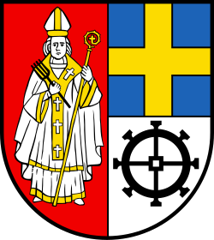
Per pale: first, gules Saint Blaise vested pontifically and mitred argent heightened Or, holding in his dexter hand a carding comb and in his sinister a crozier Or. Second, per fess azure a cross Or, and argent a millwheel sable. On the left, against red, Saint Blaise in white and gold bishop's robes holds a carding comb and a crozier. On the right, a yellow cross on blue above and a black millwheel on white below. These are the arms of the former municipality of Saint-Blaise.[14]
Founding of Saint-Blaise
No founding charter or founder is known: the village grew gradually on land occupied since prehistory. The lakeside settlement of Saint-Blaise-Bains des Dames has yielded several Neolithic occupation phases (Horgen, Lüscherz and Auvernier cultures). To these are added Hallstatt period burials, a Roman villa at Les Tuiles, remains of Roman roads (Vy d'Etra, chemin du Diable), two Roman harbours and a Burgundian cemetery at Le Vignier. The Arins estate enters written history in 1011. It was the Ruau, the stream running through the village, that shaped settlement and activity: in 1191 the abbey of Fontaine-André granted the right to build a mill on it, and its water drove mills, sawmills and fulling mills until 1950. In the Middle Ages Saint-Blaise was the seat of a mairie depending on the castellany of Thielle, whose courts it housed. The castellan was also its maire.[1][5]
History of Saint-Blaise
Neolithic. The lakeside settlement of Saint-Blaise-Bains des Dames is occupied several times, by communities of the Horgen, Lüscherz and Auvernier cultures.[1]
Roman period. A villa is built at Les Tuiles. The area is crossed by Roman roads (Vy d'Etra, chemin du Diable) and has two harbours.[1]
Early Middle Ages. A Burgundian cemetery is laid out at the place called Le Vignier.[1]
1011. King Rudolph III of Burgundy gives the « Arins » estate to his wife Irmengard: this is the first written mention of the place.[1][7]
1177. The tithe of Saint-Blaise is collected by the abbey of Fontaine-André. In 1208 it is shared with the chapter of Neuchâtel.[1]
1191. The abbey of Fontaine-André grants the right to build a mill on the Ruau.[1]
1209. The locality appears under the name « Sanctus Blasus ».[1]
1228. The church, dedicated to Saint Blaise, belongs to the deanery of Solothurn.[1]
1523. The political community of Saint-Blaise is established. The emancipation of the subjects takes place during the 16th century.[1]
1531. The parish adopts the Reformation. It includes Voëns-Maley, Hauterive, La Coudre (until 1948) and Marin (until 1978).[1]
1642. Date of the oldest fountain still visible in the village, in the rue du Temple.[7]
1750-1837. Two calico printing works (printed cotton cloth) operate in Saint-Blaise.[1]
1848. Saint-Blaise becomes part of the district of Neuchâtel, to which it belongs until 2017 before joining the Littoral region. The castellany of Thielle disappears.[1][5]
1860. The municipality is established.[1]
1888. The hamlets of Voëns and Maley are united with the municipality of Saint-Blaise.[1]
1903. Adolf von Martini founds a car factory in Saint-Blaise.[1][9]
1922. The Catholic parish is founded. Its church is built in 1939.[1]
1934. After the liquidation of the Martini company, voted on 12 June 1934, the factory becomes the Fabrique d'appareils électriques et de chaudronnerie (FAEL SA), which remains in Saint-Blaise until 2007.[1][9]
1956. Opening of a Jowa industrial bakery, a Migros subsidiary, moved to Marin in 2012.[1]
1970. The renowned quarries of Saint-Blaise cease operating.[1]
1995. Saint-Blaise is connected to the A5 motorway.[1]
2011. The village celebrates the millennium of its first mention. A fountain designed by the architect Mario Botta is inaugurated for the occasion.[7]
26 November 2023. The voters of Saint-Blaise, Hauterive, La Tène and Enges approve the merger of their municipalities.[2]
1 January 2025. Saint-Blaise becomes a locality of the new municipality of Laténa, together with Enges, Hauterive and La Tène. The central administration of Laténa is based in Saint-Blaise.[1][2]
Population of Saint-Blaise
Sources and references: [1][12]
| 1750 | 597 |
| 1850 | 1'014 |
| 1900 | 1'650 |
| 1950 | 1'859 |
| 2000 | 3'117 |
| 2010 | 3'105 |
| 2020 | 3'228 |
| 2024 | 3'198 |
Families of Saint-Blaise
Dardel. The family is recorded at Saint-Blaise in 1513, when Jean, from Villiers, obtains the concession for the village mills. It is found earlier at Le Pâquier NE in 1402 and at Villiers in 1457. Three of Jean's sons found the main branches: Blaise that of the Dardel-dit-Munier, Nicolet that of Marin, part of which returns to Saint-Blaise, and Huguenin the patrician branch of Neuchâtel. Georges-Alexandre (1775-1863), a captain in the service of the English East India Company, marries a Swedish countess and is ennobled in Sweden in 1810, where his descendants serve in the army and the diplomatic service.[15]
Citizen families before 1800. Brenier, Bugnot, Cordier, Crible, Dardel, de Chambrier, de Dardel, de Pury, Prince, Prince-dit-Clottu and Virchaux, with no precise date, as well as the de Marval family from Neuchâtel. Three families carry a date: the Veluzat in 1593, the Roulet in 1598 and the Fornachon, from Peseux, in 1690.[16]
In the 19th century. Court, Hegel, Neeb, Zimmermann and Zintgraff, with no date or origin, as well as the Martinelli of Vacallo TI and the de Tribolet-Hardy of Fleurier NE. Dated entries begin with the Zumbach of Toffen BE in 1859, then the Vischer (1864) and the Ritter (1872), from Germany, and the Felber of Niederbipp BE (1876). The year 1889 has nine: Geissler of Ins BE, Hug of Ferenbalm BE, Maurer of Treiten BE, Meyer of Werthenstein LU, Monnier of Tramelan-Dessous BE, Schori of Seedorf BE, Thorens of Concise VD, Vautravers of Romairon VD and Zaugg of Röthenbach im Emmental BE. They are followed by the Düscher of Ins BE and the Pée, from France (1890), the Ehrler (1891) and the Goller (1892), from Germany, the Engel of Twann BE and the Zweiacker of Jegenstorf BE (1893), the Bannwart of Krauchthal BE (1894), the Brigaldin, from France, and the Strübe, from Germany (1895), the Gaffiot, from France (1896), the Läubli of Ermatingen TG and the Roussey, from France (1897), and finally the Noseda of Vacallo TI (1899).[16]
Show more families (1)
From 1901 to 1962. Sixty-eight entries, all dated. Bernese (22) and Italian families (17) dominate, ahead of French (6) and German families (5). Several names recur: the Düscher and the Gaffiot, already entered in the 19th century, reappear in 1906 and 1901, the Blanck in 1910 and 1912, the Quélet in 1908 and 1939. Families also come from Poland (1948) and Sweden (1961). In 1962 the Mathez of Tramelan BE, the Morona, from Italy, and the Weisser, from Germany, close the list.[16]
Notable people of Saint-Blaise
Elie Bugnot. Lieutenant of the castellany of Thielle. His initials appear on the Rue du Temple fountain, dated 1642, the oldest in the village, and the fountain's pillar bears a globe, his family's emblem.[7]
François Robert. Sculptor. In 1948 he makes the Winegrower of the Pinte Dardel fountain and the Fisherman of the Ruelle Crible.[7]
Economy of Saint-Blaise, past and present
Vines, printed calicoes and quarries. Vine-growing long played an essential role, which ended after 1945. Two factories making indiennes, printed cotton cloth, operated between 1750 and 1837. The well-known Saint-Blaise quarries closed in 1970. A Jowa industrial bakery opened in 1956.[1]
The trades of the Ruau. For more than a thousand years the Ruau powered the village. It drove mills, a fulling mill, a spinning mill and a crushing mill. At the Moulin du Haut three wheels turned in the 18th and 19th centuries, two for grain and one for the oil mill. A fulling mill, a cloth works, operated from 1522 until about 1750. In 1770 a wool spinner set up near a fountain. The Sauvage inn, opened in 1731 and closed around 1860, served as a staging post for teams of horses. The installations on the stream worked as sawmills, fulling mills and mills until 1950.[7][1]
Martini cars. The Thurgau industrialist von Martini, known for his firearms, built a car factory at Saint-Blaise in 1903, on the boundary with Marin-Epagnier. The Cité Martini, built in 1902, housed the workers. The factory was sold in 1906 to a British company, then bought back in 1908 by the Société nouvelle des automobiles Martini. About 3'600 cars came out of its workshops, and 1908 was its best racing year. Faced with European competition and falling exports, the firm declined. The shareholders voted for its liquidation on 12 June 1934.[9]
Historic sites in Saint-Blaise
The temple of Saint-Blaise. The church, dedicated to Saint Blaise, is mentioned in 1228 in the deanery of Solothurn and becomes Protestant in 1531. The present building, raised on the site of a church from Carolingian times, combines a Romanesque tower, a Gothic vault and neo-Gothic stained glass by Edmond Bille (1878-1959). Its portal reportedly dates from 1516. It is listed as a cultural property of regional significance.[6][13]
The Hôtel du Cheval-Blanc. Historic inn on the Grand-Rue, still in business, whose origins reportedly go back to the 13th century.
The Maison de la Dîme. Building (re)built in 1581, where the tithe was collected, restored in 1989. Cultural property of regional significance.[7][13]
The Maison Neuve. Village house notable for its covered gallery, reportedly built in 1660.
The Hôtel communal. Building erected in 1694, sometimes attributed to Béat Fischer.
The Moulin du Haut and the twelve fountains of the Ruau. The Ruau, a stream that never runs dry, has driven mills since the grant of 1191. The Moulin du Haut had up to three wheels on its façade in the 18th and 19th centuries. Today the course of the stream is lined with twelve fountains, from the oldest (1642, rue du Temple) to the one designed by Mario Botta for the 2011 millennium.[7]
Remains in Saint-Blaise
The lakeside settlement of Saint-Blaise-Bains des Dames. Excavations of this lakeshore site revealed several Neolithic occupation phases, attributed to the Horgen, Lüscherz and Auvernier cultures.[1]
Roman roads and harbours. Remains of Roman roads are known in the area, notably the Vy d'Etra and the chemin du Diable, where cart ruts are reportedly still visible. Two Roman harbours and a villa at Les Tuiles complete the picture of the Roman period.[1]
The Burgundian cemetery of Le Vignier. Early medieval cemetery attributed to the Burgundians, found at the place called Le Vignier, alongside older Hallstatt period burials discovered in the area.[1]
The mechanism of the Moulin du Haut. The mill wheel, reconstructed in 1979 and possibly restored in 2003, shows milling on the Ruau attested since 1191.[7]
Protected heritage in Saint-Blaise
Cultural property of regional significance (B objects)[13]
- Maison de la Dîme
- Maison Perrier
- Maison Terrisse (Le Tilleul)
- Temple
Legends of Saint-Blaise
The bottomless Loclat. The inhabitants of Saint-Blaise are nicknamed the Loqueux (« lé Léquia » in patois), after the Loclat, a small pond in the village which, according to tradition, is said to have no bottom.
Sources
- Dictionnaire historique de la Suisse, « Saint-Blaise (NE) »
- Commune de Laténa, page consacrée à la fusion
- RTN, La commune fusionnée de Laténa verra le jour (26.11.2023)
- ObjectifNE, Projet de fusion Enges, Hauterive, La Tène et Saint-Blaise
- Swiss Spectator, La châtellenie de Thielle
- Swiss Spectator, Le temple de Saint-Blaise
- Brochure patrimoniale, Balade des douze fontaines au fil du Ruau (commune de Laténa)
- Dardel.info, Les automobiles Martini à Saint-Blaise
- Edunet, Les automobiles Martini
- Musée d'art et d'histoire de Neuchâtel, Usine Martini à Saint-Blaise
- Localcities.ch, Commune de Saint-Blaise, données OFS 2023
- État de Neuchâtel, arrêté du 5 février 2025 homologuant le recensement cantonal de la population au 31 décembre 2024
- Office fédéral de la protection de la population (OFPP), Inventaire suisse des biens culturels, liste du canton de Neuchâtel (état au 1.1.2026)
- IPI, Swissreg, emblems database: coat of arms of Saint-Blaise (no. 102868)
- Historical Dictionary of Switzerland (HDS), article "Dardel" (Myriam Volorio Perriard), German version of 20.02.2017
- Register of Swiss Surnames, 3rd edition (1989), search Commune "Saint-Blaise", Canton NE
Published by Sébastien Jörg ·
Other villages near Saint-Blaise
Missing information, or do you have a source? Suggest a correction or addition. Every submission is checked before it's published.
Suggest a change